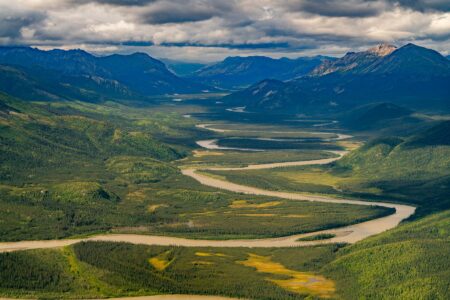

The Department of Interior has released a strategic plan that could guide the agency for the next four years, and it includes the proposed sale of federally managed public lands to states, local municipalities, and tribes. The plan to offload public lands—or “shrink the federal estate”, as the DOI’s 2026-2030 Strategic Plan puts it—comes roughly 500 days after Utah Sen. Mike Lee sparked a major national backlash with his failed plan to sell some 3.2 million acres of public lands throughout the western U.S. in the One Big Beautiful Bill Act of 2025.
“The Department will work to decrease the size of the federal estate by offering to states, localities and Tribes the opportunity to purchase federal lands,” reads a paragraph on page 16 of the 28-page plan. “Through these sales, the Department will be able to focus its resources on primary federal responsibilities and nationally significant federal lands.”
The Department of Interior manages more than 500 million acres of public lands via the Bureau of Land Management (BLM), The US Fish & Wildlife Service (USFWS), and the National Park Service (NPS). According to reporting in the Washington Sun, this marks the first time that DOI has ever announced intentions to offload public lands in a strategic draft plan. And it breaks “with 50 years of precedent that largely limited land sales.”
In addition to public land sell offs, the DOI’s new strategic plan, announced by Interior Secretary Doug Burgum on November 11, would end the use of the popular Land and Water Conservation Fund (LWCF) to acquire new public lands. The Congress created LWCF in 1964 to reinvest offshore oil and gas revenues into public lands and outdoor recreation. The fund receives $900 million every year from oil and gas projects. It was fully refunded and reauthorized in 2020 with the passage of the Great American Outdoors Act.
Using Public Lands for Data Centers
Another goal of the plan is to use public lands that do remain in the federal estate to supply materials and energy needed to construct data centers. “By developing reliable and up-to-date inventories of national resource assets, Interior will help ensure a stable domestic supply of energy, critical minerals, raw building materials and other important resources to build and power homes, data centers and long-term strength of the American economy,” the plan goes on to state. “In addition to advanced mapping, Super Intelligence and scientific data will enable the Department to expand and develop our inventory of potential resources. Together, these efforts will help the U.S. understand and actively manage its natural wealth, encourage innovation and support future development.”
The plan stops short of announcing any specific plans for data centers sites on public lands. However, there are already multiple efforts underway to permit data centers on BLM lands throughout the West. One such data center project near Boulder City, Nevada, which F&S reported on last August, was approved by the agency before a Federal Appeals Board overturned that decision.
A November 6 report from Pro Publica revealed that the Trump Administration’s US Geological Survey (USGS) has determined that some 91.3 million acres of public land managed by the Interior Department have the potential to host data centers. The states listed in the USGS report are Alaska, Arizona, California, Idaho, Montana, Nevada, New Mexico, Oregon, Utah, Washington, and Wyoming. The Pro Publica report also pinpoints Sec. Burgum’s personal investments in the AI industry at somewhere between $18.1 million and $64.4 million.

ALL NEW! 1871 CLUB FIELD TRIPS