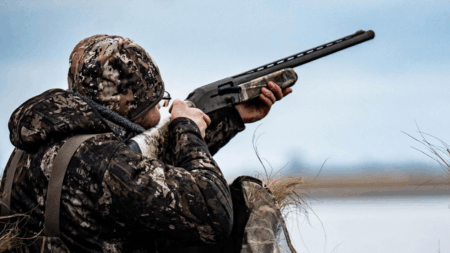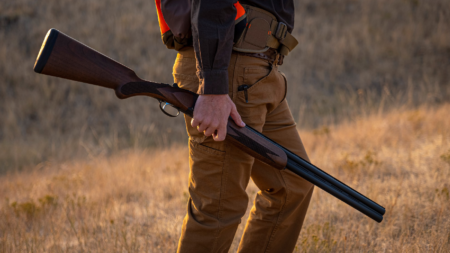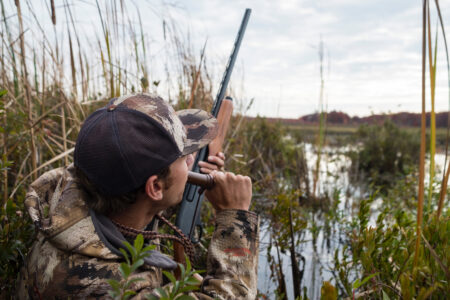

For budget-conscious shooters, the CZ Drake delivers reliable O/U performance without the premium price. For upland hunting, the Beretta 686 Silver Pigeon is the go-to choice. Waterfowl hunters should look at the Benelli 828 U Steel Field. Target shooters will want the Beretta 694 Black DLC. Turkey hunters have the Mossberg Silver Reserve Eventide Turkey built specifically for them.
- The CZ Drake is the best budget pick but comes only in 28-inch barrels with extractors instead of ejectors.
- The Beretta 686 Silver Pigeon offers a low-profile action built for upland hunters who carry all day.
- The Benelli 828 U Steel Field is purpose-built for waterfowl, handling steel shot loads without complaint.
- The Beretta 694 Black DLC is the dedicated target gun in this roundup, not optimized for field carry.
- The Mossberg Silver Reserve Eventide Turkey is the only pick here configured specifically for turkey hunting.
We may earn revenue from the products available on this page and participate in affiliate programs. Learn more
Over/under shotguns dominate clay target shooting. They are also the choice for many upland hunters, and you’ll even see some O/Us in dove fields, duck blinds, and the turkey woods. While many buy an over/under for aesthetics, these guns offer functional advantages over other shotgun types. Its enclosed action makes it very reliable and weatherproof, and unlike semi-autos and even some pumps, O/Us will shoot any shell without complaint. An over/under is usually more compact due to its shorter action and offers two chokes. Plus, many shooters feel the break action is easier to handle safely in the field, since you can easily open the gun to cross obstacles or inspect the muzzles for obstructions.
Nowadays, you can find O/Us for practically any purpose and at almost any price point, from a few hundred dollars to a few hundred thousand. Picking the best over/under shotguns means finding the gun that suits what you’ll use it for and one that fits your budget. Here are six great over/under shotguns.
- Best Budget: CZ Drake
- Best for Upland Hunting: Beretta 686 Silver Pigeon
- Best for Waterfowl Hunting: Benelli 828 U Steel Field
- Best Splurge: Browning 825 Gran Field
- Best Target Gun: Beretta 694 Black DLC
- Best for Turkey Hunting: Mossberg Silver Reserve Eventide Turkey
Best Budget: CZ Drake
best budget

CZ Drake
Pros
- Great value
- Comes in four gauges plus left-hand
- Reliable
Cons
- 28-inch barrels are the only choice
- Extractors in place of ejectors
Specs
- Gauges: 3-inch 12, 20, and .410; 2 ¾-inch 28-gauge
- Weight: 6 to 7 pounds, depending on gauge
- Length: 45.75 inches
- Barrel: 28-inch, no mid-rib, screw-in chokes, white bead, five chokes (.410 has fixed IC/Modified chokes)
- Stock: Satin-finished walnut, pistol grip, LH-stock models available for 12- and 20-gauges
- Receiver: Matte black with minimal engraving
You can pay less for an O/U, but you’ll also get less than you will with CZ’s Drake. Backed by the excellent CZ customer service, the Drake is a bare-bones O/U that will work reliably and give you the advantages of a break-open gun without breaking the bank. I have shot the Drake in 20-gauge. It weighed right at 6 ½ pounds, a good weight for a 20 that’s light enough to carry and heavy enough to swing well. The balance was a bit muzzle-heavy, but that isn’t necessarily a bad thing, as it helps the gun keep moving and adds steadiness when you point it. This is no fancy gun. It has plain wood and a bit of engraving, but it gives you the advantages of an O/U gun in a reliable, affordable package.
Best for Upland Hunting: Beretta 686 Silver Pigeon
best for upland hunting

Beretta 686 Silver Pigeon I
Pros
- Low-profile action
- Rugged locking system
- 28- and .410 built on smallbore frame
Cons
- Safeties can be sticky
Specs
- Gauges: 3-inch 12, 20, .410 and 2 ¾-inch 20 gauge
- Weight: 6 to 7 ¼-pounds depending on gauge
- Length: 45.5 with 28-inch barrels
- Barrels: 26-, 28-inch, 30-inch barrels available for 12-gauge, 5 choke tubes, brass bead
- Wood: Matte walnut
- Receiver finish: silver nitride with floral engraving
A few years ago on a ruffed grouse hunt, I noticed that all the guides carried the exact same gun: a 20-gauge Beretta Silver Pigeon. Likewise, if you rent an O/U at a South American dove lodge, it will be a Silver Pigeon. These guns have all the qualities you want in an upland gun: slender, light enough to carry, bulletproof, and trouble-free. The heart of the 686 is a very low-profile action. In place of locking lugs on the bottom of the barrel of many O/Us that add height to a receiver, the 686 has two conical pins that protrude from the breech face and fit into holes on either side of the monoblock. The pins wear in tighter as the gun ages, resulting in a tough, long-lasting, and low-profile frame, a quality that many believe makes a gun a natural pointer.
The 686 comes in four gauges and three frames. While some makers simply put 20-, 28-gauge, and .410 barrels on the same frame, the 28-gauge and .410 are built on their own “baby” frame, resulting in a pair of delightfully trim smallbores. The only drawback to the 686 is that many come with sticky safeties, but that’s a simple fix for a gunsmith.
Best for Waterfowl Hunting: Benelli 828 U Steel Field
best for waterfowl hunting

Benelli 828 U Steel Field
Pros
- Recoil reduction system works
- Steel frame adds weight for shooting heavy loads
- Stock can be shimmed to fit
Cons
- 3-inch, not 3 ½-inch, chambers
Specs
- Gauges: 3-inch 12 and 20-gauges
- Weight: 7 pounds, 20-gauge; 7 3/4-pounds, 12-gauge
- Length: 45.25 with 28-inch barrels
- Barrels: 26- and 28-inch, 30-inch, 12-gauge only. No mid-rib, vent rib, fiber-optic bead, 5 flush choke Crio chokes
- Wood: AA Matte walnut with stock-mounted Progressive Comfort recoil reducer
- Receiver finish: grayed steel
Benelli’s innovative 828U combines the added weight of a steel frame with its effective Progressive Comfort recoil reduction system to turn the 828U platform into a robust O/U capable of shooting magnum loads with minimal kick. In all other ways, it’s the same gun as the alloy-frame 828U and the only O/U with a square stock head that lets you use shims to adjust fit, as is common on semi-autos. The Progressive Comfort system is a soft cheek pad plus a recoil pad on a shock-absorbing system that gives under recoil and really works. It’s a tough, good-looking gun with its AA walnut stock. It comes in 12 and the increasingly popular 20 gauge. Benelli gets extra credit for offering the 12-gauge with the 30-inch barrels some waterfowlers prefer.
Best Splurge: Browning 825 Gran Field
best splurge
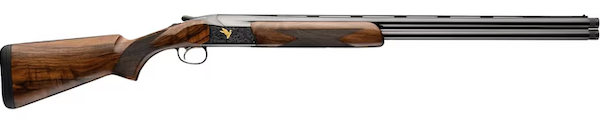
Browning 825 Gran Field
Pros
- Low-profile action
- Great value in a decorated gun
Cons
- 12-gauge only
- Extended chokes don’t belong on a classic bird gun
Specs
- Gauges: 3-inch 12-gauge
- Weight: 7.25 pounds
- Length: 45.5 with 28-inch barrels
- Barrels: 26- or 28-inch, extended chokes
- Wood: Grade III walnut
- Receiver finish: blued, with gold gamebirds
The 825 Gran Field is a handsome gun. If you want something dressy to carry in the field, it delivers at a reasonable price compared to other O/Us, given its wood grade and decoration. Actually, given what you can spend on an O/U if you seriously splurge, this gun is a bargain. The walnut is well-figured Grade III, and the receiver is fully engraved with gold inlays. I am picky about fit and finish, and I couldn’t find anything to dislike about this gun. Underneath the pretty wood, it’s the same Citori 825 we called the best of the year last time around. It handles well, has a great trigger, and it has the same low profile and lighter barrels that make the Citori 725s and 825s such shooters. The only thing I disliked was the extended chokes, which look out of place to me on an upland gun.
Best Target Gun: Beretta 694 Black DLC
best target gun

Beretta 694 Black DLC
Pros
- Durable finish
- Low profile action
- Nice walnut
- Long forcing cones
- Tramline rib
Cons
- 12-gauge only
- Acid green accents on the receiver aren’t for everyone’s taste
Specs
- Gauge: 3-inch 12-gauge
- Barrels: 30- and 32-inch (tested), extended Optima HP chokes
- Trigger: Single selective, 4-pound pull
- Wood: Grade 2.5 Walnut, pistol grip with RH palm-swell and adjustable comb, rounded forend
- LOP: 14.75 inches, extra, thicker pad included
- Weight: 8.75 pounds with 32-inch barrels (tested) and 4-ounce stock weights installed. Additional optional barrel weights add 3 ounces
The 694, successor to the 682, bridges the gap between league shooters and serious competitors. The newest version of the 694 boasts a high-tech coating Diamond-Like Carbon finish on the receiver, and improved barrel boring with long forcing cones for better patterns. The tramline rib has a recess running along its center that leads your eye to the target without making you focus on the rib, where you shouldn’t be looking. It has Beretta’s B-Fast adjustable comb hardware. With removable trunnions and barrel shoulders, you can tighten the gun if you ever manage to put enough shells through it to loosen it. It comes with a stock weight set, and barrel weights are available so you can tailor its balance to your style. It’s twice the price of some entry-level O/Us, but half the price of a high-end gun, and it can run with the bigger dogs.
Best for Turkey Hunting: Mossberg Silver Reserve Eventide Turkey
best for turkey hunting

Mossberg Silver Reserve Eventide Turkey
Pros
- Compact
- Cool retro camo
- Single selective trigger
- 3-inch 28-gauge available
Cons
- Heavy, squishy trigger
- No 12-gauge available
Specs
- Gauges: 3-inch 20 and 28 gauge; .410 bore
- Weight: 6 ½ pounds in all gauges
- Length: 37 inches
- Barrels: 20 inches, vent rib, two XX-full, one IC choke, fiber-optic bead
- Stock: Synthetic, Mossy Oak Greenleaf
- Receiver: Steel, Mossy Oak Greenleaf
Over/unders aren’t especially common in the turkey woods, but they do have their advantages. With a shorter action than a pump or semi-auto, an O/U is about three inches shorter than a repeater of comparable barrel length. An over/under also gives you the choice of barrels. Some turkey hunters like to use an open choke for birds that get in close and a tight choke for long shots.
Mossberg’s Silver Reserve Eventide gives you those advantages in a package that can only be called “cute” if shotguns can be cute. The three smallbores in the series have stubby 20-inch barrels, perfect for maneuvering in close quarters. Mossberg provides a pair of turkey chokes and IC if you want to go the open/tight choke route. The gun has only an orange fiber-optic dot, but it shoots to the point of aim. It also has a trigger with a lot of uptake and an 8-pound pull. I could get used to it because I’m a trigger-smashing clod, but it may offend you. The barrel selector doubles as the safety, so you can easily switch from open to tight chokes. It also has sling swivel studs and, all in all, it’s a great choice for someone who wants a light, compact, smallbore turkey gun.
History of the Over/Under Shotgun
Over/unders have become far more popular than the side-by-side doubles that dominated the U.S. market until WW2. The great firearms inventor John Browning believed that Americans would come to prefer O/Us because the view down the top barrel, which he called a “single sighting plane,” would be more familiar to shooters accustomed to pumps and semi-autos. The side-by-side, in contrast, presented a wide view of both barrels. Browning was rarely wrong, and he was proved absolutely right about O/Us.
In the 1920s, Browning began work on a gun that would change the world’s taste in break-actions. Prior to the introduction of the Browning Superposed in 1931, the only O/Us available were high-end, custom English guns priced far out of reach of the average shooter. Browning designed his gun to be made less expensive so anyone willing to save and stretch their budget could afford one. Browning died in Belgium while at work on his gun, and his talented son, Val, finished the design. Although introduced during the Great Depression when aspirational guns didn’t sell well, the Superposed hung on.
During the affluent post-war years, though, the Superposed found its following. Other makers, notably Beretta and a number of other Italian manufacturers, introduced O/Us of their own. Guns like the Perazzi, which won a gold medal in trap at the 1964 Olympics with a world-record score, helped make the O/U the glamor gun shooters aspired to, for targets or for hunting. Since then, the O/U has reigned in target shooting and many types of hunting. Even English-driven game shooters, for whom the side-by-side was perfected, have switched to O/Us.

How We Picked the Best Over/Under Shotguns
For many, an O/U remains an aspirational gun. Buying one is a decision not to take lightly. If you are planning to invest in a new over/under, consider the following factors:
- Reliability: Does the gun shoot twice?
- Quality of construction: Is the gun well-built? How is the fit, finish, and, if applicable, the decoration?
- Weight and balance: Over/unders are known for their “between the hands” balance because of their compact actions and steel receivers. Truth be told, some are ungainly, overweight, and ill-balanced. Making a well-balanced gun takes more than giving it two barrels. You buy an O/U because it feels lively or sometimes because it has a weight-forward balance that makes shooting targets easier.
- Ergonomics: A shotgun has to fit and feel good in hand. Its controls should be easy to use, too.
- Price/Value: Some of the guns here are cheap, some are pricey, but I scrutinized all of them to make sure you’re getting good return for your dollars, no matter how much or how little you’re spending.
What to Look for When Choosing an Over/Under Shotgun
Properly cared for, an O/U can last two or three generations, so choose wisely. I’d argue that the O/U’s longevity means you should save and stretch to buy the best gun you can. You and your heirs will have it long after the money is forgotten. Consider fit when you buy. I have been guilty of buying O/Us that didn’t fit because I had talked myself into wanting a particular gun. There is no reason to own guns that you can’t shoot well. In terms of features, look at whether the gun has ejectors, which pop the shells out into your hand, or extractors, which merely lift them for removal. Pay attention to the safety. Most O/Us now incorporate the barrel selector, if it has one, into the safety. Be sure the safety is easy to use. Sticky safeties and flat safeties are pet peeves of mine.
Think about what you’ll use the gun for. Lighter guns are nice to carry, but harder to shoot and harder-kicking on the clays course or in the dove field. If you’re choosing one gun for both upland hunting and target shooting, decide which you’ll be doing more of and pick accordingly. O/Us require a couple of maintenance steps that aren’t needed on pumps and semi-autos. You will want to clean the hinge pin or trunnions the barrels pivot on and use a bit of grease, not oil, to lubricate them. Also, keep the “knuckle,” or the joint where the forend meets the receiver, clean and lightly greased. Do those things along with your regular gun care, and your children and their children will shoot it long after you’re done with it.
FAQs
An advantage of O/Us and any two-barreled gun is that you can choose which barrel to shoot first. The top and bottom barrels might have different chokes for longer- or shorter-range shots, or even two different loads. In general, though, you should shoot the bottom barrel first whenever possible. Because it is lower, the bottom barrel recoils more straight back into your shoulder, while the top barrel may rise more. Shooting the bottom barrel first helps you get back on target faster for follow-up shots.
Over/Unders aren’t seen much in duck and goose blinds. They have distinct advantages and disadvantages as waterfowl guns. The obvious disadvantage is that an O/U holds two shells, not three. They are also slower and more awkward to reload in a duck blind. You do get two chokes, though, so you can have one barrel for the birds as they come into the decoys and a tighter choke for a second shot as they flare out. The biggest advantage of an O/U as a duck gun is reliability. The action is enclosed and protected from the elements, and O/Us will shoot in weather that might cause many repeaters to fail to fire.
Barrel length has little to do with ballistics and everything to do with how a gun balances. The length you choose depends on what you will use the gun for. Twenty-eight-inch barrels are very popular on hunting guns these days for good reason. They aren’t so long that they’re cumbersome, but they do offer some weight forward for a smoother swing. And because an O/U is shorter than a repeater, it can have longer barrels and still be fairly compact. Target guns have longer 30- and 32-inch barrels for smoother, steadier pointing. I have found that small-gauge guns are also easier to shoot if they have longer barrels.
Why Trust Us
For more than 125 years, Field & Stream has been providing readers with honest and authentic coverage of outdoor gear. Our writers and editors eat, sleep, and breathe the outdoors, and that passion comes through in our product reviews. You can count on F&S to keep you up to date on the best new gear. And when we write about a product—whether it’s a bass lure or a backpack—we cover the good and the bad, so you know exactly what to expect before you decide to make a purchase.

All new! 1871 Club Field Trips