
For most waterfowlers who want maximum storage and flotation, the Rig'Em Right Lowdown Floating Backpack is the best overall pick. For hunters on a budget, the Banded Air II Blind Bag delivers core functionality without the premium price. The Alps Outdoorz Floating Deluxe wins on versatility, the Sitka Sling Choke for low-profile carry, and the Dive Bomb Dry Blind Bag for roll-top waterproofing.
- Rig'Em Right Lowdown offers roughly 1,180 cubic inches of storage, full foam flotation, and a dedicated thermos holder.
- Banded Air II is the best budget entry for waterfowlers who need core organization without paying a premium.
- Dive Bomb Dry Blind Bag's roll-top closure provides superior waterproofing for hunters working wet conditions regularly.
- Sitka Sling Choke suits hunters who prefer low-profile, single-strap carry over a traditional backpack format.
- No blind bag in this roundup fully replaces a dedicated shell vest for hunters who prefer traditional pocket carry.
We may earn revenue from the products available on this page and participate in affiliate programs. Learn more
When I started waterfowling in 1974—and back then, it was simply known by the all-inclusive term “duck hunting“—we didn’t have blind bags, the modern day equivalent of carry-on luggage for duck and goose hunters. What we had were pockets. Lots and lots of pockets. And we filled those pockets to overflowing with what we needed, which, to a 10-year-old, was 4.73 metric tons of 20-gauge ammunition.
My old man packed a pseudo blind bag. It was, if memory serves, an olive-drab heavy canvas military style shoulder bag—something, I believe, he brought back with him from Vietnam in ’66. Inside was a spare pack of Camel Lights, a Hershey chocolate bar (with almonds), a bottle of 7UP soda, and some toilet paper wadded up in a sandwich bag. He may have had a few 2-3/4-inch No. 5 shells for his Remington 1100, but those he usually carried in his old-school Montgomery Ward shell vest.
While I resisted the idea of carrying a blind bag afield for quite a few years, I’ve since seen the proverbial light. Like hunting backpacks, they serve me well during the season and are also a place to store all my gear during those not-so-nice off-season months. When it comes to blind bags, today’s choices are many; the designs and layouts, the bells “˜n whistles, even more so. Here’s an in-depth look at what makes the best blind bags, well, the best.
- Best Overall: Rig’Em Right Lowdown Floating Backpack
- Best Budget: Banded Air II Blind Bag
- Most Versatile: Alps Outdoorz Floating Deluxe Blind Bag
- Best Sling: Sitka Sling Choke
- Best Roll-Top: Dive Bomb Dry Blind Bag
Best Overall: Rig’Em Right Lowdown Floating Backpack
best overall
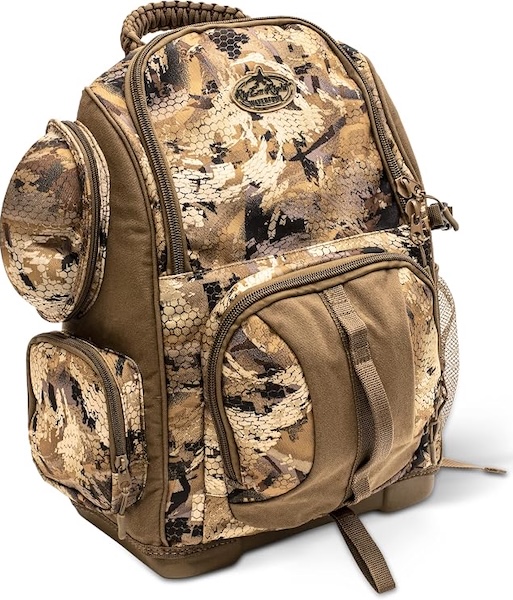
Rig’Em Right Lowdown Floating Backpack
Pros
- Dedicated thermos holder (a crucial feature, in my opinion)
- Full foam flotation
- Molded water-resistant bottom
- Incredible amount of storage space
- Solidly built
- Multiple handles for convenience
Cons
- I looked hard; couldn’t find any
Specs
- Dimensions: 17″H x 8″W x 13″D
- Weight: 3.5 lbs
Matthew and Heather Cagle at Rig’Em Right make damn good stuff. Period. One of the nicest things about their gear is it’s incredibly well thought-out; made BY duck and goose hunters FOR duck and goose hunters. The stuff just flat works.
The Rig’Em Right Lowdown Backpack is a case in point. It has roughly 1,180 cubic inches of storage inside, plus front and side pockets and a mesh/elastic pouch with a lock strap to the right (a.k.a., a thermos holder for me). It’s plenty big enough, but not so big you’ll be tempted to pack it with tons of unnecessary gear. I’m not a fan of dedicated sunglass cases on blind bags; but you can put something else you don’t want busted up in there, like Pop-Tarts or hard-boiled eggs.
I am, though, a big fan of multiple handles, and the Lowdown has them, meaning you can pick it up securely and easily regardless of how it’s laying. Zippered pockets, safe-storage interior pockets, a beefy paracord top handle, a padded-foam back, a water-resistant bottom, good stitching—and it’s good-looking enough to be used as a travel/computer bag. It even has a laptop pocket for that purpose. Well done, Rig’Em Right.
Best Budget: Banded Air II Blind Bag
best budget
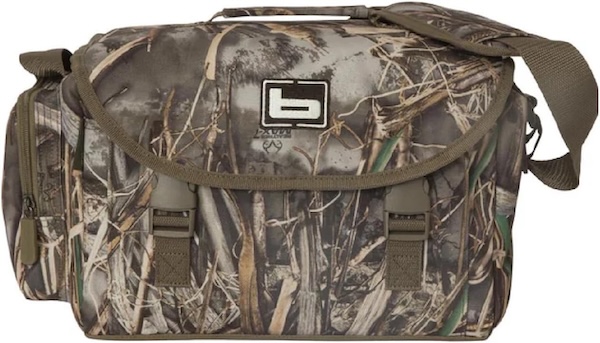
Banded Air II Blind Bag
Pros
- Great for walk-in hunters
- Plenty of interior storage
- Good-looking bag; reasonably tough and rugged
- “Armored” bottom
Cons
- Relatively small
Specs
- Dimensions: 8″H x 14″W x 8″D
- Weight: 2 lbs
I’ve used an earlier generation of what looks like Banded’s Air II bag for many years now. It started showing its age several seasons ago, but it still works just fine. Hopefully, this latest version is as long-lasting.
Banded makes a huge range of outdoor gear, among it a variety of blind bags. With a cost that’s less than $30 for the Max5 pattern, the Air II is one of their least expensive models—and unless you want to haul a water buffalo with it, it’s more than adequate. A bare-bones interior, front pouch, zippered side, zip-top lid, and a handful of camouflage options make this bag definitely worth consideration. No, it’s not the Rolls Royce of blind bags, and it has a couple of downsides, such as the hook-and-loop secondary lid closure filling with junk and becoming almost immediately ineffective. But all in all, and especially for new hunters looking to cut costs a bit, the Air II is a great choice for a bag.
Most Versatile: Alps Outdoorz Floating Deluxe Blind Bag
most versatile
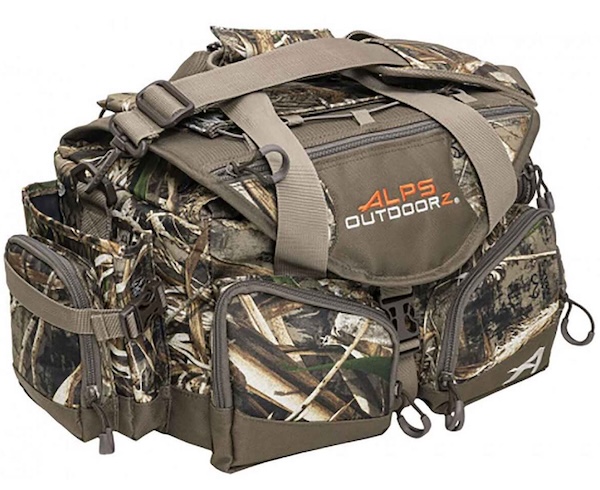
Alps Outdoorz Floating Deluxe Blind Bag
Pros
- Top opens wide for easy access to gear inside
- Large interior with zippered interior pockets, plus end pouches
- Shotshell loops keep various shot sizes handy
- Adjustable padded strap
Cons
- Full-length rear pouch has no drain holes
Specs
- Dimensions: 8″H x 12″W x 9″D
- Weight: 3.125 lbs
If I’m going to pay more than $50 for a blind bag—which isn’t a terrible price for a bag of this quality—I’d like to be able use it for more than 107 days. Enter the Floating Deluxe Blind Bag from Alps Outdoorz. Duck season ends, and you just swap those calls and gloves and boxes of shotshells for a selection of hand tools, tape measure, hammer drill, safety glasses, and work gloves, and you’re good to go for the remaining 258 days on the calendar.
The only thing I don’t care for with the Alps Outdoorz blind bag is the corner-to-corner style shoulder strap; I always find they’re in the way, regardless of how long they are. The “˜Open Wide’ zippered top is great for access, and there’s a goodly amount of room inside. I would have made one or two of the interior pockets waterproof instead of mesh for stay-dry gear, but a plastic bag will solve that. I applaud the person responsible for designing the front pouches with grommeted drains, but drains in the rear would be helpful as well. The waterproof molded bottom is rock-solid, and comes up a full 2 inches on the sides, providing ample protection. Overall, it’s a very nice multi-purpose bag.
Best Sling: Sitka Sling Choke
best sling
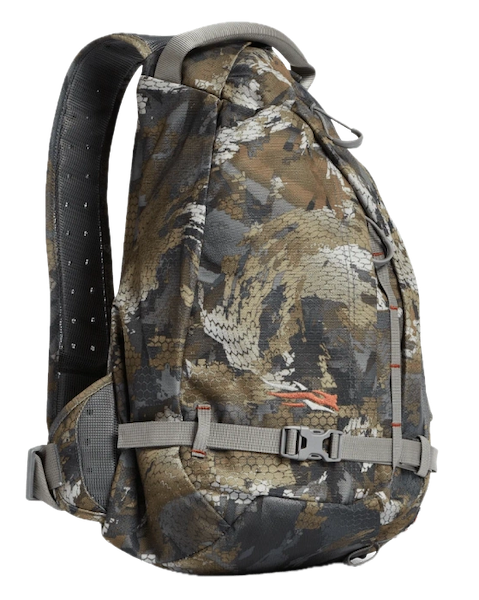
Sitka Sling Choke
Pros
- Comfortable and fully adjustable
- Doesn’t interfere with shouldering a shotgun/shooting
- Padded top and side carry handles
- Water-repellent finish
Cons
- Relatively low capacity, but it’s not meant to pack a ton
Specs
- Dimensions: 800 cu. in.
- Weight: 1.8 lbs
When Sitka first came out with their waterfowl line years ago, it was immediately obvious to me that the gear hadn’t been designed by a duck hunter. It looked good, but it wasn’t very user-friendly where it needed to be user-friendly. Fast-forward to today, and that’s all changed. Sitka’s doing a fine job of outfitting waterfowl hunters with gear that works well in the field.
The Sling Choke pack shines during those occasions when you’re don’t need an entire arsenal of gear (early season teal hunters and walk-in hunters come immediately to mind). No, there’s not 2,000 cubic inches of storage here, but 700 is plenty if you’re packing light. In my opinion, the Sling Choke ranks way up there in comfort, with the padded back allowing air to circulate between you and the pack, thus keeping you cool. I also have a Stanley thermos for coffee that fits perfectly in the bag’s “beverage sleeve,” so that’s a plus. Bonus: The Sling Choke would work well as an angler’s bag in situations such as winter steelhead fishing.
Best Roll-Top: Dive Bomb Dry Blind Bag
best roll-top
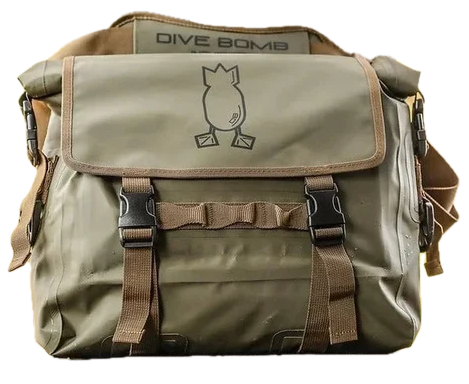
Dive Bomb Dry Blind Bag
Pros
- Keeps stuff dry, like it’s supposed to
- Versatile
- More affordable
- Adjustable padded shoulder strap
Cons
- Somewhat limited capacity
Specs
- Dimensions: 11”H x 5.5”W x 13.5”D
- Weight: 2.4 lbs
Dive Bomb introduced their first decoys in 2011, and they had such a good reception that it’s been a whirlwind ride ever since. Today, Dive Bomb features a lengthy list of hunting products, including their top-notch Dry Blind Bag. It’s waterproof like the Filson, but it’s cheaper and features a roll-top closure, which some of you may prefer.
There’s really nothing complicated about this bag at all, and that’s one of the reasons I like it. You put your gear inside, seal and roll down the top, secure the sides, and you’re all set. The see-through pocket on the underside of the lid is great for paperwork, while the front zippered pocket holds “need it now” gear like calls, training remotes, cell phone, hand warmers, and/or multi-tools. There’s a second zippered pocket in the rear.
The interior of the Dive Bomb bag is simple. No dividers or compartments, just a couple of mesh pouches to hold necessities secure and at hand. It’s old school combined with 21st century technology designed to keep stuff dry. And it works. I drop my small camera bag into the Dry-Line, where it always stays moisture-free.
How We Picked the Best Blind Bags
I’ve been using the same blind bag for over 20 years now, and while it’s a little tattered and torn in a couple spots, it still serves me well. I could replace it with any of a dozen bags here the house, so why do I keep paddling it into Washington’s tidal marshes season after season? For the same reasons I’d to carry any of the bags listed here. Those are:
- Quality construction that enables it to stand up to day-to-day abuse
- Good zippers that don’t separate or break after the first season
- A PVC or similar waterproof bottom that doesn’t leak
- Strong, sturdy handles and straps with rugged attachment points (D-Rings)
- A zippered waterproof interior pocket
- Side and/or end pockets, preferably zippered
- Enough storage space for what I’m bringing
- Room for a full-size thermos—coffee is very important
What to Look for When Choosing a Blind Bag
No, buying a blind bag doesn’t rank right up there with buying your first house in terms of details and specifics. That said, if you look at just a handful of variables, finding the bag that will best suit how and where you hunt becomes much easier. Here are four key considerations.
Style of Hunting
The biggest factor here is how you get yourself and your gear to your hunting area. Are you a walk-in hunter? Do you take a boat or an ATV? Do you have a short walk to a permanent blind? If you’re a walk-in hunter—say, a refuge waterfowler—you’re likely going to want a small, lightweight bag that’s easy on your shoulder, or a backpack style bag that distributes the weight more evenly. If you’ll be using a boat or an ATV, get a bag as big as the mountains; after all, all you have to do is heft it into the sled, and off you go.
Amount of Gear
Duck and goose hunters are notorious for packing a LOT of stuff into the field—and the bigger the bag, the more stuff you’re going to carry, and the heavier the bag will be. Do you really need a hardcover book and a battery-operated Keurig coffee maker? Well, if you’re like me, maybe you do need the Keurig. Take a look at the gear you use. Will it fit in a 600-cubic-inch bag, or do you need an 1,800 incher? They’re out there, along with everything in between.
Floating or Non-Floating
Put your gear into a floating blind bag, and there’s a good chance you won’t lose it all when the bag goes in the drink. But floating blind bags are heavy and bulky. So think: Do you need something that floats, or will you be okay when—not if, but when—your stuff goes over the side?
Camouflage Pattern
Blind bags come in every camouflage pattern that’s on the market: Mossy Oak, Realtree, Optifade, old-school Woodland, and others. Or—and some may cringe—you can get a non-camouflage bag. My thought is this: If a mallard gets close enough to see that my blind bag isn’t bedazzled in the latest camouflage pattern, it’s close enough to shoot.
FAQs
A blind bag isn’t an absolute necessity, but it’s extremely handy for helping keep your gear dry and organized. They’re great for storing all your duck hunting gear during the off-season. “Where’s my headlamp?” you ask in June. Why, it’s in your blind bag, right where it should be.
It really depends on what you’re looking for—size, style, camouflage pattern, extra features such as pockets—and how much you’d like to spend. At the low end, $25 will buy you a bag, but it might not last for 20 years. Upper end, you’re looking at $350, which is a lot to pay, but it depends on your wallet and what you plan on putting inside that bag. If you’re carrying electronics of any sort, I’d go with the more expensive higher quality bag.
The simple answer is whatever you think you’ll need for the day’s hunting. I carry the essentials, plus some: Duck/goose calls, ammunition, portable power for my cell phone, a small first aid kit, a pepperoni pizza MRE, snacks, water, extra gloves/hat/socks, multi-tool, duck strap, Camo-Compact with mirror, extra eyeglasses, and, of course, toilet paper in a Ziplock bag.
A floating blind bag is designed with additional padding (flotation) so, should the bag accidentally go into the water, it doesn’t sink and can be more easily retrieved.
Final Thoughts
Almost without exception, waterfowlers carry with them a mountain of gear. And because there’s often so much, getting it all to your blind and keeping it organized can be a challenge. Blind bags help greatly with the organizational aspect of any waterfowling adventure by keeping gear, especially those smaller easy-to-lose items like calls and headlamps, all in one conveniently located spot. And if it weren’t for blind bags, where would we “˜fowlers put our most important pieces of equipment—our trusty old thermos, and our toilet paper?
Why Trust Us
For more than 125 years, Field & Stream has been providing readers with honest and authentic coverage of outdoor gear. Our writers and editors eat, sleep, and breathe the outdoors, and that passion comes through in our product reviews. You can count on F&S to keep you up to date on the best new gear. And when we write about a product—whether it’s a bass lure or a backpack—we cover the good and the bad, so you know exactly what to expect before you decide to make a purchase.
ALL NEW! 1871 CLUB FIELD TRIPS