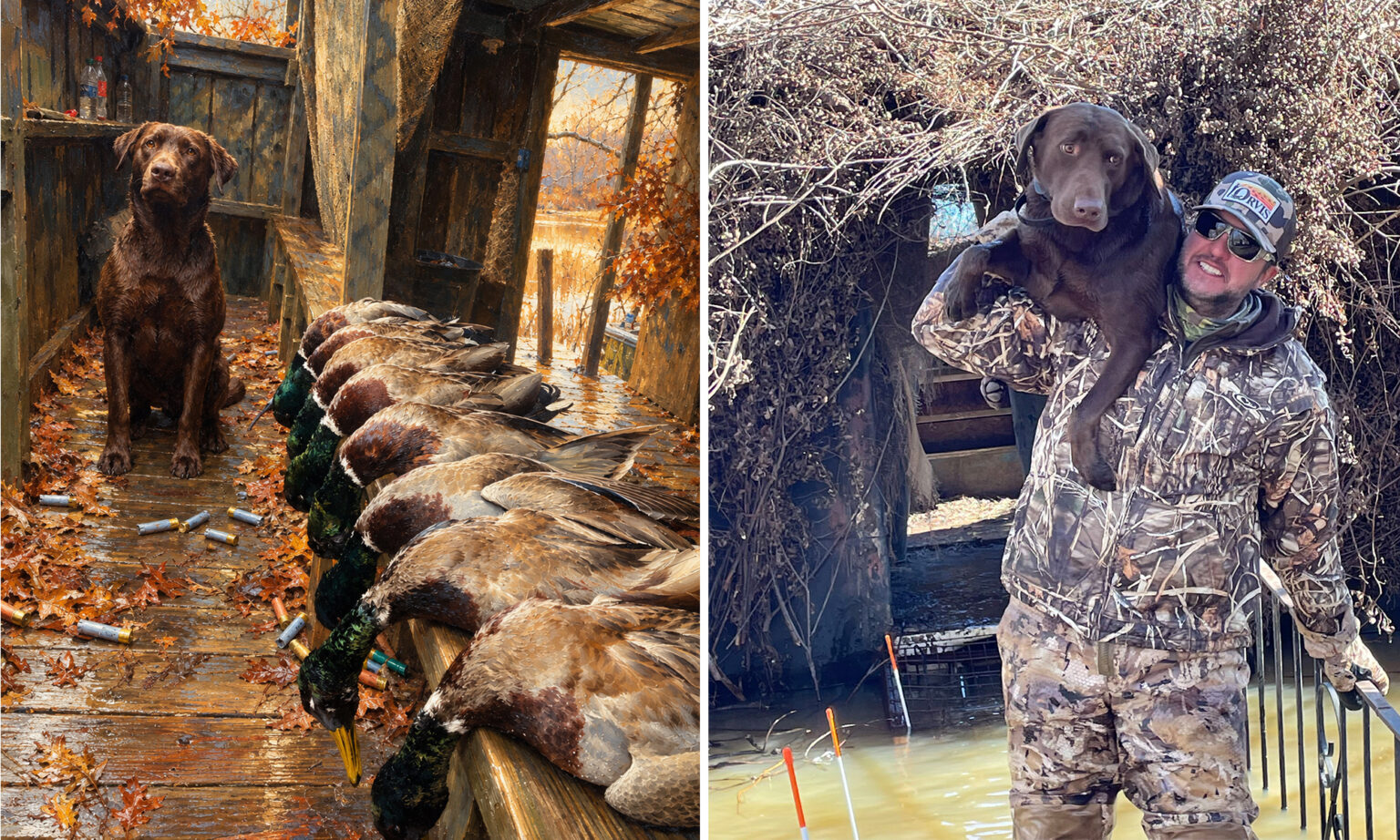
Ask anyone who, at any point in their life, had that dog—the hunting dog of a lifetime—and you will see a unique look in their eyes. They will tell you that of all the hunting and fishing experiences in their lives, those years with that dog were the best. The connection, the magic of owning the dog of their life, is special. For me, in my life, that dog wasn’t my dog. Which means two of us—my friend Luke and I—experienced the dog of our lifetimes, in the same Labrador retriever.
Back in the summer of 2017, I agreed to take Luke’s new chocolate Labrador puppy for a few weeks to work on obedience. Luke had received “Choc” as a gift, and this dog was rambunctious and wild from the start. The initial plan was that I would work on sit and here and just spend three or four weeks helping the pup become a good citizen. What happened instead was that I experienced the hunting dog of my life.
It’s probably worth mentioning at the outset that I am not a professional dog trainer. I’m a lawyer, but Labs have always been part of my life. I had my first black Lab a month before I was born. My parents acquired her just before I entered the world. So, I have never really been without a Labrador in my life.
It’s also worth mentioning a bit about my buddy. I suspect that you have heard of him. His name is Luke Bryan. My buddy is well known in virtually every home in America. I remember so clearly that first night bringing Choc into our house; he was like the cartoon of the Tasmanian Devil, whizzing around and destroying everything in his path. But at the same time, he had these giant paws—way too big for his body, and he would do this big goofy head tilt and look at you with his tongue out in a way that you just couldn’t get mad at him. He had and, still has, the thickest, softest, light chocolate coat of hair, and back then he felt like he had twice the amount of hair that his body size needed.
Choc showed his intelligence and understanding from the very start. Within a day or two, with treats as incentives, he understood what sit, here, heel, place, and kennel meant. He loved to retrieve and naturally returned and delivered the toy or bumper to my hand. Choc slept at the foot of our bed and went to work with me every day. I believe this is a vital part of development and training. While dogs gain key parts of learning, including words like their name and the commands that I have mentioned, they also gain a tremendous amount by being present and interacting with people in their lives, throughout the day. I had a very short training session every morning and another one in the evening. During the day, he went to my office and learned how to be around all the sights and sounds of downtown Jackson, Tennessee. I mentioned earlier that the initial plan was 3 or 4 weeks of obedience training, but as those first weeks passed, I realized that this one was special.
I have trained dozens of dogs over the years. But Choc was one in a million. I am not sure that I can put it into words. But when you meet him, you can see it. There is a depth to him that I haven’t seen in other dogs. No matter their awards, titles, and ribbons, Choc rises above them all.
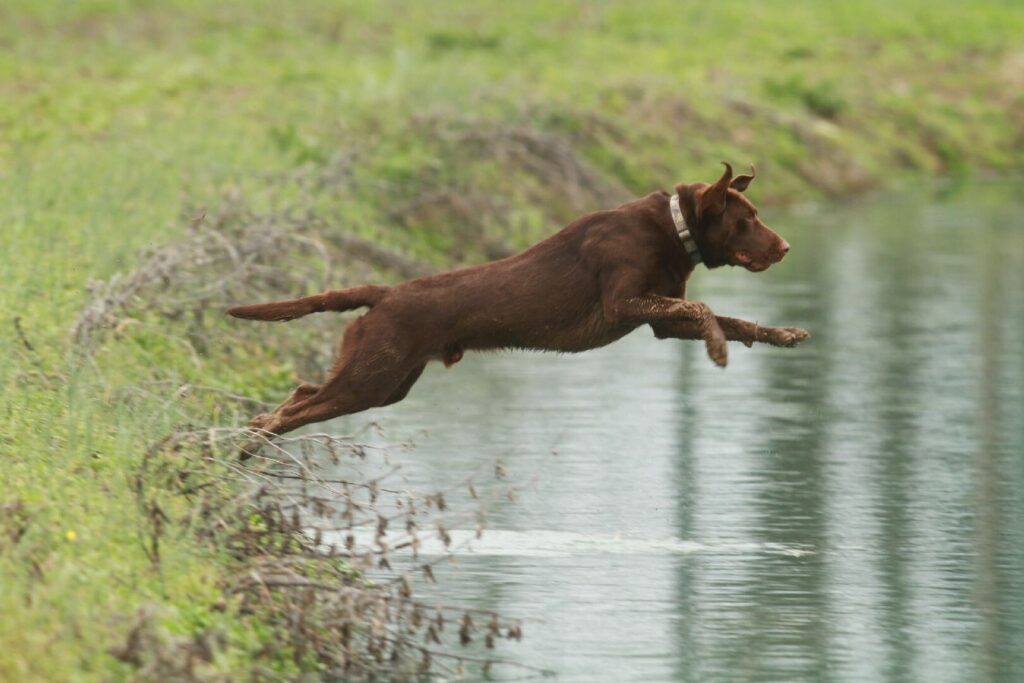
Luke and I decided to go ahead and pursue the next phases of training, with a goal of running a seasoned hunt test in the early fall. As Choc matured, it became clear that his physical gifts were equal to his intellect. He could run like he was shot from a rifle. He could jump flat-footed into my pickup with the tailgate up. The next phase of training included force fetch, basic casting, and lining drills. We also worked on marking, gun conditioning, retrieving feathered bumpers and real birds.
In force fetch, Choc understood the drill within a couple of days and within a week I was doing a walking fetch with him, just attacking the bumper on command. With the hand signals (casting), I swear it seemed that he already knew what to do. Most dogs do three-handed casting for months, but with Choc, he seemed to understand not only basic casting, but rotation and angle backs from the very start. On lining drills, he would “force the pile” at 100 yards, within a matter of days.
In addition to his intelligence, his love for retrieving, and hunting for that matter, was evident from the very start. Most Labs love to retrieve and get excited when they know it is time to train. But Choc was different; even as a puppy, he had an intensity and focus in his eyes. It was like he was saying “teach me more” every single time we trained. His intellect and intensity also had their challenges. Most of those are outside the training field or lake. In fact, I could fill this article with Choc mischief stories, but I will limit it to three:
When he was still very much a puppy, he and I finished training for the evening session. My wife, Angie, and I were having friends over for dinner. We bought two dozen hand-cut beef filets, and I sat them in the center of the island in our kitchen. I walked to the back porch to light the grill. I was outside the house for less than two minutes. During that time, 6-month-old Choc jumped flat-footed onto the island and ate all 24 filets.
A month later, we left Choc loose in the house while we had to the store. Apparently, a training bumper had made its way under the new sectional sofa in our hearth room. During that half hour, Choc destroyed and even ate part of that new sofa.
About a month after that, I took Choc down to my friend Possum Northcutt’s house. Possum is a pro dog trainer. I ran Choc through a simulated seasoned hunt test, and he did a near-perfect job. Then because it was hot outside, I started my truck, turned on the a/c, and put Choc inside to keep him cool. Then Possum and I worked with another dog.
When Choc heard the guns fire and saw the other dogs working, he lost it. He was determined to get out of that truck and join the action. As he tried to escape, he chewed the passenger door handle, the passenger dash, and the steering wheel of my truck. He chewed the dash down near the airbag and thank goodness it didn’t discharge in his face.
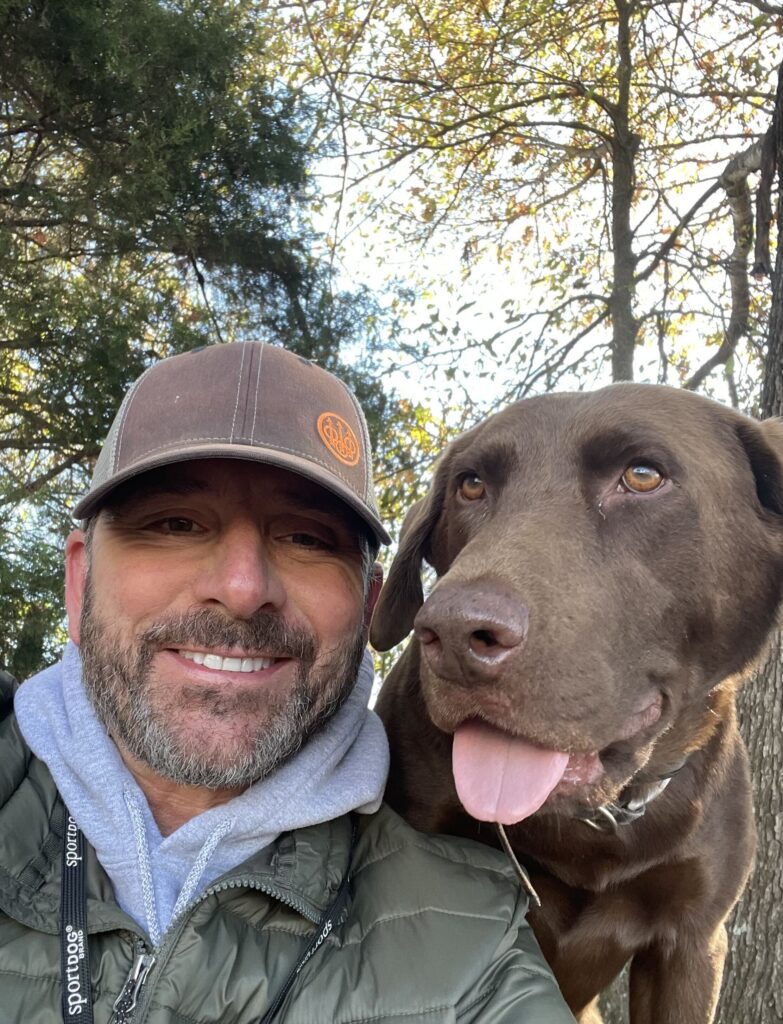
Those of you who are dog trainers are probably thinking, These are serious obedience issues, and there was a breakdown in training. And for any other dog, I would say the same thing. But with Choc, it’s different. He knows right from wrong. He knows what the rules are. He knows what the commands are. But throughout his life, because of his incredible intelligence, he would weigh the options, calculate the consequences that he could expect, and decide for himself what action he preferred.
In the fall of 2017, we ran the first hunt test competitions with Choc. We skipped the starter level and went straight to seasoned. In the tests themselves, Choc was flawless, with one funny exception. But waiting in the holding blinds for his turn was almost more than he could bear. In hunt-test competitions, four or five dogs will wait their turn to run by standing with their handler in a “holding blind.” It’s essentially camo material wrapped around T-posts. As dogs ahead of us would run, Choc would jump four and five feet in the air, flat-footed, just to see or try to see what was going on.
These hunt tests include use of real ducks, marked retrieves, blind retrieves, diversion birds, actual shotguns firing blanks. The dogs must stay under control, complete the tasks required, in a simulated hunting scenario. All sorts of rules can get the dog disqualified, far too many to cover here.
I haven’t mentioned Choc’s marking ability yet. From his earliest days, he had a natural ability to remember (“mark”) where a bumper or bird fell, with GPS precision. And he could remember it for far longer than any dog that I have ever witnessed. I marveled at it so much that I found myself trying to test his limits. I would throw 6 or 7 marks in heavy cover, and then make Choc wait 10 or 15 minutes. Most dogs lose the memory of location with time or any distraction, but Choc could wait all that time and run straight to every single mark like they were on a string for him.
I said that Choc was flawless in hunt tests with one exception, and it’s worth sharing the exception. To pass a hunt test, you have to pass before three judges both a land and water test. On this one day, Choc had been perfect in the land test. On the water, He nailed the water marks and even completed a diversion bird, on the second marked bird. All he had left to finish and pass was the water blind.
At this point, I should talk about Choc’s nose. I’ve joked that he has to have a little bloodhound in him, because he could smell a bird when the wind was all wrong in a way that the average dog just couldn’t smell. That’s an important part of the water blind on this test. Unbeknownst to me, one of the field trial marshals had walked up just two feet behind and to the side of Choc and me as I lined Choc up to send him on this water blind. The marshal should not have been standing there. And, he was holding the diversion bird that Choc had just retrieved. Choc’s body position was good. His head was locked. I said, “Dead bird! Back!” And Choc leaped and snatched that diversion bird out of the marshal’s hand and returned to my side.
His sense of smell is so precise that he knew exactly where the bird was without ever looking. He was disqualified, which I still disagree with because the marshal put that bird so close to Choc that Choc was just doing what he was born to do.
Despite all this success, Choc still wasn’t a duck hunter. That came on a cold, wet day that winter. Luke had a small lake on his farm that gadwalls were using. So he set up a little makeshift blind on the levee. Luke, my son Weston, our friend Dallas Davidson, and I took Choc, with a dozen decoys, and set up behind that little blind. I sat in the mud with Choc and whispered to him as the ducks began to work. A group of five birds locked up, and the guys dropped them all as I continued to whisper to Choc. In that moment, it all came together for him. His life’s purpose, his genetic memory, and his heritage. Choc picked up all five of those birds. I sure wish we had saved one to mount. We killed a few more that day, but I will never forget that first magical volley.
Over the years, Luke and I, along with our family and friends, have had countless magical hunts with Choc. Maybe the most memorable for me is a rainy day on the middle fork of the Forked Deer River. It was just Luke and Choc and me. We were in a timber hole and wave after wave of ducks came in. We shot only greenheads, took turns, and let them get close. Choc did not lose a single bird. If you asked me to describe a perfect duck hunt, that would be it.
You can actually duck hunt with Choc and look only at him until you are ready to shoot. He will sit like a sentinel, watching every single bird in the air from daylight to dark. You can just watch him as he studies the birds as they work. Choc carefully follows every duck, whether it’s one or a hundred and one, that is working. And then when they are in range, when it’s time to call the shot, his eyes lock like lasers, and his shoulders flex. Even though he makes not a sound, it’s his way of saying, “Take ’em.” Over the years, we have lost track of the number of birds that Choc has retrieved. It’s way over a thousand. His desire, intellect, marking ability, and sense of smell create a show every time you hunt with him. He seldom loses a bird. In fact, time after time, he will bring back yesterday’s ducks, where someone hunted the day before and couldn’t find a duck, and Choc finds it the next day.
Choc will turn 10 next year. His steps have slowed. He has some grey in that thick brown coat. All the shotgun blasts have taken much of his hearing. But the fire inside him has not diminished. He loves the hunt. He loves every sight and sound of a day in the field. He loves doing the thing he was born to do, with the ones he loves. Through all the training sessions, hours, days, and years, Choc has taught me something too. Do what makes you happy. Do it with those you love. Work hard and use your gifts. And remember, the dog of your life may be your buddy’s dog.
All new! 1871 Club Field Trips