
TWENTY-FIVE YEARS LATER, as I strive to remember lost details from the fishing trips I took with my father, I find it’s easier to retrace my steps if I close my eyes.
A short journey comes into focus: From the parking lot of the trout stream, we cut through a patch of woods that spits us onto a gravel trail that runs along the section of river where bait is legal—water crowded with dozens of spin anglers, most with stringers of dead trout clipped to their belts. Next, we ascend the ramp to a suspended footbridge and stop midway across to gaze down at the giant trout hovering in a deep pool while they ignore the same balls of dough bait they’ve probably seen a thousand times.
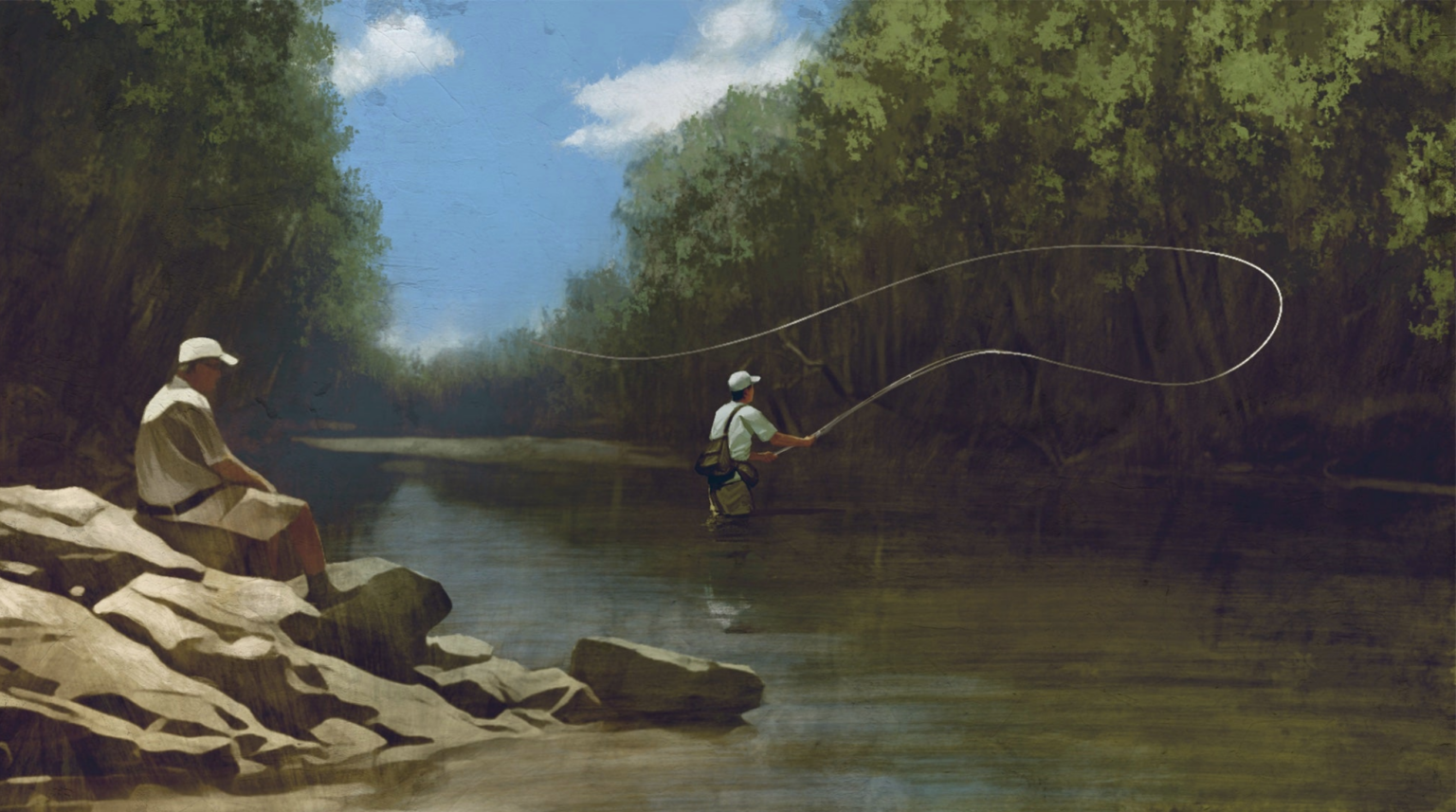
At the end of the bridge, we come to the trailhead of a narrow dirt path. I lead the way, walking with my 5-weight poised like a sword, doing my best to thread it through the tangle of overhanging branches. The river runs below us to the right, paralleling the trail. One misstep would result in a painful fall down the rocky bank and into the water. Midway along the path is a spot so eroded we have to cling to a sapling as we take turns lunging over the gap, one leg at a time. Once I’ve crossed safely, I stop to watch and make sure Dad does the same.
“You good?” I ask.
“Yep.”
Now that the hardest part of this short journey is over, the distance between my dad and me expands as my pace quickens. The access point to the river is just up ahead. I can almost see it.
I
On a Saturday morning in January, my younger brother, Michael, called with news that Dad had suffered a stroke. Little was known at the time—just that another tenant in the thin-walled apartment building where our father lived alone had dialed 9-1-1 after hearing his cries for help, and that EMTs had to break the jamb on Dad’s deadbolted front door before they could load him into an ambulance and rush him to the hospital.
Over the next 36 hours, Dad would undergo two operations: the first to remove a blood clot in his brain; the second to remove part of his skull, creating space so that his brain could continue to swell without killing him.
During all of this, and in the days that would follow, my father lived in darkness. Not only had the stroke paralyzed his entire left side, but he could no longer open his eyes. Worse yet, even when doctors lifted his eyelids for him, my father could no longer see.
II
I was the last of the four sons to come home following Dad’s stroke. Mike, the youngest, and only one who still lives in St. Louis, was naturally the first to know. Brian, the oldest, drove up from his home in Arkansas as soon as he got the news on Saturday. Patrick caught a flight from Florida on Monday. I left New York Tuesday morning.
Mike picked me up at the airport and drove directly to the hospital. We didn’t say much in the car, but he mentioned that Brian and Pat were already there with Dad in the ICU. A thought occurred to me: This would be the first time in three years that the four brothers were in the same room. All it took to bring us together was our father nearly dying.
I had seen a photo of my dad following the stroke, but it still didn’t prepare me for the moment when I approached his hospital bed. Normally tan and spry, my father looked as ashen and frail as I had ever seen him—as if he’d aged 20 years overnight. A dozen or so staples snaked across his freshly shaven head, and a maze of tubes connected him to a battery of machines that beeped, hissed, and flashed. His eyes were shut.
I took his right hand. “Hey, Dad.”
He squeezed. “Hey, bud.”
He held on until I let go. I sat down and just stared at him for a while.
***
I stayed in St. Louis for the rest of the week, spending as much time at the hospital as visiting hours allowed. I don’t know if I have ever been more grateful for my brothers’ company. For one, being together made it easier to keep Dad engaged—to bring him into conversations and bring out his sense of humor. Like the moment he began to grab at the top of his bedsheet.
“What are you looking for, Dad?” Mike asked.
“Goodies,” he replied. Not even a stroke could tame Dad’s sweet tooth.
My brothers’ company also nurtured small acts of compassion—pretty much the opposite of the hazing and teasing that infested our childhood. Like when Brian came back into the room, sat on the edge of Dad’s bed, and asked, “Would you like me to hold your hand, Dad?”
“Yes, please,” he replied.
In fact, I found the periods of my brothers’ absence—when I was alone with my father—the most difficult. I could never tell if Dad was awake or asleep, and, not wanting to disturb him if he were resting, I often allowed the room to remain quiet. And in that silence, I’d find myself staring at him again, sometimes crying as softly as possible—afraid of making him aware of how sad and frightened I was by the thought of losing him.
On the final night of my stay, when it was again just the two of us, I found the courage to interrupt the silence and, following Brian’s example, sat on the edge of Dad’s bed and asked if I could hold his hand. I told him how much I had enjoyed being with him all week. He squeezed my hand and said thank you.
His hospital gown was partially open, and I noticed, on the left side of his chest, a not-so-small tattoo. It was of two celestial bodies overlapping, and around the spheres were our names: Brian, Patrick, Colin, Michael.
“I don’t think I’ve ever seen that tattoo on your chest, Dad.”
“The sun and the moon,” he said. “And my boys.”
***
The next morning, I had enough time for a short visit before my afternoon flight back to New York. Brian arrived just before I did, and as we settled in, he checked on Dad with some small-talk questions: How’d you sleep? How are you feeling? Do you need anything? The tone of his final question, though, felt more direct: “Can you open your eyes for me, Dad”?
What happened next still stuns me.
Dad’s eyes shot open, as if he’d awoken from a bad dream. For the few seconds’ worth of strength he could muster to keep them from closing again, his vision, he said, was quite blurry—but he could at least make out the shapes of both Brian and me. After everything we’d been through in the past week, this felt like a miracle. There he was again—the dad I knew. Or, the dad I mostly thought I knew.
As uplifting as it was to see him open his eyes, something about the moment nonetheless troubled me. It hit me at the airport: Until that time, I’d always thought my father’s eyes were light brown or hazel. Turns out, they’re blue.
III
After I returned home to New York, I couldn’t shake the unnerving guilt I felt over not knowing the color of my dad’s eyes—or of once knowing and then forgetting, which somehow seemed worse. If I can’t even remember the color of my own father’s eyes, I thought, what else must I have forgotten?
The notion that any hazy memory of Dad could have been lost forever had we lost him felt like a reckoning. I found myself desperate to recall and reclaim as much of the time my father and I spent together as possible. The occasions that sprang to mind first—that seemed most precious and worth saving—were the days when Dad accompanied me to the river during my first seasons as a fly fisherman.
***
About a week after my trip to St. Louis, on a clear afternoon in January, I arrived early for an appointment uptown. To kill time, I decided to take a stroll in the park across the street and call my father.
I was encouraged by the strength in his voice when he answered. He still had a long way to go, but at least he was beginning to sound like his old self again. I asked how he was doing. Just OK, he said. He was eager to be transferred out of the ICU and disheartened that his vision hadn’t improved.
I tried to cheer him up with new anecdotes about his three-month-old grandson. Then, knowing how much he loves New York, I described my walk through Central Park. I told him how spectacular the weather was, that it felt like spring, which had me looking ahead to trout season. I mentioned that I’d been thinking about the fishing trips he and I took way back when.
“Do you remember those?” I asked.
“I remember them very fondly,” he said.
His answer lifted my spirits. Maybe he could recall some of what I’d forgotten and help me restore those faded memories. “What do you remember?” I asked.
“Just that they were so serene,” he said. “I would sit on the riverbank and read or watch you cast. It was so peaceful.”
His response was touching, but not what I expected. Neither serenity nor peace occupy any memory I have from that period in my life; I would’ve guessed the same would be true of my father’s own memories—or those belonging to anyone else in my family. His response wasn’t exactly what I craved, either. It was unrealistic, maybe even selfish, of me to have wanted him to remember what I could not from something that happened 25 years ago, but I had hoped he could provide more—more time-hidden details about the conversations we shared, about the aesthetics of the river, about who I was, what I was like, at the time.
My father never fished during those trips, so I asked if he remembered why he wanted to come along in the first place. “Was it because I was young, and you just wanted to make sure I’d get there and back home safely?”
“That’s probably true,” he said. “But I mostly just wanted to spend time with you.”
“We went a bunch of times, right?”
“Only a few.”
“Are you sure?” I asked. “There was the one trip we took with Brian and a different trip to Bennett Springs with both Brian and Mike where we camped a couple of—”
“I’m talking about when it was just the two of us,” he said.
I checked my watch; I had to get to my appointment. Before I said goodbye, I tried once again, pleading with my father to give me more. “Is there anything else you can tell me from those trips?”
“No,” he said. “Just that I have very fond memories of them, and that they were serene and peaceful.”
IV
Lately I’ve wondered if I ever would’ve become a fly fisherman were it not for my parents’ divorce. I was 16 the summer my father moved out. Brian and Patrick were old enough to live on their own, which left just Mike and me at home with our mother. That period was difficult for all of us, and we each coped in our own way. Speaking only for myself, I can’t say that I handled the separation well.
I didn’t resort to drugs, drinking, or delinquency. Instead, I became convinced that my purpose in life was to go unseen, to do whatever was necessary avoid creating any additional problems or drama for my family. This meant doing well enough in school to keep teachers at bay. Helping at home enough to give my parents less to worry about. Telling people I was fine when I wasn’t.
I started wearing a tight-fitting rubber band on my right wrist. Anytime I began to feel sad or upset, I’d pull it back and snap it against the inside of my wrist several times in rapid succession—enough times so the sting would distract me from those real feelings and let me get back to what I thought was normal. I had a few friends, but I never saw them outside of school—paranoid that parties could lead to trouble, and trouble would lead to more problems at home. So, I stayed home every weekend, shutting myself in my bedroom, where the only escape and enjoyment I found came from a newfound obsession: movies.
I watched them incessantly, no matter the genre: indies and foreign films; slashers and westerns; cult flicks and classics. I constantly sought out recommendations—one of which came from Brian and would go on to change my life.
The first time I watched A River Runs Through It, I had no idea that the movie had already kick-started a craze among wannabe fly anglers. In fact, given that my fishing experience up to then was limited to catching panfish with nightcrawlers at the apartment-complex pond where my grandparents lived, I didn’t even know what fly fishing was. Which, to me, makes the reaction I had to the film even more extraordinary.
Pretty much from the opening scene of an old, lone angler tying a dry fly onto his leader, I was in awe. I had been transfixed and transported by films—books and songs, too, for that matter—but never like this. The idea that you could escape everything by stepping into a river in the cool of the evening and cast suspended loops of fishing line over the water before letting that line gently fall, and then wait, hope, for a trout to rise to your fly, and then bring that trout to your hand before releasing it back into the water, alive, was beyond my comprehension. I did not know that such solitude and grace were attainable. At some point during my viewing of the film, I became aware that all the sadness and pain and problems in my life had momentarily vanished. I wondered: If I could fly fish, would they vanish more often, and for longer?
I decided then and there that I would take up fly fishing. Not knowing where to begin, though, I did the only thing I could think of: I started the movie all over again.
***
St. Louis, Missouri, is hardly a bastion of fly fishing, but I happened to live close to two fly shops—T. Hargrove and Feather Craft—both of which operated right down the street from one another. I must’ve passed each one a thousand times in my life, but it wasn’t until a couple days after watching the movie that I nervously walked through the door of one of them.
The young guy working behind the counter at T. Hargrove probably sensed I was out of my element the second he saw me. “Need help with something?” he asked.
“Do you guys give fly-fishing lessons?” I replied.
He looked bewildered. “”˜Fly-fishing lessons?'”
“Yeah,” I said. “I want to learn.”
Once he’d had a chance to process just how green I was, he walked me over to the shop’s book section and handed me a copy of Fly Fishing for Trout in Missouri, a beginner’s manual. “Start by reading this,” he said.
I grabbed the book and flipped through the pages that, I believed, contained all the answers I needed to become a fly fisherman. Then I remembered I was broke. I returned the book to the shelf and said I would have to come back. I suspected the guy thought he’d never see me again—that his homework assignment scared me off. I was looking forward to proving him wrong.
***
As I worked toward saving money for the book, there was one thing I still needed to take care of if I were truly serious about getting into fly fishing: Telling my father that I was serious about getting into fly fishing.
I needed to do this for several reasons, not the least of which was the hard truth that I couldn’t take up fly fishing without it eating into the time that I devoted to soccer—which, practically since the moment I could first run, consumed nearly every second of my free time. Soccer was also at the heart of an intense bond with my dad.
My father loved me unconditionally, I knew that. But there were times when I felt as if I needed to compete for his affection. My soccer games were often played far from home—30- to 45-minute drives were the norm—and it was usually just my dad and me driving to them. If I played well, he’d dote on me, his golden child, the whole way home. But if I had an off game, his icy demeanor could make me feel shunned and ashamed, like I should apologize over and over for embarrassing him on the sidelines in front of the other parents. Prior to my parents’ separation, I thought my primary reason for being was to make my father proud by being great at soccer. He expected me to be a junior-high star, then captain of the high school team. And the fantasy didn’t end there: I could earn college-scholarship offers if I worked hard enough. But that work was exhausting, physically and mentally.
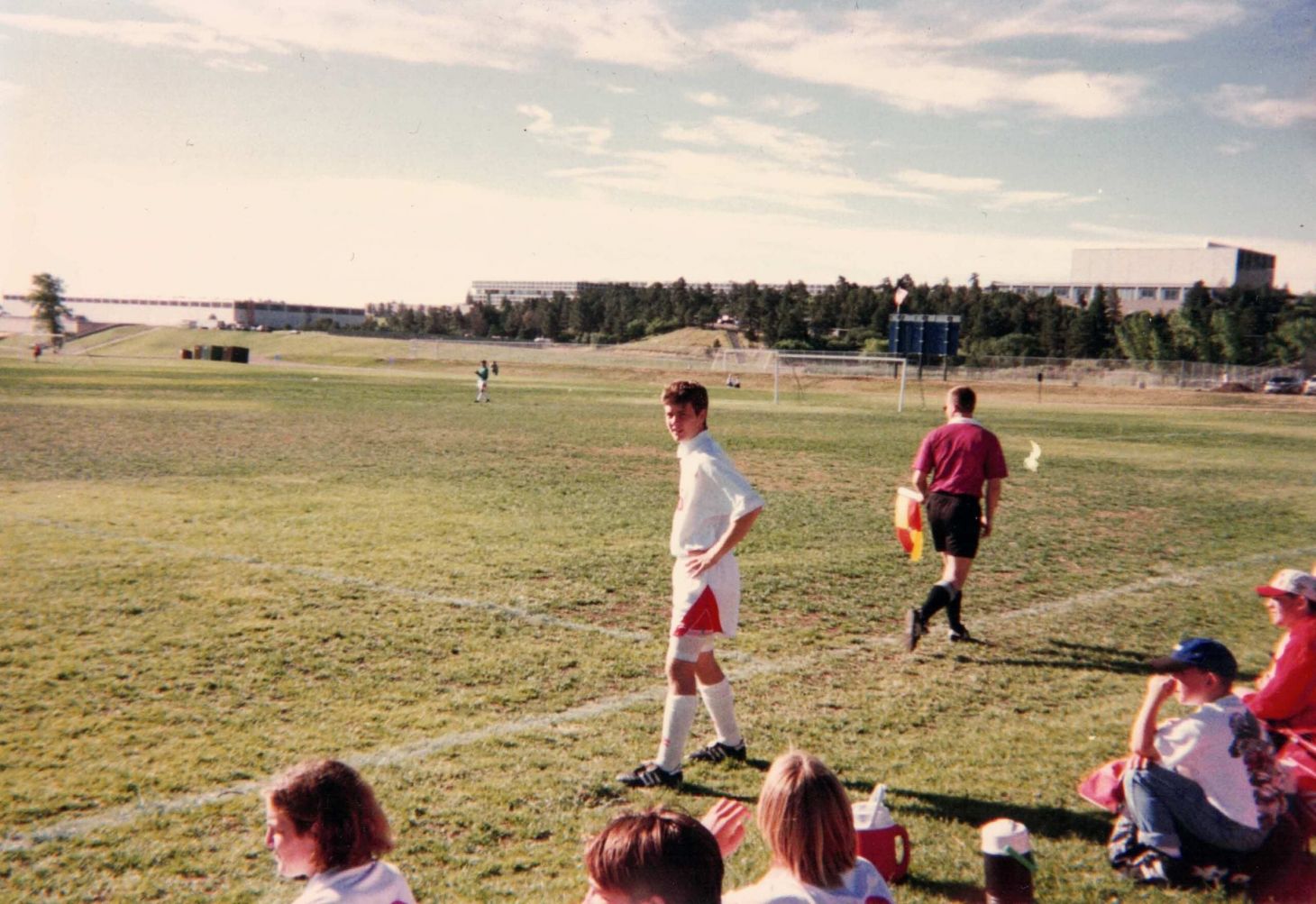
After my first high school season, I was already feeling burned out. Dad’s decision to leave home that summer didn’t exactly motivate me to reclaim my enthusiasm. When tryouts began in August, I was out of shape, a step slow. The head coach did not mince words when he cut me from the varsity team and relegated me to the sophomore squad. In the final game of that season, we won the class championship. My teammates were ecstatic. I was ambivalent. They went out to celebrate. I went home and watched movies.
Looking back, a part of me can’t help but wonder if, subconsciously, my decline as a soccer player was self-inflicted—my way of retaliating against my father, my way of saying: If I quit, will I still matter to you? Will you still be there for me when I need you?
To his credit, Dad didn’t push back when I told him, at the end of that championship season, that my soccer-playing days were over. He probably saw it coming. Also to his credit, he didn’t question me a few months later when I said I was interested in learning how to fly fish. He even offered to give me the money to purchase the book at the fly shop.
I thanked him but declined the offer. I wanted to start this discovery on my own terms.
***
When I returned to the fly shop a few weeks later, I walked to the book rack, grabbed a copy of Fly Fishing for Trout in Missouri, and paid for it with my own money.
I read the book cover to cover that very night—then started it all over again the next evening. Within a week, I knew the difference between a wet and dry fly; what a leader and tippet were and how they should be connected; where some of the most accessible trout streams within driving distance of home were; and what kind of rod, reel, and line I should get.
Paying for that gear was another thing; I would need help. While my parents didn’t agree on much of anything back then, I at least managed to get them to come together on one thing: Buying me my first fly-fishing rig for my 17th birthday. So, after school one Friday in March, I visited the shop and walked out with a St. Croix Imperial 5/6-weight rod, a Ross Colorado reel, and a spool of Scientific Anglers WF5F line. That evening, I rewatched A River Runs Through It while rigging, unrigging, and re-rigging my very own fly rod and reel. A rare moment of bliss.
***
Once I was equipped, fishing was all I could think about. I read other books. I mail-ordered Cabela’s, Bass Pro, and Orvis catalogs. I borrowed VHS cassettes of trout-fishing tutorials from the library. I practiced fly casting at the park after school and worked on tying knots at night while I watched movies. I was the happiest I’d been in years.
The final step was signing up for a casting clinic at the fly shop. Since I’d never cast in front of anyone else, this was a big deal. I was one of maybe four or five beginners who’d come. When the instructor eventually made his way to me, he observed me make a series of forward and back casts, then told me to stop.
“You haven’t been practicing at all, have you?” he said. My heart sank. I was crushed. Before I could figure out a response, though, he cracked a smile. “I’m messing with you,” he said. “You already cast better than guys who’ve been doing this for years.”
I remember how excited I was to share his words with my dad.
***
Finally, I was ready to go fishing. I picked out a weekend that spring and asked my folks for the OK. My mom sweetly gave me her blessing. Dad did, too—but he told me that he wanted to come along.
This was not the answer I desired. I wanted fly fishing to be my thing, which meant going alone. I pushed back—promising I’d be careful, assuring him I knew what I was doing and where I was going, and swearing I’d get home safe. But there was no changing his mind. If I wanted to fish, I’d have to go with my father.
V
The night before my first fishing trip, I was too excited to sleep so I stayed up late sorting through and reorganizing my fly vest. I had asked Dad to arrive early—5 a.m.—so I could be on the water, ready to go at 7 a.m. sharp, when a siren would blast throughout the trout park, alerting anglers they could begin fishing.
Dad pulled up to the house right on time. I stashed my tackle in the trunk and got in the car. Waiting for me on the seat was a sleeve of mini powdered-sugar donuts and a bottle of orange juice.
“Ready?” he asked.
“Yep.”
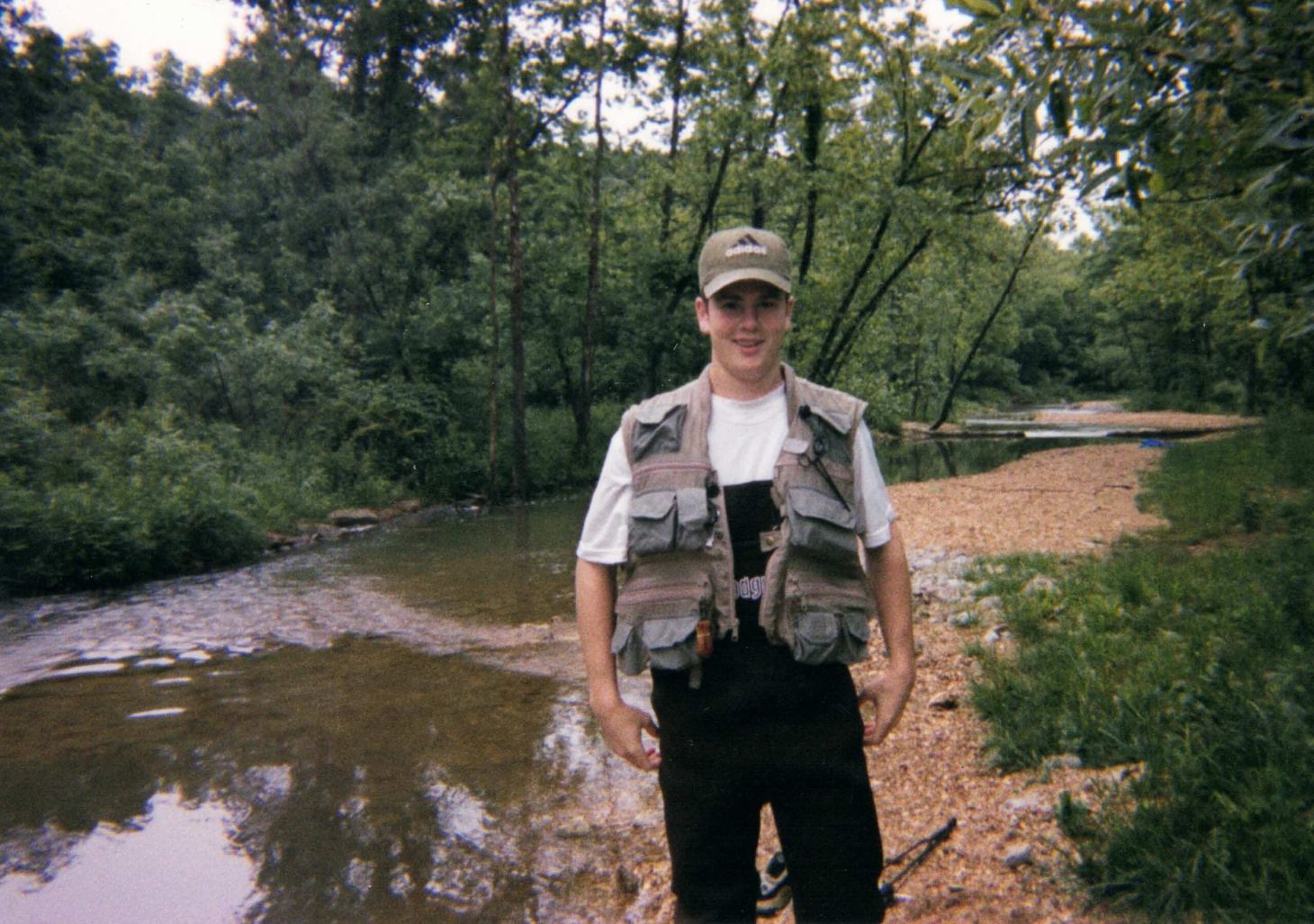
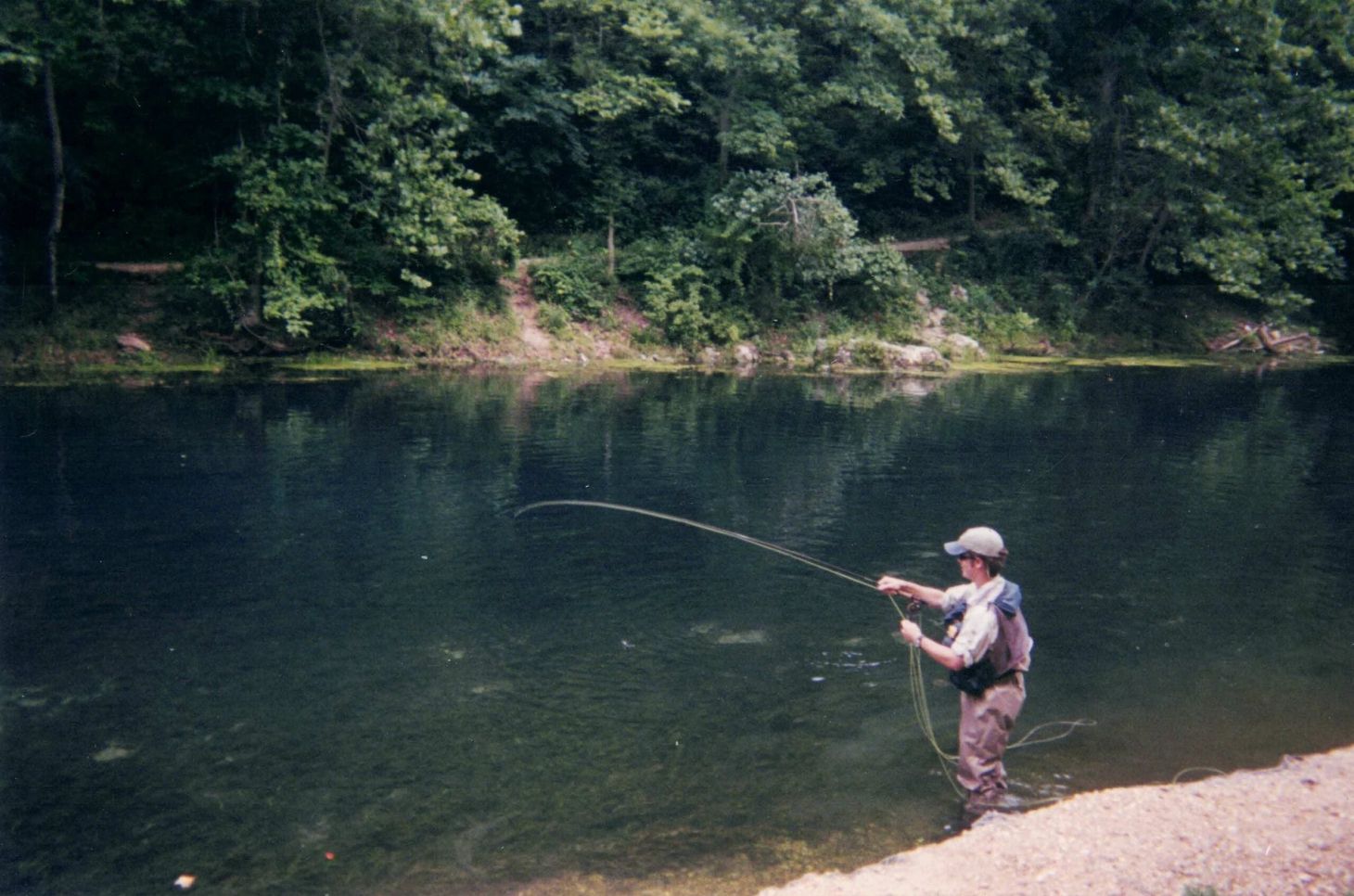
It was a 90-minute drive to Maramec Spring Park. After crossing the footbridge and winding our way along the narrow dirt path, including past the eroded gap where we had to cling to the sapling, a long stretch of river came into view. I remember thinking it was just perfect.
Brush, wildflowers, and hardwoods lined the banks. In most stretches, the stream measured about 50 feet wide—big enough for several anglers to fish with ample casting room. Small stones blanketed the riverbottom, which made for easy wading. The surface of the water had a bit of everything: eddies, riffles, foam-speckled seams, and deep pools near the confluence with the Maramec River downstream. Mostly, though, the clear current flowed at a smooth, calming pace that was ideal for drifting nymphs and dry flies or swinging streamers.
The only thing that could have made the river more perfect was if I’d caught a trout. I got skunked on that first fishing trip with Dad. And the second. And the third.
As much information on fly fishing as I’d absorbed from the books I read and the instructional videos I watched, none of it truly prepared me for those first sessions on the river. Looking back, I suspect my on-the-water struggles stemmed from the fact that I didn’t know what the hell I was doing. Being able to cast my fly rod at a park lawn was one thing; transferring those casts to a moving body of water where I had to contend with complex currents and hook-snagging obstacles was another thing entirely.
I didn’t expect fly fishing to be easy, but I didn’t anticipate struggling as much as I did, either. What made things worse was that I always seemed to be fishing alongside another angler or two who were catching fish. Watching them was painful. I’d get jealous and competitive as I counted their catches. A voice inside would start to taunt me. You’ll never be as good as them, it’d say. You should quit this, too.
There were times when it got so bad that I fought tears on the water. I still prayed back then, and I struggled to accept and understand why the Powers That Be were making fly fishing, of all things, so damn difficult—at a time when everything in my life was already so damn difficult. The sadness felt inescapable. At home, I was reluctant to walk past my mom’s bedroom door, fearful that I’d hear her crying alone again. At school, I had to listen to classmates rave about parties that I wasn’t invited to. At my dad’s new place, I watched him settle into his surroundings with such delight that I began to wonder if I were part of the reason he wanted to leave home in the first place. At night, I was haunted by the memory of Mike, my kid brother, struggling to comprehend what our father meant in the moment when he broke the news that he was moving out—catching his breath between sobs to ask, “Will you ever come back?” And now, at the trout park, I seemed to be the only person on the entire river who couldn’t land a fish.
Long before my first fishing trip—when I was naive and confident enough to assume I would catch trout on those initial outings—I committed myself to being a catch-and-release fisherman. It was almost as if I’d attempted to make a pact with the river: If you grant me the joy of what it must feel like to land one of your trout, I promise I’ll never let one die. Maybe I put too much faith in that pact. Maybe I kidded myself into believing that such a pact could be made. But as I struck out on the river, time and again, I remember a part of me feeling as if the river had betrayed me, too.
***
As the trout-less days piled up, I was not the most enjoyable person to be around. I sulked and spoke very little during the drives home from the river. When I still played sports, there were occasions when my father could sense his presence was a distraction—that he was putting too much pressure on me just by being there—and mercifully he would leave. I suspect that’s what happened after the third fishing trip we took together. Dad had to have known how much fly fishing meant to me, and even though I imagine he would’ve preferred to keep coming along, to spend time with me during a period when he and I were seeing less and less of one another, he did what he must have thought was best as far as helping me succeed on the river. He said I could start fishing alone.
VI
I dream about my father some nights. Not all the time, but I’m guessing more often than I can actually remember. The most recent example of one that I do recall took place a couple months after his stroke. In it, I found myself walking the halls of the ICU where my dad was recovering. The dream setting matched reality to a T—right down to the sliding glass door that opened into his room.
When I entered, Dad sat up and turned to look in my direction. I froze when I saw him. The scar on his head had healed, and his hair had not only grown back but was brown instead of gray. His face bore no wrinkles; he looked 30 years younger. His eyes were wide open—and brown, just like mine.
“Who’s there?” he asked.
Before I could answer, I woke up. For days afterward, I couldn’t get past this disturbing feeling that I’d seen what my father would have looked like had he suffered his stroke at my age. Or what I would look like were I to have a stroke today.
***
There’s another dream, from a few years ago, that I think of regularly. In this one, I’m alone in my childhood bedroom, holding a dying rainbow trout. As I begin to tremble and panic, I turn around and see my father standing just outside my door.
“I need help,” I tell him. “I can’t let it die.”
Dad tells me to follow him. We rush to the bathroom across the hall. He starts running cold water from the faucet and guides my hands into the basin. As water pours over the trout, color slowly spreads across its body—a greenish back, pink flanks. The fish regains its strength and starts to writhe in my hand. Just as if I were releasing a trout back into a stream, I sense when it’s the right moment to let go. When I finally do, the fish pulses away, alive.
What I don’t remember from that dream—and what I wish I could—is if I said anything to my dad when he was there for me when I needed him.
VII
My solo fishing trips did not go any better than the ones I took with my father. I never even hooked a trout let alone landed one. I dreaded coming home and having to tell my parents, again and again, “No, I didn’t get anything.”
One evening when I made one of those confessions, I was at Dad’s place for dinner. After spilling my guts about another skunking, he put an offer on the table: His friend George was a serious fly angler. My dad had told George that I’d recently started fishing but was struggling, so he asked George if he’d be willing to take me to the river one day. George said he’d be happy to.
“What do you think?” Dad asked.
“That would be amazing.”
***
George had money. This was evident not only by the fact that he picked me up one Saturday morning in a Lexus, but that our fishing destination would not be anything like the public trout parks I was used to. Instead, he took me to a private stream called Windrush Farms—a name I recognized from my copy of Fly Fishing for Trout in Missouri, in which the coauthors raved about it being one of the best trout streams in the state. Windrush’s two miles of stream were stocked with trophy trout and limited to just a dozen or so anglers per day. The catch? A day pass cost $30—a small fortune to 17-year-old me. Fortunately, George paid my way.
George took me to one of his favorite pools and advised me on what kind of fly to tie on—probably a Pheasant Tail or a Prince. He told me where to cast. And when the strike indicator stuttered, he told me to set the hook.
Just like that, I had caught my first trout on a fly rod.
After he netted the fish, George got out his camera and took a picture. A couple of weeks later, after he’d had the film developed, he gave the photo to my dad, who gave it to me. In the image, I have on my loaded vest. The hat I’m wearing is tan with a blue bill and with a rainbow trout embroidered on the front; it was a gift from Brian. The expensive-looking polarized sunglasses I have on were George’s spare pair because I’d forgotten mine. My smile is enormous, and in my hands is a healthy rainbow trout—with a dark-green back and hot-pink flanks. It probably would’ve measured 16 inches, but it’s tough to say because I’m blocking most of it with my hands. I didn’t yet know the right way to hold a trout for a photograph.
That was the only fish I caught at Windrush Farms with George, but it was enough. It kept me going. It gave me hope.
***
I wish I could remember what it was like to come home with good news later that day, and to tell my parents that I had finally caught a trout. When I saw my dad, I’d like to think that I at least had the good manners to thank him for setting up what was essentially my first guided fishing trip. But even if I did, it has still taken 25 years for me to truly appreciate and understand what my father did for me that day: He helped me catch my first trout on a fly rod.
And, by doing so, he helped me keep going. He helped me find hope.
VIII
At 1:21 a.m., on October 16, 2022, my son, Leonard, was born. He weighed 8 pounds 12.7 ounces, measured 21.5 inches, and, to my surprise, had blue eyes. I don’t know why, but I had a gut feeling that he would arrive with brown eyes, like mine. I’m so glad he proved me wrong.
My son’s eyes are like the sea at its most wondrous—emerald-bright from afar, crystal clear up close. When they widen, his entire face beams, and it can seem like he’s smiling without ever moving his lips. Almost daily, I find myself wandering in those eyes of his.
***
IX
X

All new! 1871 Club Field Trips



1 Comment
Beautiful writing piece, with descriptors that true outdoorsman can appreicate. Your Father is right on… God Created us and nature, and fly fishing affords us the opportunity to grow, love, and be grateful for our Blessings! Lastly, Marriage and children are amazing gifts, again from God.