Hundreds of years after the invention of gunpowder, the firearm continues to reshape the battlefield. While early hand cannons may have been more frightening than effective, they started us down the path to modern weaponry with effective ranges measured in thousands of yards—not tens of yards. Along the way, firearms have become more portable and reliable. The following is a quick tour through over 800 years of military-firearm innovation.
1. Hand Cannon
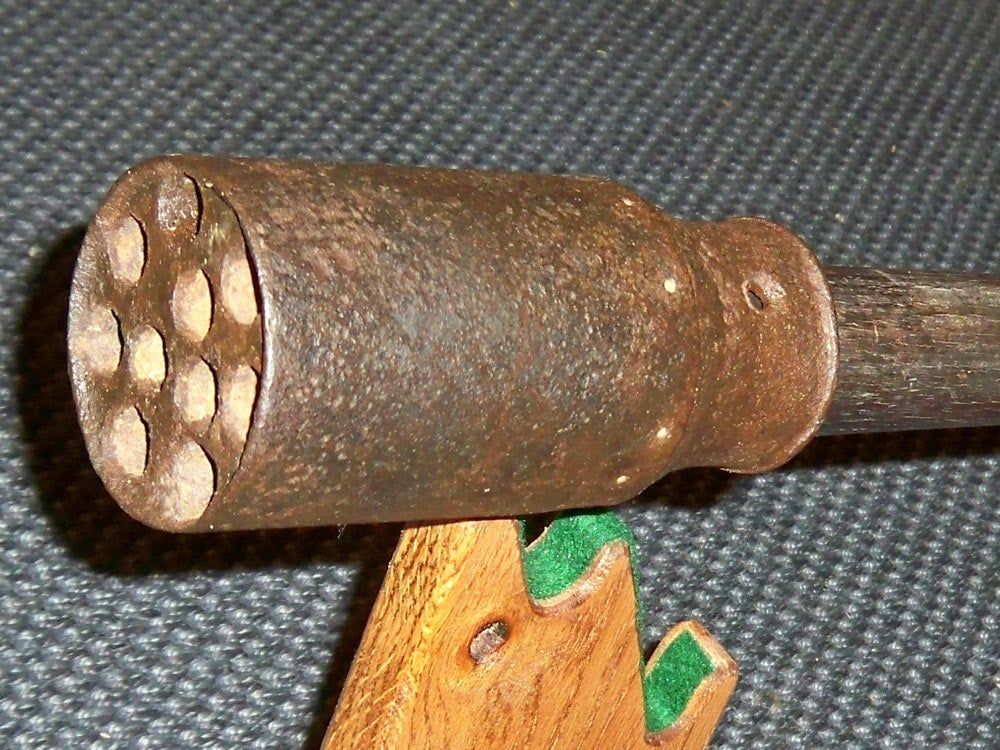
The “hand gonne” fired lead and stone balls, or grapeshot loads of sharp flint. (Photo: Wikimedia Commons)
The earliest depiction of a firearm dates to a 12th century cave in China, and guns became widespread in Europe in the 14th century. “Hand gonnes” were often served by a crew of two—one holding and aiming the gun, the other applying a match to the touch-hole. Early guns often had long handles that could be braced against the ground, while others were held over or under the arm. They fired lead and stone balls, and sometimes grapeshot loads of sharp flint. Like the longbow, the hand cannon could defeat plate armor. Unlike the long bow, which required years to learn, the hand cannon could be fired with minimal training.
2. Arquebus
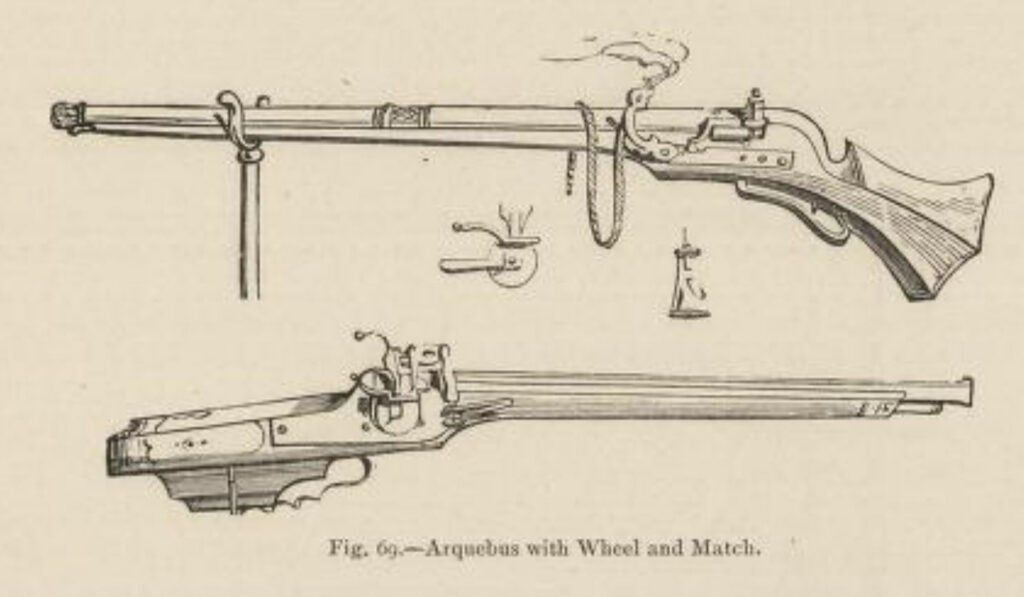
A sketch of an arquebus—a forerunner to the musket and rifle. (Photo: Flickr.com/PatrickGray)
The forerunner of muskets and rifles, the arquebus appeared in the 15th century. It was fired by means of a match in a lock that was lowered to the touchhole by a lever that was a forerunner of the trigger, and the long-barreled guns were often braced on a monopod. The Turks are credited with massing arquebusiers together to fire volleys in the 16th century, and volley firing remained the dominant infantry tactic well into the 19th century. The arquebus was replaced by the snaphaunce, an early flintlock, in the mid 1500s.
3. The Land Pattern Musket—a.k.a. “Brown Bess”

The Brown Bess was the British service arm until it was replaced by the percussion musket. (Photo: Wikimedia Commons)
In the 18th century, nations standardized their muskets to make supplying large armies with ammunition and spare parts easier. The Land Pattern musket, known as the Brown Bess, was the British service arm from 1722 to 1838, when percussion muskets replaced it. It was .75 caliber and was used by both sides during the American Revolution. The Brown Bess could be loaded and fired three to five times a minute. Intended for close-range volley firing, the Brown Bess had no sights was most effective at ranges well under 100 yards.
4. Dreyse Needle Gun
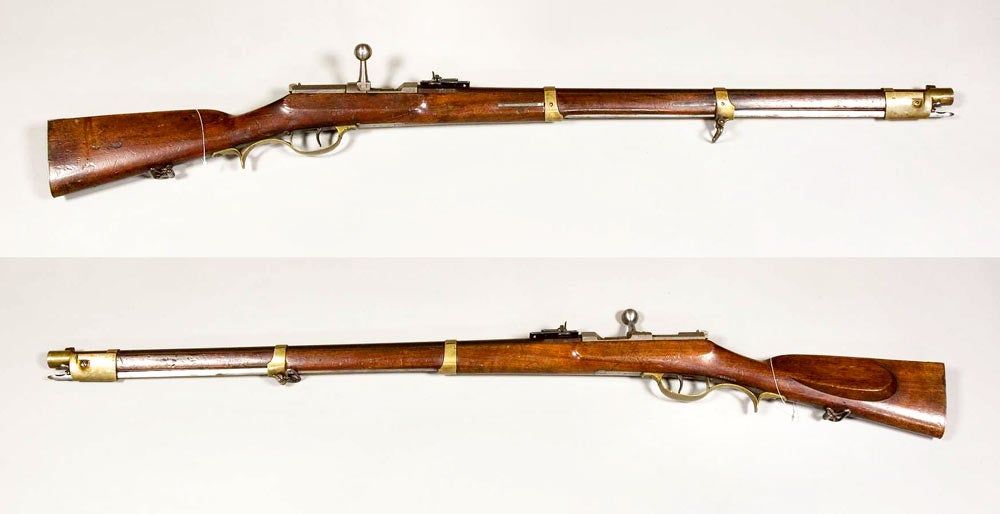
The needle gun increased a soldier’s rate of fire to 10 to 12 shots per minute. (Photo: Wikimedia Commons)
The first breechloader adopted by any military, the Dreyse Needle gun was the Prussian service arm used from 1841-1873. The soldier opened the breech by means of a bolt and loaded a paper cartridge containing a primer, an oblong bullet, and powder. The primer was pierced by a long, needle-like firing pin. Not only did the needle gun increase a soldier’s rate of fire to 10 to 12 shots per minute, it gave him mobility, as it could be reloaded easily from a prone position and on the move. Dreyse guns proved decisive against muzzleloaders in the Austro-Prussian War of 1866.
5. Colt Paterson Revolver
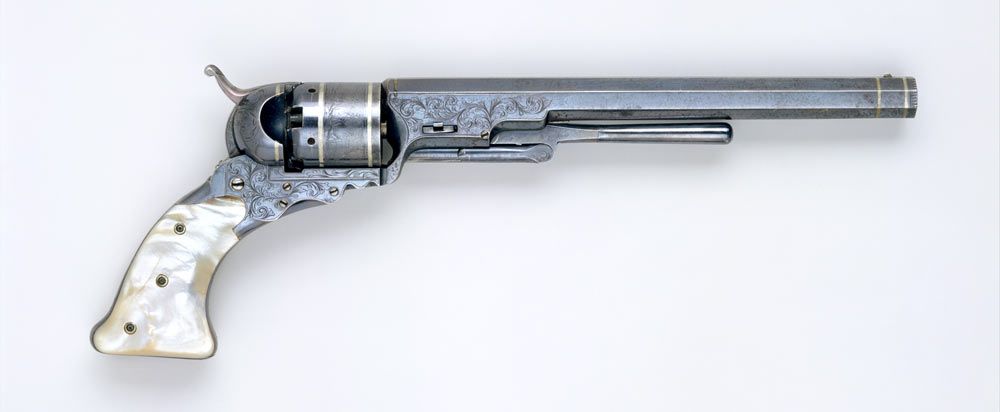
The Colt Paterson revolver became the iconic handgun favored by Texas Rangers. (Photo: Wikimedia Commons)
Samuel Colt’s first commercially offered revolver, made in Paterson, N.J., could fire five .36-caliber balls as fast as the shooter could cock the hammer and pull the trigger. Colt sold a few to the U.S. Army, but it was the Texas Navy that adopted the pistol enthusiastically. When it disbanded in 1843, the Navy’s Colt revolvers were issued to the Texas Rangers, who found them to be ideal firearms for fighting Comanches. Skilled horseman and archers, the Comanches had enjoyed the advantage in mounted, running fights until they faced Rangers armed with two revolvers apiece.
6. Spencer Repeating Rifle
The Spencer was a reliable gun for the Union during the Civil War and could fire 15 rounds a minute.
The first repeating rifle used in combat, the Spencer held seven rounds of .56-56 rimfire ammunition in a tubular magazine in its stock. It could have been a war-winner for the Union had the conservative War Department adopted it on a wider scale, but they feared the Spencer’s appetite for ammunition would stress supply trains. A reliable, rugged gun, the Spencer could shoot 15 rounds a minute. The Federal government did buy about 100,000 Spencers, and their firepower gave Union soldiers—the cavalry, mostly—a decisive edge in several engagements.
7. Gatling Gun
The Gatling gun fired rounds at a rate of 350 to 400 per minute.
Dr. Richard Gatling conceived of his gun as a labor-saving device not unlike his seed drill, which allowed one person to do the work of many. He hoped his invention would reduce the size of armies, cutting down on deaths from combat and disease. The hand-cranked Gatling gun had four to 10 barrels and fired bullets in calibers from .45 to 1 inch at a rate of 350 to 400 rounds per minute and presaged true automatic guns like the Maxim gun, which debuted in 1884. Gatling guns played an important role at San Juan Hill, and Gatling’s multi-barrel concept lives on today in the form of electric-powered mini-guns.
8. Quick-Firing 6-Pounder Hotchkiss
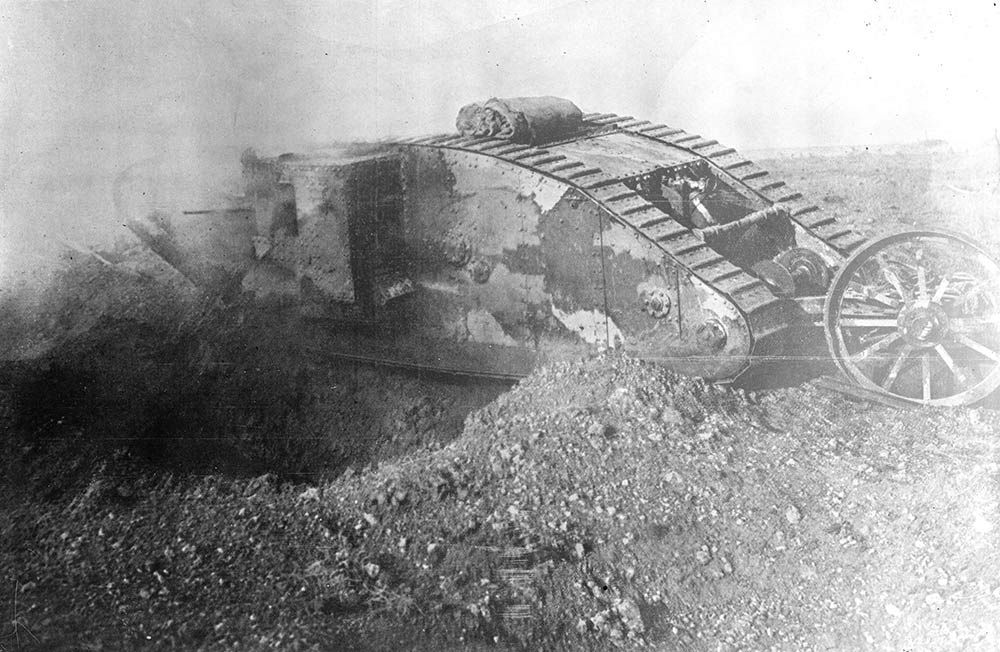
British Mark 1 tanks were equipped with two 6-pounders. (Photo: Wikimedia Commons)
Developed in 1885 to defend ships from torpedo boats, the 6-pounder makes this list because it was the first tank cannon. British Mark 1 “male” tanks—a.k.a. “land ships”—mounted two 6-pounders in sponsons that allowed them to fire forward or to the sides. The 57mm Hotchkiss 6-pounder fired at a rate of 25 rounds per minute and could be loaded with solid, shrapnel, or explosive shells. Armed with Hotchkiss guns and machine guns, the first tanks allowed soldiers to move across no man’s land. The long barrel of the naval version proved unwieldy in combat, and future tanks mounted a shorter-barreled version.
9. SMLE (Short Magazine Lee Enfield)
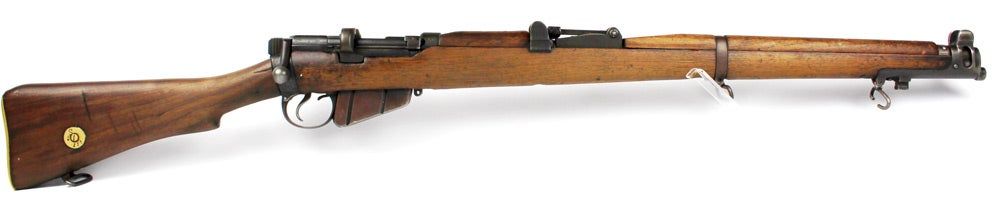
The revolutionary SMLE was Britain’s main battle rifle from 1895 to 1957. (Photo: Wikimedia Commons)
At the end of the 19th century, armies adopted smokeless powder and smaller, higher-velocity ammunition. Although it wasn’t the first bolt action for smokeless powder (that was the French Lebel), the Short Magazine Lee-Enfield may have been the greatest. Its magazine held 10 .303 cartridges. A very slick bolt action that enabled trained troops to fire 20 or more aimed shots per minute working the bolt with thumb and forefinger and firing with the middle finger. It served as Great Britain’s main battle rifle from 1895 to 1957.
10. Colt 1911
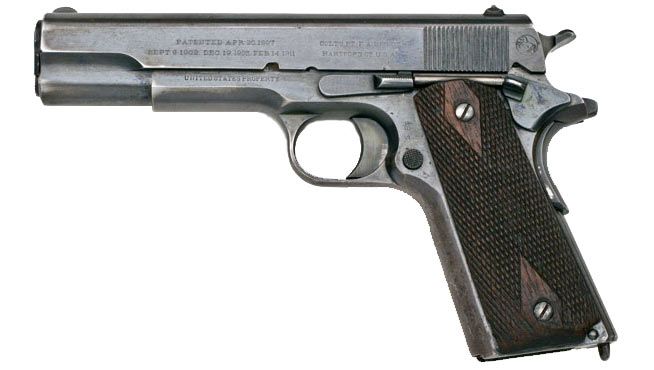
The Colt 1911—an American Icon—is the most successful pistol design ever. (Photo: Wikimedia Commons)
The US Army began its search for a semiauto pistol around 1900. Hard lessons of the Moro Rebellion in the Philippines dictated a big bore for stopping power. The Army subjected several guns—including a .45-caliber Luger—to an arduous torture test. John Browning’s entry emerged as the winner. Designated the Model 1911, it’s the most successful pistol design ever. Ergonomic, hard-hitting, and reliable, the 1911 served from WWI through Vietnam as the US service pistol, and it remains in use today among special operations groups.
11. Browning M2 Machine Gun
Soldiers train with the Browning M2 in Fort Hood, Texas.
The Browning M2 debuted in 1933 as the final answer to the need for a large-caliber machine gun. The air-cooled, belt-fed M2, known as “Ma Deuce,” has proven to be so versatile and successful, it is still in use today. Firing .50-caliber cartridges that are deadly to over a mile, the M2 has been used as an anti-personnel, anti-vehicle, and anti-air gun—in addition to serving as the main armament for aircraft. Scope-mounted versions were even used as sniper rifles in the Korean War and in Vietnam, most notably by Marine sniper Carlos Hathcock, anticipating true .50-caliber sniper rifles like the Barrett and MacMillan TAC 50.
12. Flamethrower
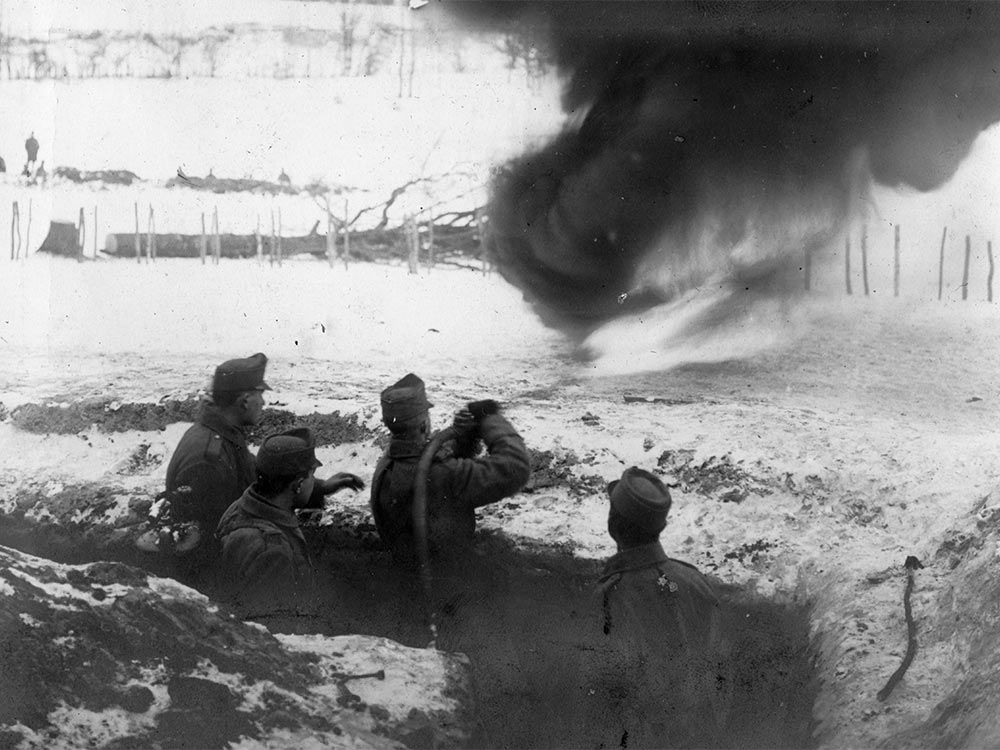
The flamethrower first appeared on the battlefield during WWI, spitting flames 20 to 40 yards. (Photo: Wikimedia Commons)
A different kind of _fire_arm, the modern flamethrower debuted in World War I in the hands German troops. One tank on the user’s back held fuel, the other, compressed air that could project a flaming stream 20 to 40 yards. Allies quickly developed flamethrowers of their own, and both sides often picked former firefighters to operate them. Besides its psychological effect, the flamethrower proved invaluable for clearing fortifications, especially during the U.S. Pacific campaigns in WWII. Flamethrower operators were conspicuous on the battlefield and often targeted—so much so that, during WWII, the Russians issued flamethrowers with tanks disguised as knapsacks and wands made to resemble the Mosin-Nagant rifle.
13. M1 Garand
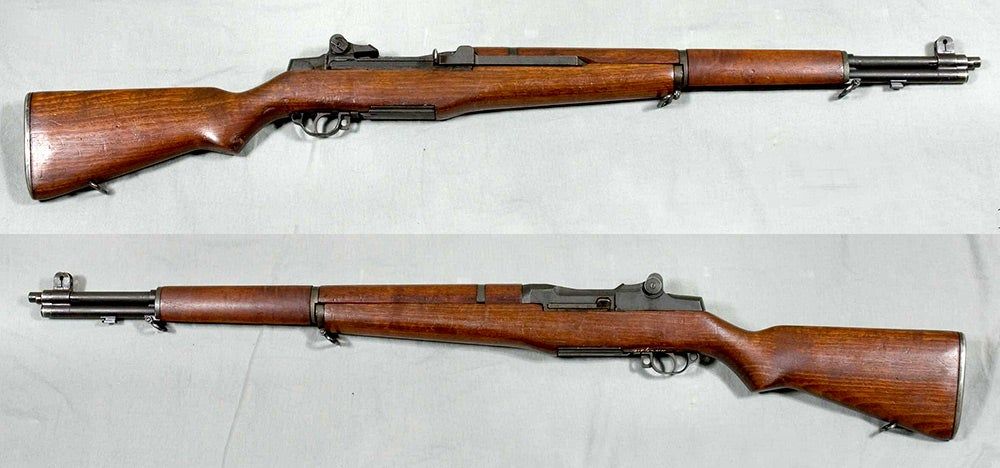
Gen. George Patton considered the M1 Garand to be the greatest battlefield rifle ever made. (Photo: Wikimedia Commons)
The first semiautomatic rifle, the M1 Garand was as the U.S. service rifle from 1936 to 1959. Chambered for the powerful .30/06 cartridge, the M1 held eight rounds. Ammunition was loaded by means of “en bloc” stripper clips. The M1 gave U.S. soldiers and Marines a firepower advantage in the field against the bolt-action rifles of their opponents and spurred the development of semiautomatic rifles. Nearly 5.5 million were made during World War II, and George Patton famously called it “the greatest battle implement ever devised.”
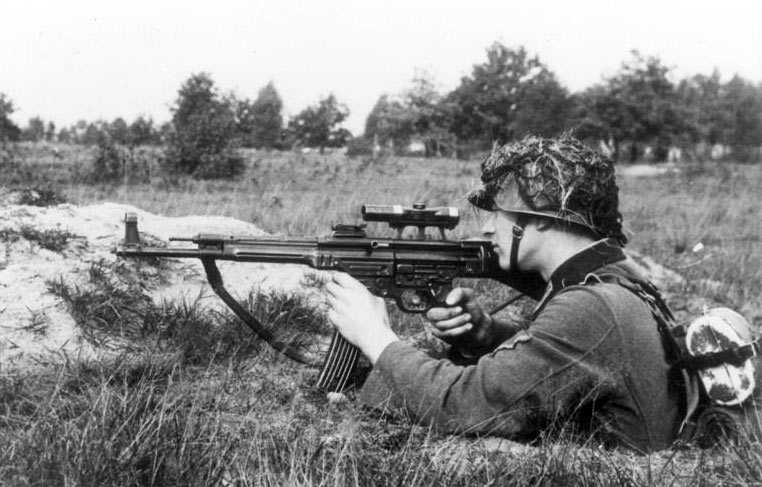
14. German STG 44
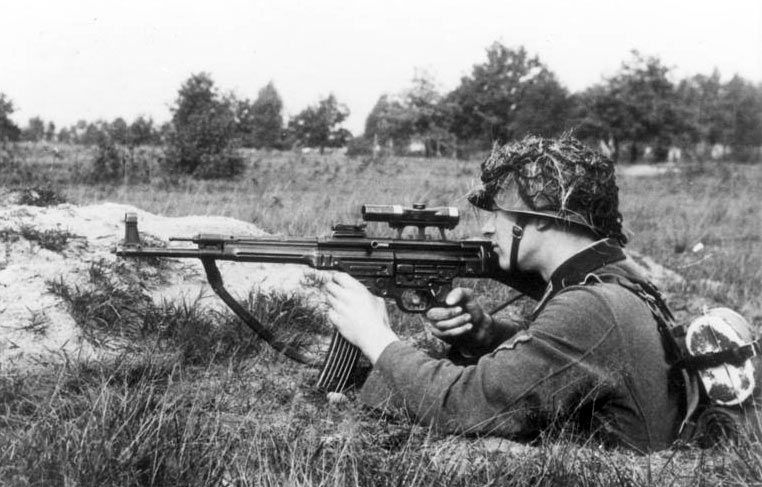
Known as the “storm rifle,” the STG 44 was effective out to 400 yards.
Known as the “storm rifle,” the STG 44 was effective out to 400 yards. (Photo: Wikimedia Commons)
The STG 44 combined the select fire-auto and semiauto capability of a submachine gun with a 7.92×33 cartridge that was effective out to 400 yards. Known as “sturmgewehr” (“storm rifle”), it created the class of infantry firearm now known as the “assault rifle.” Almost 500,000 of the gas-operated STG 44s were made, and they appeared on the battlefield in 1943. They gave German soldiers a range advantage over the Soviets, who often armed entire platoons or even companies with short-range submachine guns. Most served on the eastern front where they were quite effective. On a visit to the Eastern Front, Hitler is said to have asked a general what he needed, and received the reply: “More of these new rifles.”
15. AK 47
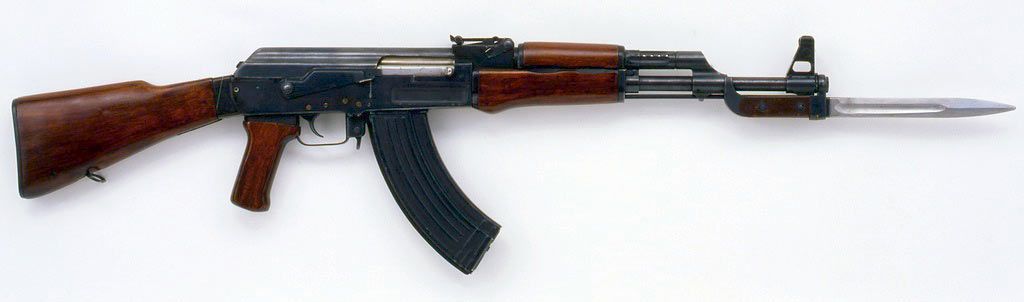
With more than 75 million made, the AK 47 is the most popular small arm in history. (Photo: Wikimedia Commons)
Soviet tank crewman Mikhail Kalashnikov began his career as a weapon designer in 1941, while he recuperated from wounds suffered in battle. Drawing upon the designs of both the M1 and the STG 44, Kalashnikov invented an assault rifle in 1947. Kalashnikov made his rifle simple and rugged, with loose tolerances wherever possible, and designed to function in dirty environments. The AK 47 has proven reliable in any conditions the world over, and it is the most popular small arm in history, with 75 million made.
16. M16
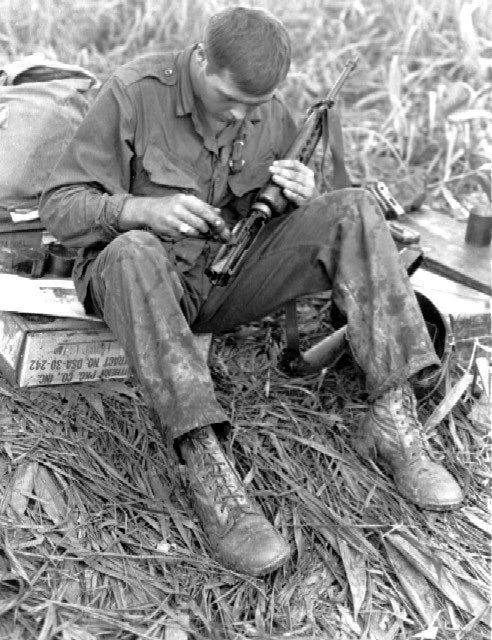
A U.S. solider cleans his M16 during the Vietnam War. (Photo: Wikimedia Commons)
Developed to replace the .308 caliber M14, the gas-operated, select-fire M16 had a composite stock and space-age lines that made it look like no other rifle of its time. It made revolutionary, controversial use of a small-caliber, high-velocity .223 cartridge as well. Issued to troops in Vietnam beginning in 1965, the M16 suffered malfunctions in the field due to a change in gunpowder for its ammunition, and the mistaken belief that it didn’t require much cleaning. Once over its early growing pains, the M16, and its carbine variant, the M4, went on to become the longest-lived service rifle in American history.
17. M256 Smoothbore Gun
The cannon on the M1 Abrams tank can hit targets over 2 miles away.
In order to hit what they’re shooting at, tanks have always had to stop so the gunner could aim. No longer. The M1 Abrams’ M256 smoothbore 120 mm cannon can destroy targets over 2 miles away while the tank and its targets are on the move, as it has proven in both Gulf wars. The M256 has a sophisticated fire-control system that accounts for factors, such as crosswind, barrel heat, rotation of the earth, and more, and updates new fire-control solutions 30 times a second, resulting in tremendous accuracy. The M256 fires a range of munitions from armor-piercing depleted uranium rods to high-explosive and close-range canister rounds.
The 3 Worst Guns Flops Ever
For every deadly advance in battlefield technology, there have been missteps, too. Here are three guns widely considered to be among the worst small arms used in combat.
1. Chauchaut Machine Gun
On paper, the French Chauchaut machine gun was a great, even revolutionary, idea: at 20 pounds, it could be carried and even fired on the move by a single gunner advancing with the infantry, or used defensively with a bipod to aid in accurate shooting. Unfortunately, WWI was fought in mud, not paper.
The Chauchaut’s 20 round magazine, open on one side so the gunner could see how many rounds it contained, admitted all kinds of dirt and debris that made an already poorly-made gun jam even more frequently. Chambered in 8mm Lebel for the French army, the Chauchaut was also made in .30-06 for Americans.
2. Type 94 Nambu Pistol
Intended as a compact sidearm for Japanese aircrews and tankers, the Type 94 was chambered for the comparatively weak 8mm Nambu cartridge, which was only the beginning of the gun’s shortcomings. Its fragile firing pin broke easily, it was difficult to take apart, and easy to damage when you did. What made the Type 94 truly horrible, however, was an exposed sear bar on the left side of the frame. Give it a good bump and the gun went off, even with your finger nowhere near the trigger.
3. Nock Volley Gun
Made for the British Royal Navy during the Napoleonic Wars, the seven-barreled Nock gun was made to be fired from the fighting tops of a warship’s masts, from whence it could rain a volley of .46 caliber balls onto French boarding parties. Unfortunately, the recoil of seven shots at once dislocated shooter’s shoulders and even broke clavicles. It was the ultimate “you should see the other guy” weapon. Sailors and Marines feared the recoil of the Nock gun, while officers feared the massive muzzle blast that could set rigging afire. A second, smaller model proved insufficiently less scary, and the gun was abandoned.

All new! 1871 Club Field Trips