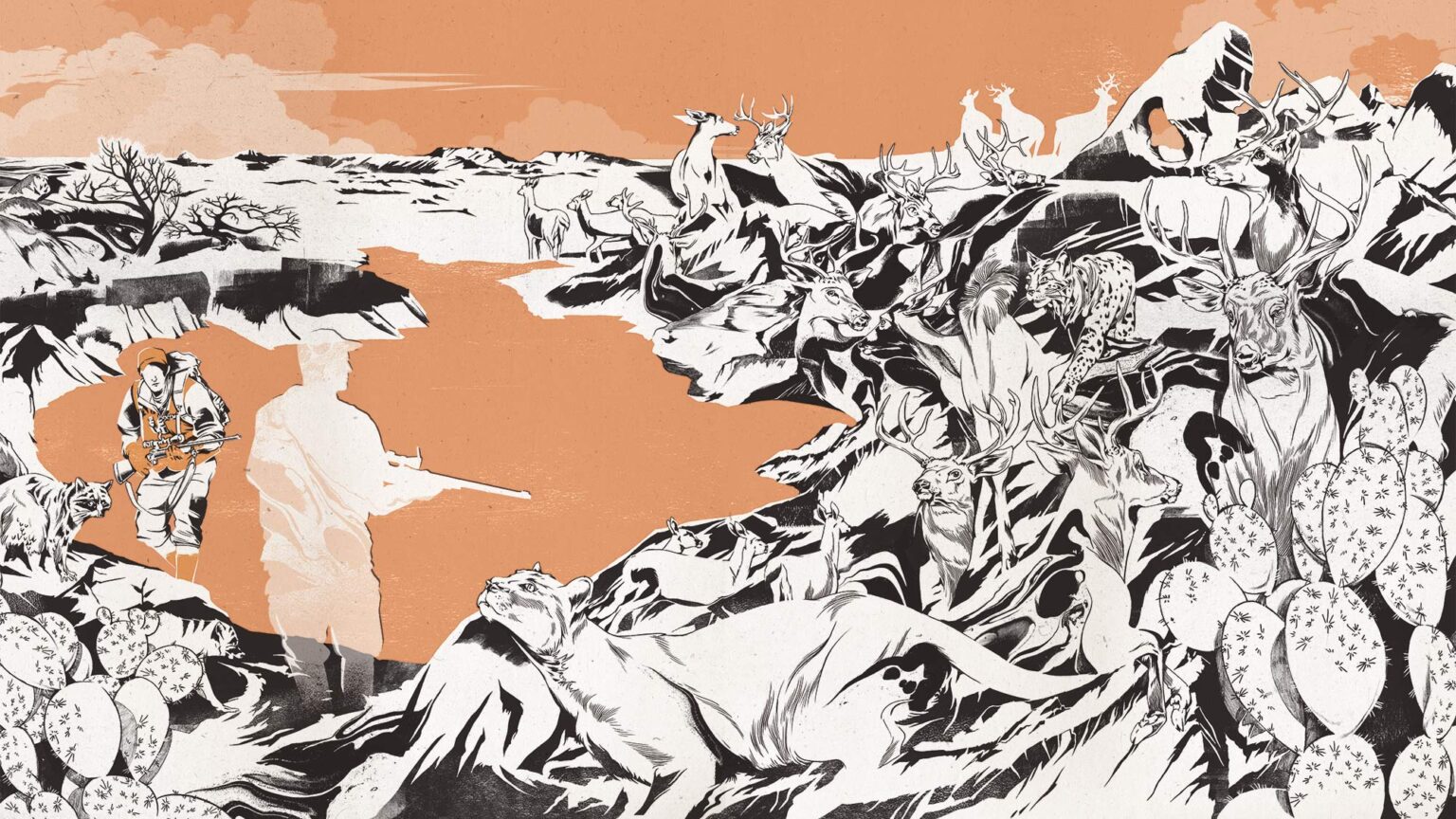
IT’S TOO CLOSE to the bone. This is not the way it’s supposed to go. Always before, our hunters have left quietly, in perfect chronology, as orderly as children filing out to playground recess, one at a time, each successive oldest passing through that door—as if leaving the camp house to go look around for something; one more hunt and then not coming back. Stepping through that door, and into the landscape of our memory. Old Howard—not blood related, but the man who owned and leased to us the deer pasture, stepping out quietly, in his late 80s. And then Old Granddaddy, a while later, in his late 80s. When it was his time.
The next two oldest, Uncle Jim and my dad, Charlie, began showing hints of mortality in their 70s—Uncle Jimmy, with a stroke, and Dad, with bladder and then prostate cancer 10 years ago, but both battling those things back, recovering, and still hunting, hunting on, and still with us.
My oldest cousin wasn’t supposed to step to the head of the line. He wasn’t supposed to cut in front of anyone. The oldest son of Uncle Jimmy, as I am Charlie’s oldest, he—his name was also Rick—and I were supposed to become the Old Ones someday. That was the model that had been presented to us. That was what we knew.
Rick was already in his 60s, but in my mind he is still a handsome, reckless teenager, burning with life; he is still young and daring, charismatic, and troubled. Did I say reckless? In my mind, he and I are both still young and vital, undiminished and uncompromised.
LIKE IT IS for all of us who have been gathering here once a year to hunt for a week—uncles, cousins, brothers, grandfather, nephews—the deer pasture is, was, Rick’s church. He was religious—he differed from me there—and was a minister, but he had this other church, too, as do we all. We’re old enough now that we have children who wander it, who hunt it that same week each year: the first of November. There are more bunk beds in the camp house now, more hunters, but no matter. The juniper of the thousand acres, for the most part, hides us, as it hides the deer.
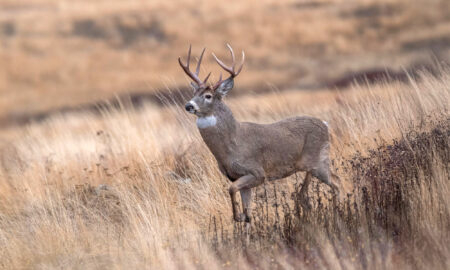
But we see things, if not always each other, as we walk along the stony-bottomed creeks and pass between the rounded boulders and sit quietly beneath the oaks, hiding in a nest, a rampart, of broken limbs, remnants of where the old trees’ branches broke off, burdened by their own sweeping weight, their own excessive reach. We sit beneath such trees, motionless, hidden from the world in our camouflage, and watch raccoons trundle past, bobcats, armadillos, turkeys, and always deer.
This hill country hardscrabble was our heaven, the place where, when we were away from it, we were always working our way back to.
I grew up with him—I knew him for all of my 57 years—and I hunted with him 35 of those years, one week each year without fail. Thirty-five weeks, day and night, cleaning whitetails, cooking, doing the dishes, telling stories, fixing broken trucks and broken water pumps, nailing tin back on the roof after thunderstorms, listening to LSU and University of Texas football games, to Dallas Cowboys and Houston Oilers games. Thirty-five weeks—shy of a full year—of deer hunting with him, though always at the same time of year so that in some ways it would, and did, seem as if time remained frozen, until it wasn’t, and didn’t.
By all rights, we should have had a full year together.
AS RICK GREW OLDER, he slept later and later. Finding a whitetail deer became less of a concern to him. He talked a big game—pretended to be always on the lookout for “Ol’ Mossy Horns”—but as the years went on, he loved that bed. We’d have a campfire in the evenings, with the flat-topped silhouette of Hudson Mountain to the east, and watch the stars—always, shooting stars in that country. One night, long ago, one passed so close to us that we heard its ripping crackle, smelled its scorch—an amazement. Then, one by one, we’d drift back into the bunkhouse, lie down on our beds, and read. He’d fall asleep with the book on his chest and, later, begin snoring. For that reason, it was always a race to see who could be the first to get to sleep. Rick didn’t do anything halfway.
HE’D HAD TRAGEDY in his life. A car wreck in which his wife was killed. Another accident in which a jacked-up truck he was working on fell on his hand, crushing it. He was a doctor and surgeon, and couldn’t practice after that, but volunteered abroad for weeks each year. Another year or more of his life, I suppose, in the cumulative, spent doing that.
But about the deer hunting: As young men—boys, really—this Hill Country hardscrabble was to us a wild garden, a land of rattlesnakes, cactus, wild pigs, and giant granite boulders shaped by time into fantastic hoodoo forms: a clenched fist, an Easter Island visage, a rhinoceros, a hippo. We hiked up and down the water-smoothed slot canyons, swam in the deepest pools beneath sparkling waterfalls. From the first day, it was our heaven, the place where, when we were away from it, we were always working our way back to.
RICK WAS A MAN of enormous passions and appetites, which can be, of course, a precursor, a way of segueing into the fact that at different times of his life he had problems with the bottle. Actually, I guess it was always a struggle, and he was either winning, or losing. The last years of his life he was winning, and I’m glad for that.
I’m grateful I have no such challenges, grateful I don’t have to waste days, then years, owned by such a disease, and can instead—through the fluke of luck—sit quietly in the junipers and in the oak creeks, and listen to, and watch, the trickling, gurgling plates of gold water swirl past, fractals of gleaming water spinning; disassembling, reassembling. This last year—the last year we had him—I was sitting in the deep shade, the abiding shade, on a wicked hot day (gone, it seems, are the crisp November hunts of my youth), and as I watched, a male wood duck came drifting down that lane of gold light, his plumage wildly flamboyant, charismatic, outrageous; and yet, he, too, was seeking shade.
Jörn Kaspuhl
I DO NOT look forward to the gap of him this year. Those hoary clichés that we try to stand on, like a foundation, at such times: He will be missed. It won’t be the same without him.
No, it won’t.
HERE ARE PLACES we can go to find him, now that he has gone to where the others have gone on ahead.
The Water Gap. There’s a tradition, each night before—especially the first night before—in which we think and talk about where we each want to go the next morning. Rick loved the East Side, the Back Side, and the Burned-Off Hill. But always the Water Gap—a narrow cleft, a deep dark place, spooky, yet so beautiful; spookiest and most beautiful right at dusk, with darkness coming in over darkness. The arching limbs of hickory trees forming a canopy over the canyon, both sides of the hollow so steep that it is hard to stand up straight, easy to tumble and roll to the bottom. A good place to sit quietly and watch, and wait. Of course he loved it, and we knew on the nights that he got back into camp a little late that that was where he had been hunting, sitting there in the gathering gloom, waiting all the way until last light before coming the long way home. Like I said, as he grew older, he always slept late. It makes no sense that for once, he should be the first among us—among the cousins and brothers—to head out. It’s so atypical. It’s so surprising. I forget sometimes that’s why it’s called life.
THE HOW DOES and does not matter. He was on a motorcycle. “You’re too old,” I wanted to tell him, and to be honest, with some anger, or at least irritation. But it must also be said it wasn’t his fault. But it is also true people don’t see motorcycles unless they are looking for them. The last time I saw him was at my youngest brother’s wedding in Austin, at the first edge of spring. So it goes.
HE ALWAYS CAME into hunting camp with stories. Sometimes, being dramatic, I think he embellished the facts. Put ornate curlicues on them and elaborate punctuations. So much so that on the rare occasion—or I assume it was rare—he came back in with one incredible story or another, one which was unadorned, and we didn’t believe it, he would be surprised, frustrated. “No, really,” he would say. “God’s honest truth!”
Such was the story of his sighting of a mountain lion one morning, over on the East Side. When he described with admirable specificity its tawny gold color and long tail floating behind it, we razzed him that he had just seen an extraordinarily large fox squirrel, one with an exceptionally bushy tail.
I for one always believed him, though I never gave him the pleasure of acknowledging that—how I wish I had, now—and I even went so far as to make lion tracks with my fist in a sand creek, to spur the rumor and get him agitated.
“See, I told you!” he said, coming back into camp, wanting to show us all the tracks he’d found.
For 20 years, Rick continued to insist the sighting was legit, telling all of us each year to be careful, that there were lions out there.
I believe he saw the lion, and that it must have been an amazing thing. A thing that scared him and filled him with the awe of the world’s beauty, the way that something surprising, something wonderful, can happen in any next-step. And that he carried that with him, the way we all carry certain things—gains and losses, regrets and hopes—with us, all of the days, across all terrains.
OH YES, another thing: He was a father.
He had been a husband, at different times, and tried his best; a son, brother, cousin, nephew, grandson, ditto—but he was a father. The most important thing. I know for a fact that on his rambles through this land of granite, that that was what he was proudest of: being a father. He was always talking about his children, updating us with their doings—four daughters and a son.
I know for a fact that in his quiet times he would be looking around at the beauty of the place, and would be considering not his travails and stresses, his troubles and challenges, but his blessings: that here, if only here, all worries became diminished, put in their proper, tiny, mortal perspective.
Sometimes, whitetail deer would walk right past him, while he was thinking such things.
We all, always, want one more day; and if given that extra day, what would we do with it? Not, I think, go hunting; not, I think, focus on the killing of one more whitetail.
Which is precisely what makes those days—uncounted, and timeless—so valuable. Who knows when the last hunt is? Rarely does anyone know.
Whether this is a blessing or not, I cannot say: only that we were in no way ready for him to leave without coming back, and that we will be talking about him, telling stories about him, for a long time yet to come, as he told stories about those, the Old Ones, who had been here before us. He has become one of them, already. Already, so soon.

All new! 1871 Club Field Trips