
We may earn revenue from the products available on this page and participate in affiliate programs. Learn more
If bismuth and tungsten have been the recent trends in non-toxic pellet materials, steel and copper may be the pellets of the future. Some of that steel may be loaded with a bit of TSS, but we have to face the fact that bismuth and tungsten prices are rising out of control, and that China contains 80 to 90 percent of the world’s supply of both metals. Tungsten and bismuth have applications far beyond making pellets to shoot ducks and geese with, and global demand is up. That leaves us with steel and, potentially, corrosion-inhibited copper.
Copper shot is one of the most exciting new developments. Boss was the first to offer corrosion-inhibited copper shot to the US market. Denser than steel, it delivers more energy than steel shot, though not as much as bismuth. It is harder than bismuth, but soft enough to be safe in older guns. At around $2 per shell, it’s not cheap, but premium steel is expensive, too.
Speaking of steel, mixed loads—some are stacked, some are not—continue to set the trend in non-toxic ammo. It’s getting hard to find shells with a single shot size. Stacked loads of two different sizes of steel are a gimmick. Stacked loads of two different sizes of steel work. Both can be true at the same time, and they are.
The shells I patterned this year, most of which were of mixed shot size, patterned very efficiently, and they seemed to place a good mix of big and small shot in the right parts of the pattern. Mixed loads of premium pellets and steel remain a trend, and I am becoming a believer. Here’s a closer look at all of the best duck loads available today.
- Best Overall: Winchester Last Call Double Shot
- Best Budget: Remington Duck Club Steel
- Boss Copper 3/5
- Rob Roberts Raptor
- Apex Stratified S3 Steel
- Boss Warchief CuProx
- Federal Ultra Steel Double Stack
- Winchester Final Pass
- HeviShot HeviHitter
- Apex Shadowgrass Blend
Best Overall: Winchester Last Call Double Shot
best premium
Winchester Last Call Double Shot
Specs
- Gauges: 3-inch 12-gauge,3-inch 20-gauge
- Material: Steel and TSS
- Payloads: 1 1/4-ounce (3-inch 12-gauge), 1-ounce (3-inch 20-gauge)
- Velocity: 1425 fps (12-gauge), 1350 fps (20-gauge)
- Shot Sizes: BB steel/7TSS, 2 ½-steel/8TSS (12-gauge) 2 ½ steel/9TSS (12- and 20-gauge)
- Load Tested: 3-inch 12-gauge 2 1/2×9

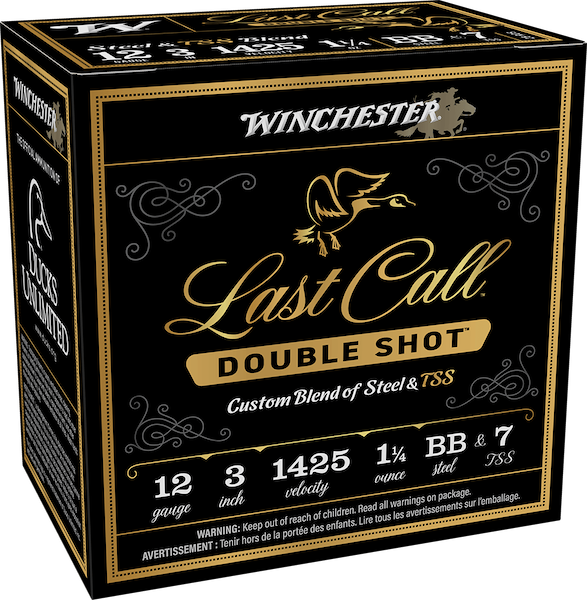
Last Call is Winchester’s pricey all-TSS load. Last Call Double Shot combines steel with a pinch of TSS to fill out patterns. Packed in 25-round boxes, the shells are stamped in gold with the Last Call logo. They have the sealed wad and primers that have made Winchester shells waterproof for years. Inside, I found bright, shiny, round 2 ½ steel pellets mixed with TSS 9s. Counting out the shot in the 1 ¼ ounce load, I got 199 total pellets, 56 of which were TSS. That totaled only about .16-ounce of TSS pellets.
However, despite what seemed like a stingy serving of TSS, these shells really shot. At 40 yards with the RR 3, they delivered 84 percent patterns, with 85 percent of the TSS pellets finding the 30-inch circle. That translates to about 165 pellets on target, all of them hitting with roughly steel 2 ½ energy. That is way more pattern density than you need for any duck, and since I believe the best use of stacked loads is in medium range, you could open your choke to IC or Light Modified and still have an unescapable pattern for ducks that dropped into your decoy spread. I brought some of the BBx7 on an early-season hunt, thinking I’d use them after the ducks stopped flying while I waited for a goose. Instead, I got some shots at late-arriving ducks and poleaxed them with this ammo, without tearing them up. By the time I got through the two boxes of BBx7s Winchester sent me, Last Call Double Shot was my new favorite ducks-and-geese-over-decoys load.
Best Budget: Remington Duck Club Steel
best budget
Remington Duck Club Steel
Specs
- Gauges: 3 1/2-inch, 3-inch and 2 ¾-inch 12-gauge, 3-inch 20-gauge and 3 ½-inch 12 gauge
- Material: Steel
- Payloads: 1 3/8 ounces (3 ½-inch 12-gauge), 1 1/4 ounces (3-inch 12-gauge), 1 1/8 ounces (2 ¾-inch 12-gauge), 1 ounce (3-inch 20-gauge)
- Velocity: 1500 fps (3 ½-inch 12-gauge), 1400 fps (3-inch 12-gauge), 1375 fps (2 ¾-inch 12-gauge), 1300 fps (3-inch 20-gauge)
- Shot Sizes: BB, 2,3,4 (3½-inch and 3-inch 12-gauge) 3,4 shot (2 ¾-inch 12-gauge, 3-inch 20-gauge)
- Load Tested: 3-inch 12-gauge 2
I was in a café in Stuttgart, Arkansas, years ago, after a timber hunt with the CEO of a company that made premium non-toxic shot. He was going on about how the high price of his ammo was just a small part of any duck hunter’s budget, and how most people don’t shoot many shells in a season anyway, so the difference in overall cost was negligible. He then made the mistake of turning to our guide and asking, “How many shells do you shoot in a season?”Kenny figured in his head for a moment, then said, “About seven cases.” If that’s you, then Duck Club Steel is worth a look.
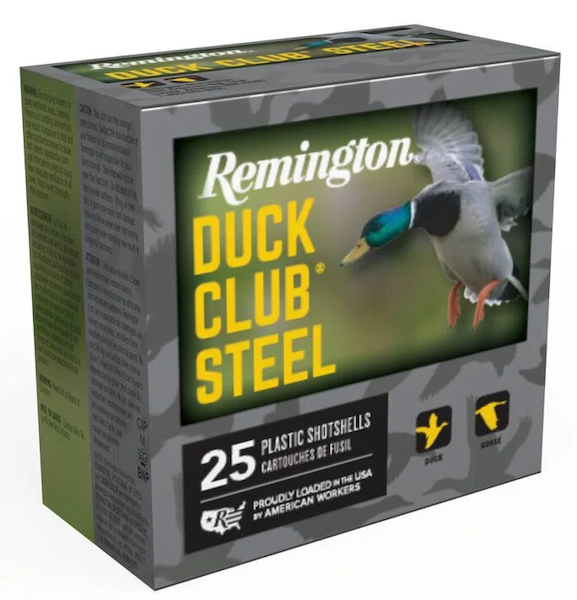
Duck Club Steel is Remington’s affordable steel shell, replacing the now-discontinued Sportsman Steel in the lineup. It’s also been updated with new powders and primers. Duck Club comes in all sizes of 12-gauge, plus in 3-inch 20-gauge. The 12-gauge hulls are black, the 20s are yellow, and if you’re looking for frills, you’ve picked the wrong box of shotgun shells. The stamping on my sample 12-gauge hulls was faint right out of the box. The primers were sealed, though. And, while unplated and plain, the steel 2 shot in my sample shells was round and uniformly sized.
The 3-inch 12-gauge loads have a muzzle velocity of 1400 fps, which is fast enough without producing the undue recoil of a higher-velocity load. Patterns through my IM/RR 3 choke averaged 70 percent at 40 yards. This is not earthshaking pattern performance, but it’s not underperforming, either. If I burned through shells by the case and wanted to keep ammo cost under control, I would shoot these with total confidence.
Boss Copper 3/5
most innovative
Boss Copper 3/5
Specs
- Gauges: 3-inch 12-gauge, 16-gauge, 3-inch 20-gauge, 2 ¾-inch 28-gauge, 3-inch .410
- Material: Corrosion-inhibited copper
- Payloads: 1 1/2-ounce (3-inch 12-gauge), 1 1/4-ounce (2 ¾-inch 12-gauge), 1 1/8-ounce (16-gauge) 1 1/8-ounce (3-inch 20-gauge), 7/8-ounce ( 2 ¾-inch 28-gauge), ½-ounce (3-inch .410)
- Velocity: 1350 fps (12-, 16-, 20-, and 28-gauges), 1325 fps (.410 bore)
- Shot Sizes: 3, 5, or 3/5 blend (12- and 20-gauge), 3/5 or 5 (16-, 28-gaug,e and .410)
- Load Tested: 3-inch 12-gauge 1 ½ ounce 3/5
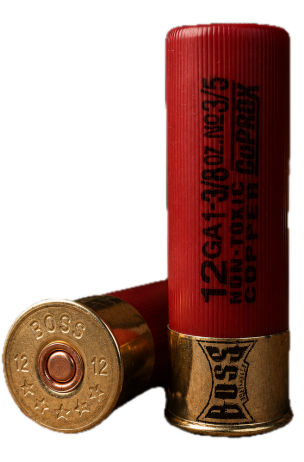
Boss, having made its name with bismuth shotshells, pivoted to copper as the price of raw bismuth rose out of sight. The pellets are corrosion-inhibited copper, which the USFWS lists as non-toxic. “Corrosion-inhibited” refers to fluorescent powder coatings detectable by ultraviolet light. At 8.9 grams per cubic centimeter, copper is denser than steel (7.8 g/cc) and not quite as dense as bismuth (9.6 g/cc). Copper has a relatively low Brinell hardness number of 35 (bismuth is 18, steel is 136), making it safe for older gun barrels. The pellets are hard enough to remain round and resist deformation in the barrel, unlike bismuth, which needs a buffer to perform at its best. European makers have offered copper pellets for a few years now, and Winchester experimented with them years ago. Boss is the first to offer it to the US market. Like all Boss ammo, it is only available directly from Boss.
My test loads consisted of 1 ½-ounce 3/5 blended pellets loaded into a 3-inch hull. The pellets were round but had some manufacturing marks. The one-piece wad is plastic treated to degrade in the environment. Patterns at 40 yards through the RR 3 choke ran around 65 percent, which is Improved-Modified performance, although well below what this choke usually delivers with steel. But 1 ½ ounces of 3/5s still gave me 150-160 hits in a 30-inch circle, which is more than enough pattern density for any duck.
I’m guessing you can shoot one size smaller than steel and expect similar results, so anything you can do with a steel 2—which is a lot—you should be able to do with a Boss copper 3. And, based on the patterns I shot, you don’t need an entire ounce-and-a-half, so these should make viable smallbore pellets, too. Personally, I am looking forward to trying these in the 3-inch Model 12 I never get around to shooting during the season.
Rob Roberts Raptor
Specs
- Gauges: 3-inch 12-gauge, 3-inch 20-gauge
- Material: Steel
- Payloads: 1 3/8 ounces (12-gauge), 1 ounce (20-gauge)
- Velocity: 1400 fps
- Shot sizes: 2,3,4
- Load tested: 3-inch 12-gauge 3
- Price: $32.99 per 25
As a believer in payload over speed, I was rooting for the Rob Roberts Raptor ammo to perform well, and it didn’t let me down. Roberts, well known as a shotgun doctor and chokemaker, collaborated with Federal on a load made to shoot through his Raptor choke series. The shells trade an extra 1/8 of shot for 50 fps less velocity and come in a bright green hull with a silver steel head. The shot is uniformly shiny, round, zinc-plated steel loaded inside a one-piece plastic shotcup.
Generally speaking, lowering velocity tightens patterns. I shot these through a Rob Roberts RR3 choke, since I had one on hand. The patterns were about 68 percent, which falls within expected IM performance, and I was struck by their uniformity and distribution on paper. There was a good concentration of pellets in the 20-inch core and enough spread throughout the outer 20-30 inch ring of the circle to add some margin for error. It only confirmed what I learned about these shells when I shot them in Saskatchewan last fall: they work very well. For what it’s worth, we were not shooting Raptor chokes on that hunt, and the shells were plenty deadly. This year Federal also added 3-inch, 1-ounce 20-gauge loads to the Raptor line.
Apex Stratified S3 Steel
Specs
- Gauges: 3-inch 12-gauge, 3-inch 20-gauge
- Material: Steel
- Payloads: 1 1/4 ounces (12-gauge), 1 ounce (20-gauge)
- Velocity: 1450 fps (12-gauge), 1300 fps (20-gauge)
- Shot sizes: BB/2 (12-gauge only) 2/4
- Load tested: 3-inch 20-gauge 2/4
- Price: $26.99 per 25
Apex, the original TSS-loader, has branched out into steel and even into some lead dove loads. The S3 stratified steel waterfowl line consists of two 3-inch 12-gauge loads and one 3-inch 20-gauge shell. Since 20s are the thing right now, I tried the 20-gauge load. The shells have yellow hulls, as 20-gauge shells should, with silver stamping on them of the Apex logo and the word “Stratified.” Since the 20s come in only one shot-size combination, there are no printed shot-size numbers to wear off.
The pellets in my test shells were stacked with the large size on top. The 2 shot were shiny silver; the 4 shot were a dull, dark matte color. I shot them through my Caesar Guerini Woodlander with a factory flush IM choke. Patterns averaged a very good 75 percent, which, with these loads, meant a little over 90 hits in the 30-inch circle at 40 yards, split evenly in number between 2s and 4s. Given that half the pellet strikes at 40 were from 4 shot, which is running out of steam at the distance, I’d call this an excellent load for 30 yards if you want to shoot a 20. It would make a great choice for wood ducks, and I wouldn’t be afraid to shoot teal with it, either, as I like bigger pellets. This is a fine load for all closer-range waterfowling. It would even drop a goose in a pinch if some honkers visited your decoy spread and you waited until you saw the whites of their eyes.
Boss Warchief CuProx
Specs
- Gauges: 3-inch 12-gauge, 3-inch 20-gauge
- Material: Corrosion-inhibited copper
- Payloads: 1 1/4 ounces (12-gauge), 1 ounce (20-gauge)
- Velocity: 1475 fps (12-gauge), 1500 fps (20-gauge)
- Shot sizes: 20-gauge 5 shot
- Load tested: 3-inch 20-gauge 5 shot
- Price: $40 per 20, $355 for 200 (20-gauge)
War Chief, the Boss “improved ballistics” brand, now comes in the new CuProx copper shot. War Chief bismuth achieved tighter patterns by adding buffer materials. War Chief CuProx achieves its ballistic edge through a rougher surface, which results from less polishing. Boss contends that the rough surface acts like dimples on a golf ball, helping it fly straighter and farther.
Boss ammo comes 20 to the box. The War Chief box has a cool distressed copper finish that, unfortunately, makes the fine print on the box nearly impossible to read without bright light. It points out several features of the ammo, including a biodegradable wad with a cushioned section that collapses to cushion both your shoulder and the pellets under setback. The copper pellets, it notes, are mined and made in the United States, which, we can only hope, makes their price more stable than shells that rely on imported materials. The shells themselves have the War Chief logo stamped on the head.
I was skeptical about the claim that dimpled pellets would fly straighter than polished pellets. Then I shot these. The test loads were one ounce of 5 shot at 1500 fps, and they shot 72 percent patterns from an IM choke at 40 yards. By comparison, the Legacy CuProx shot 63 percent, so there must be something to these dimpled pellets after all. I shot them into ballistic gelatin, comparing them to various loads, and my impression is they penetrate about like a steel 3. So I would pick two sizes smaller in CuProx War Chief than you would with steel. Add to that that these are safe in older guns, and you’ve got a winner.
Federal Ultra Steel Double Stack
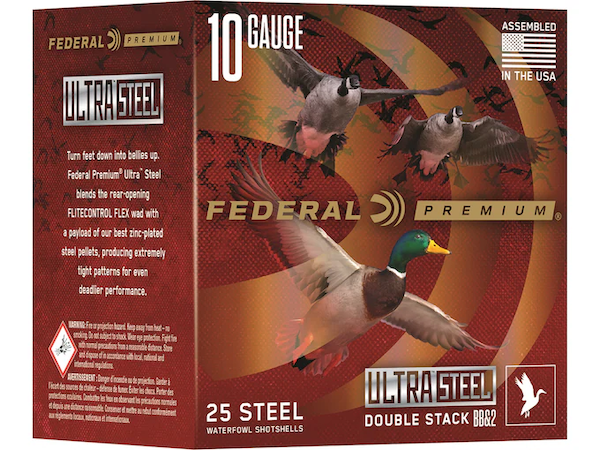
Federal Ultra Steel Double Stack
Specs
- Gauges: 31/2-inch 10 and 3 ½-inch 12 gauge
- Material: Steel
- Payloads: 1 5/8 ounces (10-gauge), 1 1/2 ounces (3 ½-inch 12-gauge)
- Velocity: 1400 fps (10-gauge), 1500 fps (20-gauge)
- Shot Sizes: BBBx1, BBx2 (10-gauge) BBx2, 2×4 3 ½-inch 12-gauge
- Load Tested: 10-gauge BBBx1
Federal extended its UltraSteel Double Stack lineup two years ago, and finally, the big guns get some love. New loads for the almost-forgotten 10-gauge and the 3 ½-inch 12 should find a receptive audience now that bismuth’s high price is cooling the smallbore trend. It may be time to put down that new 3-inch 28-gauge and take another look at that big bore gathering dust at the back of the safe.
I cleaned the cobwebs off my Browning Gold 10 to pattern the BBBx1 load. First, though, I cut one of the brown hulls open and examined the pellets. The BBB pellets were on top, and there was a full ounce of the big shot stacked on top of 5/8-ounce of 1s. Usually, in stacked loads, the smaller pellet payloads outweigh the big ones. Not here. You get a full ounce of big pellets, backed by 5/8 ounces of 1s, which works out to about 62 of each, all loaded into Federal’s rear-braking FliteControl Flex wad.
Assuming overchoking the large BBBs might prove counterproductive, I tried this with a Rob Roberts RR2—about a Light Modified—at first. Patterns averaged 70 percent, which is good performance, and resulted in about 90 hits in a 30-inch circle. That’s more than enough for a goose, especially when the BBBs were well-represented in the middle of the pattern. Under the counter-assumption that I could be wrong about the over-choking, I tried the RR 3 (Improved Modified, give or take) and was rewarded with frightening 82 percent patterns.
Winchester Final Pass
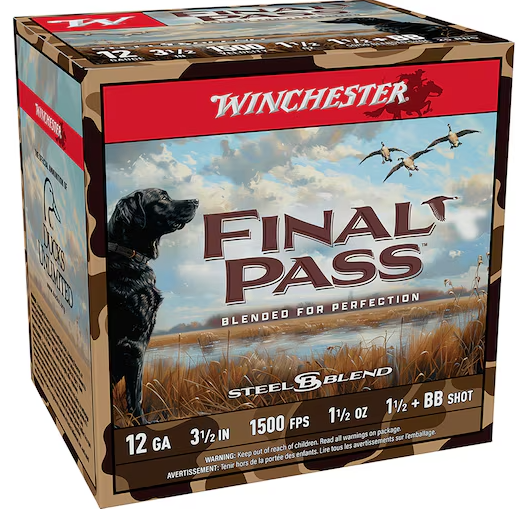
Winchester Final Pass
Specs
- Gauges: 3 ½-inch 12-gauge, 3-inch 12-gauge, 3-inch 20-gauge
- Material: Steel
- Payloads: 1 ½-ounces (3 ½-inch 12-gauge), 1 ¼ ounces (3-inch 12-gauge), 1 ounce (3-inch 20-gauge)
- Velocity: 1400 fps (12-gauge), 1300 fps (20-gauge)
- Shot Sizes: BBx1 ½ (3 ½- and 3-inch 12) 2 ½ x4 (3-inch 12-gauge, 3-inch 20-gauge)
- Load Tested: 3-inch 12-gauge 2 ½ x4

Not content to offer a stacked load like everyone else, Winchester came up with new shot sizes—1 ½ and 2 ½—to combine with standard 4 shot. My sample loads were 2 ½ x 4, so I took the opportunity to count and weigh the size 2 ½ pellets. Weighing an average of 3.2 grains (vs 3.5 for a standard 2), 2 ½ pellets give you 137 per ounce, vs 125 2s. So you get 12 more pellets per ounce with almost the same energy.
The shot is loaded in a two-piece shotcup/overpowder seal arrangement, with a lacquer seal around the primer. In most duplex loads, the large pellets are stacked on top of the smaller ones. Here, they are mixed together. Winchester engineers found that with two pellets fairly close in size, there is no need to separate them. Based on the pattern board result, Winchester engineers are pretty smart. These gave me a solid 75 percent pattern from an RR 3 choke, which translates to about 160 hits in a 30-inch circle. That makes them dense enough even for small ducks like teal. It would be great for wood ducks and, I’d predict, potent enough for big ducks over decoys, too.
HeviShot HeviHitter
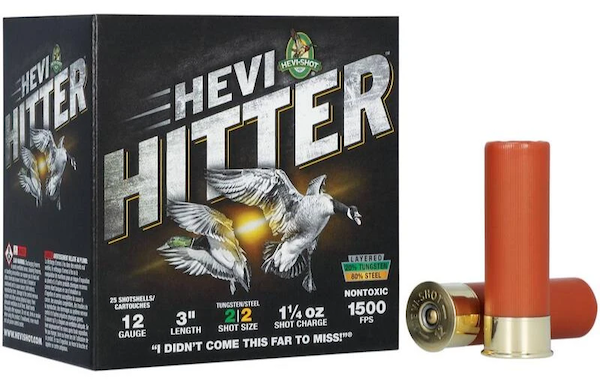
HeviShot HeviHitter
Specs
- Gauges: 3-inch 12-gauge, 16-gauge, 3-inch 20-gauge, 3-inch 20-gauge
- Material: HeviShot and Steel
- Payloads: 1 1/4-ounces (3-inch 12-gauge), 1 ounce (16-gauge), 7/8 ounce (3-inch 20-gauge), ¾-ounce (3-inch 28-gauge)
- Velocity: 1500 fps (12-gauge), 1350 fps (16-gauge), 1450 fps (20-gauge), 1450 fps (28-gauge)
- Shot Sizes: BB/BB, 2/2, 3/3. 4/4 (3-inch 12) 2/2, 4/4(16-gauge) 2/2, 3/3, 4/4 (3-inch 20-gauge) 2/2, 4/4 (3-inch 28-gauge)
- Load Tested: 3-inch 12-gauge 2/2
Up until now, the usual mixed stacked load combined a larger size of steel with a smaller size of bismuth, tungsten-iron, or TSS. Often, shooters chose the two pellets because they had similar energy levels. The smaller shot increases the overall pellet count and adds extra energy. The steel was there to fill the pattern and keep the price down. HeviShot HeviHitter instead matches two different materials—steel and HeviShot—of the same pellet size. You give up pellet count, but you gain in energy. Compared to any steel pellet, a HeviShot pellet of the same size is a wrecking ball, carrying twice as much energy downrange as the steel pellet.
My sample 2/2 shell was loaded in the traditional HeviShot light-brown/tan hull, with a pinch of flax-seed filler on top, as is also typical of HeviShot ammo. The HeviShot pellets were fairly true to size, which hasn’t always been the case with HeviShot, although they retained the little bulges and goiters, and two were stuck together. I counted 21 HeviShot pellets and 116 steel 2 pellets loaded into a one-piece wad. By comparison, a straight 1 ¼-ounce load of steel 2s contains 156 pellets, so you lose about 20 pellets overall by using HeviShot instead of all steel.
I weighed the steel and HeviShot pellets, too. The steel pellets averaged 3.5 grains, as they should. The HeviShot averaged around 6 grains, give or take. That weight confirmed that these are the original, 12-gram/cubic centimeter original HeviShot, not the watered-down pellets sold at times in the past.
Shot through the RR 3 choke I used throughout this test, the HeviHitter put 96 pellets into a 30-inch circle at 40 yards. This is enough for big ducks, and definitely enough for geese. Given that both pellets were the same size, I couldn’t tell where the HeviShot pellets were landing in the pattern. To find out, I shot five 9×12 paperback phone books at 35 yards through the RR3/IM choke. Every shot hit the books with at least 25 pellets. Anywhere from 1 to 4 of those hits were a HeviShot pellet. So the odds are pretty good, but not 100 percent that you’ll put 1 or 2 HeviShot pellets into a goose-sized bird with the 2/2 load. Sometimes it might be more, sometimes it might be none. The only way to find out if these work for you is to pick up a box or two.
Apex Mossy Oak Shadowgrass Blend
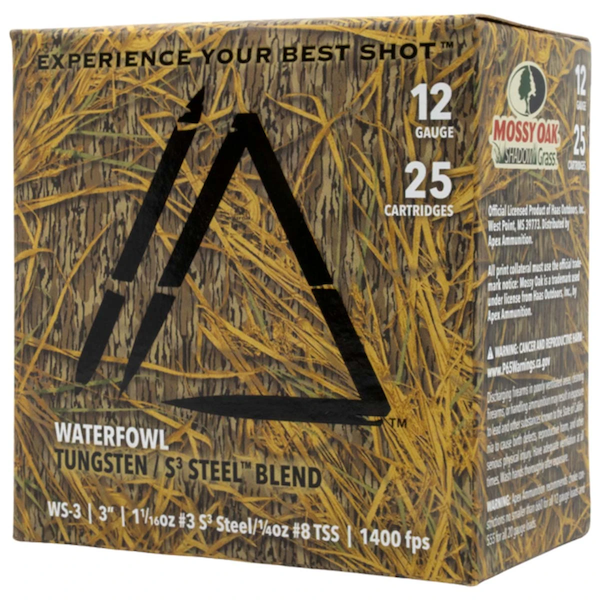
Apex Mossy Oak Shadowgrass Blend
Specs
- Gauges: 3-inch 12-gauge, 3-inch 20-gauge
- Material: Steel and TSS blend
- Payloads: 1 5/16-ounce (3-inch 12-gauge), 1 1/8-ounce (3-inch 20-gauge
- Velocity: 1400 fps (12-gauge), 1250 fps (20-gauge)
- Shot Sizes: 3 steel, 8 TSS
- Load Tested: 20-gauge
Apex, the first maker to offer factory TSS ammo, builds on its lineup of S3 steel/TSS ammo with the Mossy Oak ShadowGrass Blend. Does it sway me that the boxes are printed in my all-time favorite camo pattern? The answer is no, of course, but the boxes are great-looking. Nevertheless, we’re after inner beauty here. What’s inside these shells is a mix of very pretty, shiny, round steel 3 shot layered on top of a thimble-full of precious TSS 8s.
The 20-gauge shells I tested are loaded with ¼ ounce of TSS and 7/8 ounce of steel, while the 12-gauge holds 1 1/16 ounces of steel on top of ¼ ounce of TSS. Since my sample loads were 20-gauge shells and because I don’t have a choke tighter than Modified for my 20-gauge semiauto, I decided to give them a break and shoot them at 35 yards instead of the standard 40. This was perhaps condescending of me. At 35 yards with a Modified, the Shadowgrass Blend printed patterns dense enough that a teal flying sideways couldn’t get through unscathed. After counting up holes big and small and doing the math, it worked out to 82 percent patterns, which was very strong performance.
The TSS pellets were generally well distributed through the pattern, except for one odd pattern where most of the TSS wound up in the upper-right quadrant, though plenty of pellets still spread across the circle to reliably kill a duck. These shells will absolutely add punch to your 20. The 12-gauge shell has a heavier payload, but since all the extra pellets are steel, you only get about 25 more steel 3s per load. The 12 is much faster, at 1400 fps vs the 1250 fps of the 20. Still, of the two, I like the 20 and would shoot any decoy duck with it.
How We Tested Duck Loads

The first step was to examine the exterior of the shells, then dissect each shell, inspect the components, and count the pellets to confirm the manufacturer’s specs were accurate. We conducted pattern tests with each shell at ranges of 30 and 40 yards, using appropriate chokes for the load’s intended purpose. The results were tabulated and evaluated for effectiveness. Any failures to function (dead primers, etc.) were noted.
What to Look for When Choosing Waterfowl Ammo
A shotshell is only one part of a system made up of the shell, the waterfowl gun, and the choke. Choose choke/load combinations that perform best for the type of shooting you do with your shotgun. Pattern-testing your gun is how you learn what it does at various ranges. Shoot a big sheet of paper, then draw a 30-inch circle with the densest part of the pattern at the center. Check that the pellets are spread fairly evenly across the circle. A good pattern will be denser in the center and more open at the fringes, but not so dense that it tears up birds and is easy to miss because it’s so small. Shoot at the range you expect to shoot in the field. Shoot at least three patterns at each distance with each choke/load combination, although shooting five patterns is better, and ten gives you the clearest idea of what’s going on. There can be lots of variability from shot to shot.
In general, you should choose very open chokes for TSS, which typically are small, hard, tight-patterning pellets. Improved Cylinder is a good place to start testing TSS loads. Likewise, Hevishot HeviXII patterns efficiently, so start with open constrictions there, too. For steel, a Light Modified or Modified choke usually works well for over-decoy shooting, and an Improved Modified is best at longer ranges. Bismuth, unless it’s buffered like Winchester or Boss War Chief, often patterns inefficiently because the load loses pellets to shattering. Pick a tighter choke to compensate, such as Modified for close range or Improved Modified.

FAQs
Both 2 and 3 shot are effective pellet sizes for ducks when you’re using steel shot. Three shot has a higher pellet count per ounce (153 for 3s vs 124 for 2s), so it can put more hits on target. On the other hand, 2s have more energy. My advice is to shoot 3s for ducks over decoys if there is no chance of geese, and pick 2s if Canada geese, snow geese, or specks might visit your spot.
The best load for shooting ducks combines enough pellets and energy to deliver lethal hits while keeping recoil manageable so you can shoot effectively. If money is no object, TSS or Tungsten-Iron HeviXII are the best loads because they are very dense and retain a lot of energy, even in small pellet sizes that give you high pellet counts. In steel shot, a 12-gauge, 1 ¼-ounce load of 2 or 3 shot for big ducks like mallards, or 4 shot for wood ducks and teal, is usually best and most cost-effective.
The 12-gauge remains the standard duck gun, as it should. It’s the most versatile gauge in terms of the range of loads you can find. It’s also the best choice if you want to keep costs down and shoot steel pellets, because the 12-gauge hull has the capacity needed to hold enough big steel shot. Some disagree, but I don’t think 3 1/2-inch shells are necessary for ducks. A 3-inch shell holds enough shot, and 3 ½-inch shells kick hard.
Smaller gauges, 20- and 28-gauge, are currently popular. They make good waterfowl guns, although their smaller hulls work best with denser pellets like bismuth, HeviXII, and TSS, where you can choose smaller pellets and fit enough in the hull to produce adequately dense patterns. If you shoot steel in a 20-gauge, your range will be limited because pellet counts are lower and 20-gauge hulls can’t hold enough bulky pellets like BBs.
Why Trust Us
For more than 125 years, Field & Stream has been providing readers with honest and authentic coverage of outdoor gear. Our writers and editors eat, sleep, and breathe the outdoors, and that passion comes through in our product reviews. You can count on F&S to keep you up to date on the best new gear. And when we write about a product—whether it’s a bass lure or a backpack—we cover the good and the bad, so you know exactly what to expect before you decide to make a purchase.

All new! 1871 Club Field Trips