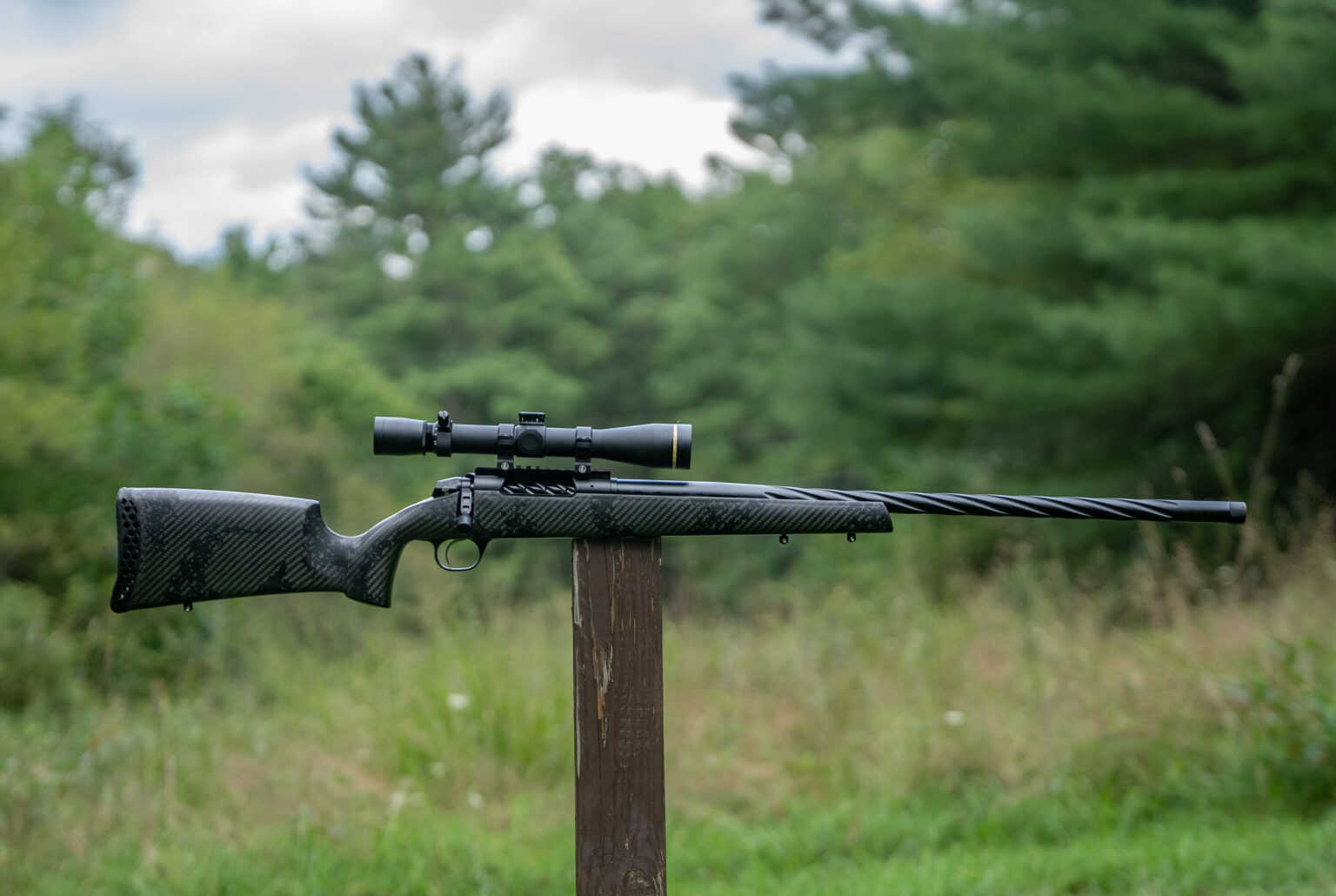
When I first started writing about guns professionally, it was at the height of the in-line muzzleloading rifle frenzy. I grew up with traditional muzzleloading rifles, so I had the front-stuffing background to write about in-lines. However, I quickly developed a hatred for them, mostly because of the poor quality of many budget in-lines I had to test, but also because of the inconsistency of blackpowder substitutes and the less-than-stellar precision these rifles delivered. However, up until just recently, I had never tested anything like the new 307 MZY from Weatherby. Now that I have, my mind is beginning to change. If you’re a serious muzzleloading hunter with deep pockets and you’re looking for a new in-line, I think this just might be the rifle.
Weatherby 307 MZY Specs
- Length: 45.0 inches
- Weight: 7.1 pounds
- Barrel: 26 inches
- Action: bolt action
- Trigger: Trigger Tech, 2.75-pounds as tested
- Capacity: front-loading single-shot
- Caliber: 0.45 or 0.50
- Finish: Black Cerakote
- Stock: Peak 44 Bastion carbon fiber
- Price: $2699 to $2849
Weatherby 307 MZY Muzzleloader Overview
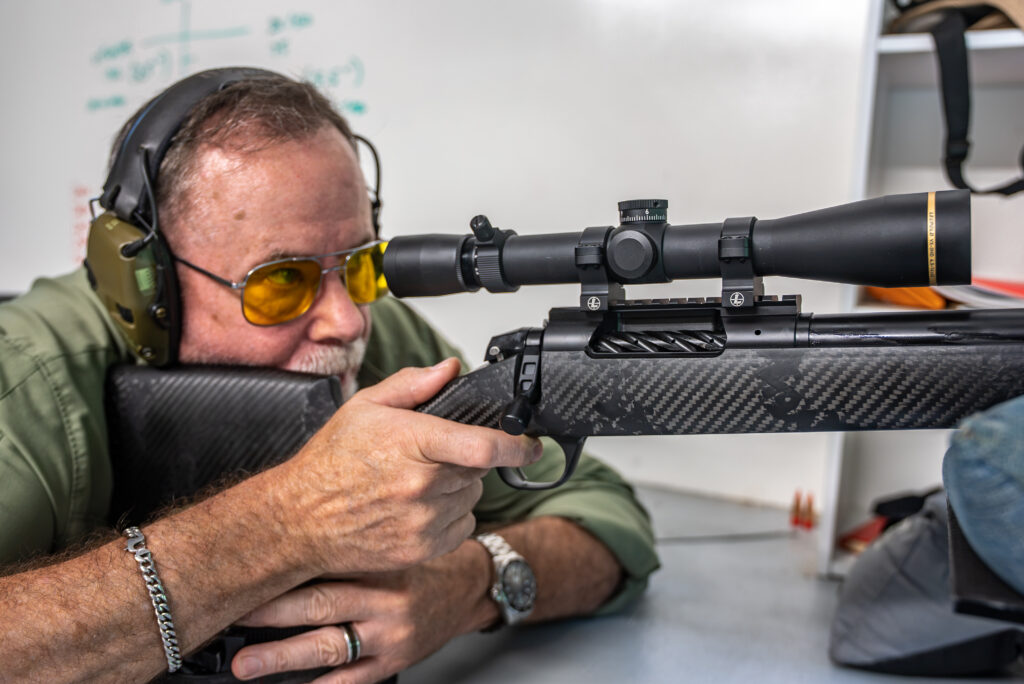
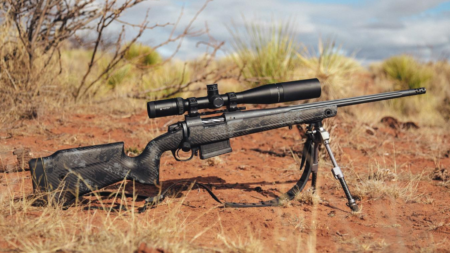
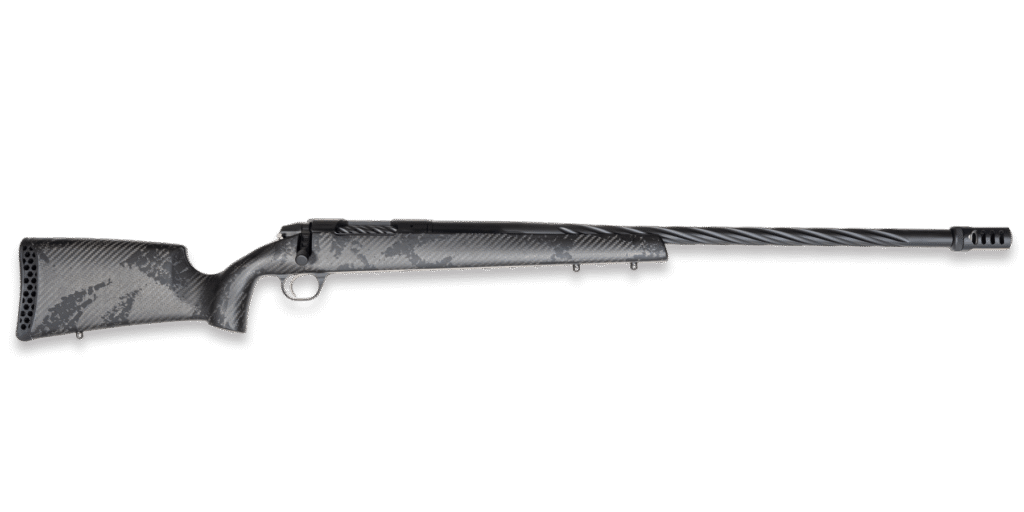
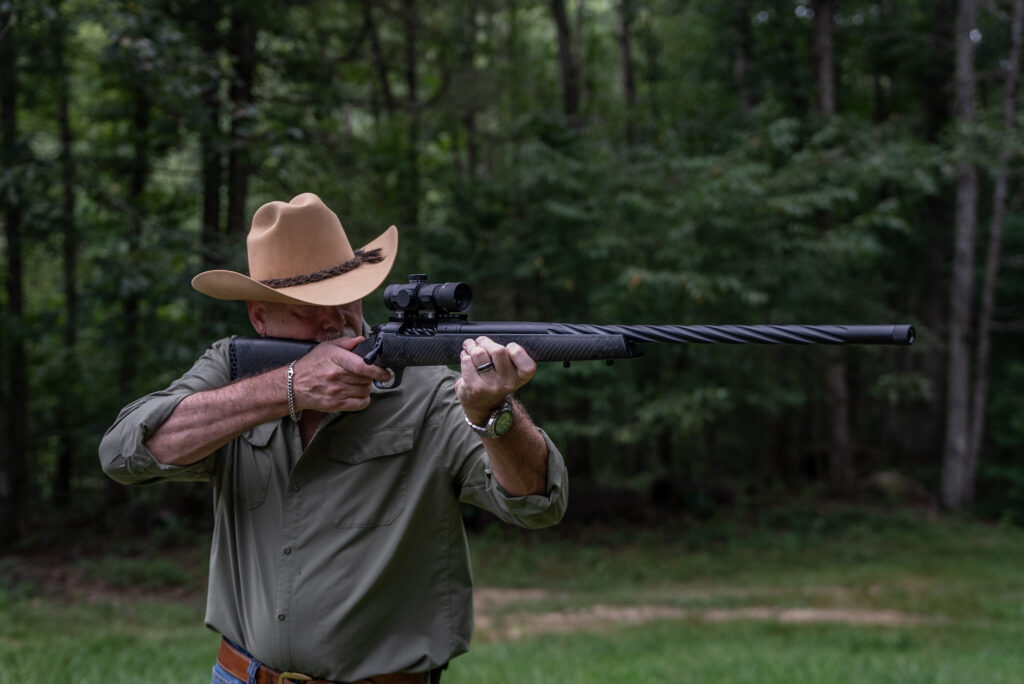
If you saw the Weatherby 307 MZY muzzleloader on the rack at your favorite gun store, you’d probably think it was a centerfire rifle, because that’s what it looks like. It has no ramrod, for starters, and the rifle is built on the same Model 307 bolt action Weatherby uses for their centerfire rifles. The stock is a Peak 44 Bastion carbon-fiber model, like what Weatherby uses on some of those same centerfire rifles.
The Peak 44 stock has a 3DHEX recoil-reducing butt pad, and there is one sling-swivel stud at the rear and two underneath the forend. This stock weighs in at about 24 ounces and has a carbon bedding block, vertical grip, and a comb with negative drop. As stated, there’s no ramrod hole, but Weatherby provides a collapsible ramrod and a carry pouch for it with the rifle.
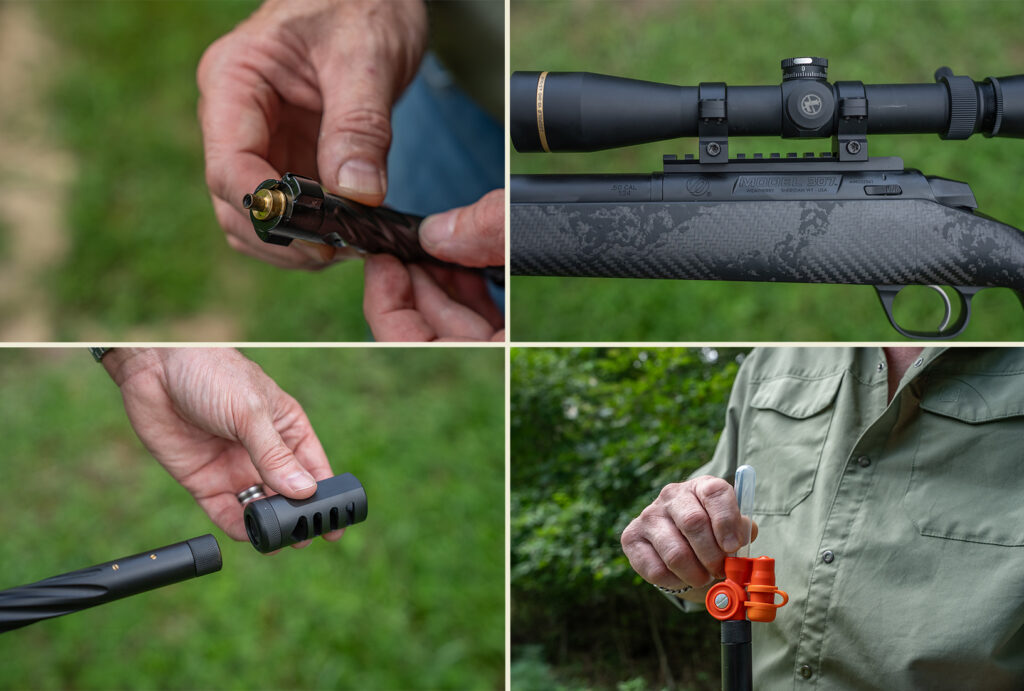
The Peak 44 Bastion is a high-end rifle stock (as a replacement stock on some Weatherby rifles, it retails for $880). But what sets this in-line apart from a conventional budget-priced in-line is the Arrowhead Gen2 Ignition System. This system utilizes a primer module that holds a large rifle primer just like a centerfire rifle case does. These brass reuseable modules fit inside a recess in the 307 MZY’s bolt face, and 20 of these modules come with the rifle. You press the primer into the module with a reloading press or a hand-priming tool, just like you would use to load centerfire ammunition, and after you fire the rifle, you punch out the primer with a loading press or a standard de-capping die. Arrowhead offers a special de-primer tool for $27.99. These modules interface with a special breech plug that screws into the breach of the barrel through the action with a ratchet, extender, and a socket Weatherby provides. Together, the primer module and breach plug provide a weather-sealed ignition system eliminating blow back.
This 307 MZY in-line is available in 0.45- or 0.50-caliber, and both come with a 26-inch radial fluted barrel. The muzzle is threaded, comes with a thread protector, and a massive muzzle brake. The barrel is also drilled and tapped for a hooded front sight that accepts interchangeable reticles. If you want the front sight, you specify that with your order, and an upgraded open sight system ($169.95) is also offered. (Optical sights are not allowed in some locations during some muzzleloading seasons.) The rear sight is installed using the rear scope mounting holes on top of the action where it is drilled and tapped for scout mounting. If you prefer an optical sight and a scope rail, a rail is available from Weatherby.
Weatherby 307 MZY Test Results
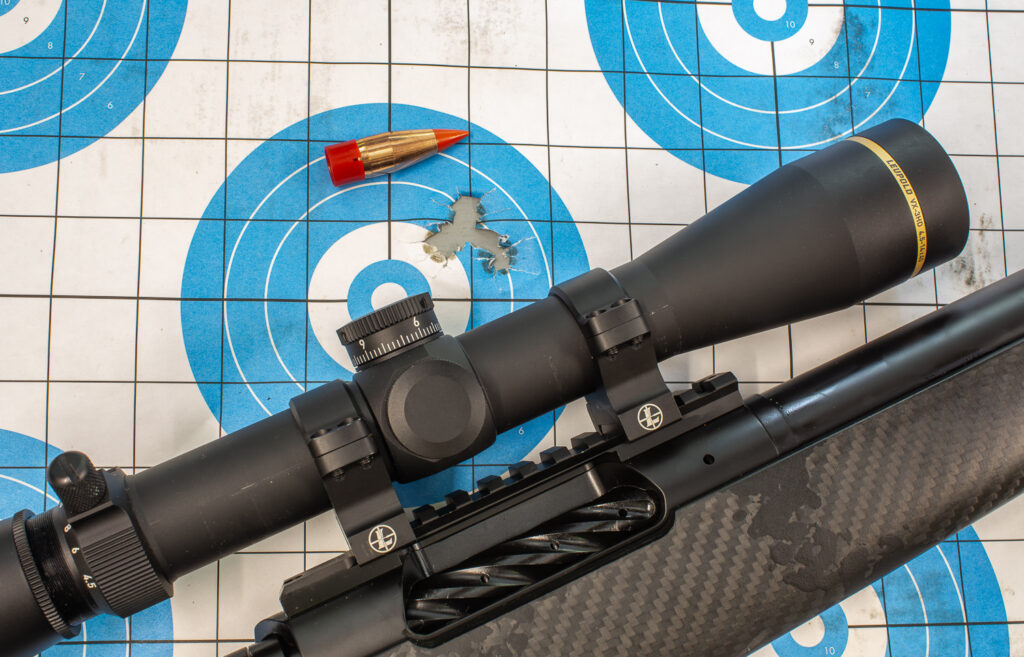
The propellent recommended by Weatherby for the 307 MZY is Blackhorn 209. A half pound container of Blackhorn 209 works out to about 40 shots with the 81.0-grain load I settled on. One difference with the 307 MZY is that instead of establishing a charge of powder by volume, as with most in-lines, Weatherby suggests weighing out each charge. Specifically, they suggest 105 grains of Blackhorn 209 by weight, which works out to about 150-grains by volume. The rifle comes with Cedar Mountain Quick Loaders, and once you’ve weighed out your charge, you can pour it into the Quick Loader and then transfer the powder down the barrel while in the field.
Weatherby also suggests using the Hornady Bore Driver bullets, and I tried two of those, plus the Nosler 300-grain saboted 0.458-caliber Ballistic Tip bullet. The first shot I fired was with 105 grains of Blackhorn 209. The recoil was—um—impressive. I decided I did not like it, so I backed the charge down to 81.0 grains and proceeded to fire three of the 340-grain Bore Drive bullets into one ragged hole. The recoil was still stiff, so I installed the muzzle brake that comes with the rifle. With the brake, the rifle was much more pleasant to shoot, but the other two bullets I tested did not shoot as well as the first. Here are the results.
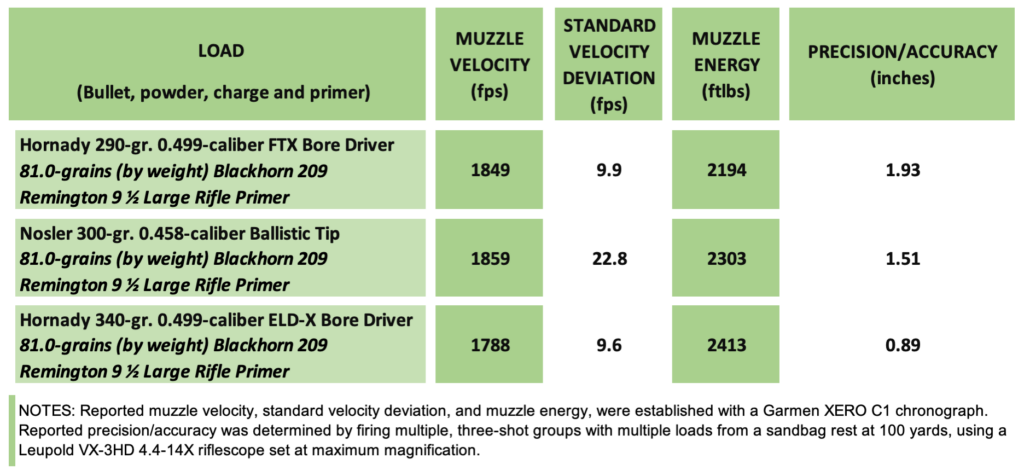
It’s important to note that I did not “work up” loads for this rifle. To find the best-performing load in a muzzleloader, that is generally the best approach. Sometimes a slight change in powder or a different bullet can drastically impact precision. It can also be a time-consuming proposition. I simply picked a practical charge weight with the Blackhorn 209 powder, and tried three different bullets with that charge. Additionally, some muzzleloaders shoot best when you clean between each shot. However, I could tell no difference in how the MZY 307 performed from a clean barrel or one dirtied by several shots.
Final Thoughts on the Weatherby 307 MZY
Pros
- Lightweight
- Accurate
- Weatherproof ignition
Cons
- Long
- Expensive
I’m convinced that with some time spent tuning a Blackhorn 209 load to the optimum weight for the bullet chosen, this rifle would shoot very well. With the Arrowhead Gen2 Ignition System, it is also a very simple and weatherproof solution for an in-line muzzleloader. I prefer it to any in-line I’ve ever worked with. Additionally, the Cedar Mountain Quick Loaders are the best field-loading solution for a muzzle loader I’ve seen. (If you’re a muzzleloading hunter, but don’t want to spend the kind of money you’d need to for the 307 MZY, you should still pick up a couple Cedar Mountain Quick Loaders.) These Quick Loaders even work with the 307 MZY’s muzzle brake.
The only problem I experienced with the rifle was that one of the unused 20 primer modules and three of the used ones would not fit in the bolt-face slot. These are designed to be reuseable, but they are also expensive; 20 modules cost about $100. Also, for the recoil sensitive, there’s a reason Weatherby includes a brake with this in-line; 105-grians of Blackhorn 209 behind a 300-grain bullet will get your attention, and I expect after a few shots without it, you’ll fully understand why.
This is an expensive in-line, especially in a world where you can pick one up for less than 500 bucks. The inexpensive in-lines are OK if you’re just wanting to do a little muzzleloader hunting. But I wouldn’t recommend any of them for more serious long term use or if you’re looking to get extreme precision for shooting at any distance. For the avid in-line hunter, the 307 MZY makes sense, especially on a once-in-a-lifetime trophy hunt. It’s also a rifle that should last a lifetime, and one you could pass down to your muzzleloading descendants. Weatherby did a good job with this rifle, and for the die-hard modern muzzleloading hunter, it’s a fantastic choice.