
For a reliable everyday handheld, the Yaesu FT-60R is the proven choice — rugged, dual-band, and still in production after 20 years. For mobile use, the Icom ID-5100A leads the category. Beginners on a budget should start with the Baofeng UV-5R. Operators who want full-featured digital capability and can spend more should look at the Kenwood TH-D74A.
- The Yaesu FT-60R has been in continuous production since 2004 — batteries, accessories, and service parts remain widely available.
- The Baofeng UV-5R is the entry point for new licensees who want to learn the hobby without significant financial commitment.
- The Kenwood TH-D74A is the splurge pick for operators who need advanced digital modes and full-featured capability.
- The Yaesu FT-60R lacks digital modes including APRS — operators who need those capabilities must look elsewhere.
- All ham radios require an FCC Technician's License to transmit legally — factor in testing time before purchase.
We may earn revenue from the products available on this page and participate in affiliate programs. Learn more
What are ham radios? In short, ham radio operators are amateur radio enthusiasts who communicate with one another via radio frequencies assigned specifically to this community by the Federal Communications Commission (FCC) or the International Telecommunications Union. Ham radio operators are required to be licensed by the FCC, a process that involves testing, knowledge, and demonstration of abilities pertaining to such radio communications and the use of the corresponding equipment. Upon completion, operators are assigned a call sign—e.g. AB1PAL—unique to them.
Today, there are some three million licensed ham radio operators worldwide, with about 700,000 here in the United States. Ham radios can be large or small, portable or stationary, mobile, handheld, or any of several configurations. Some can transmit but a short distance, while others are capable of bouncing a signal off the moon and sending it halfway around the planet! Below are some of the best ham radios on the market, with an emphasis on units for the beginner “˜ham.’
- Best Handheld: Yaesu FT-60R
- Best Mobile: Icom ID-5100A
- Best for Beginners: Baofeng UV-5R
Author’s Note: Traditionally, I’ve handled the information for reviews myself. However, when it comes to ham radios, I’m just a bit out of my wheelhouse in terms of experience. So I found someone who truly knows their way around the airwaves: Justin Roberts. An EMT and volunteer firefighter with Wahkiakum County in Washington and Wahkiakum Fire District 4, Roberts has held his Technician’s Level FCC License for 12 years, served as a 911 dispatcher, and sits on the county’s emergency radio board. He operates daily on the 2M/440 frequency, and he knows his stuff.
Best Handheld: Yaesu FT-60R
best handheld
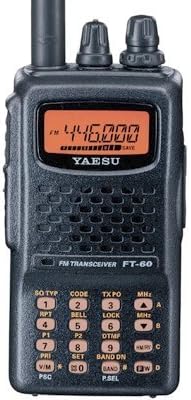
Yaesu FT-60R
Pros
- Excellent price point
- High 5-watt power output
- Big LCD display
- Rugged water-resistant housing
- User-friendly
- 1,000 memory channels and 10 memory banks for dedicated channel allocation
Cons
- Somewhat limited range of features
- No digital modes, i.e. APRS
The FT-60R was introduced in 2004 at the Dayton Ham Radio Show (known in The Circle as “˜Hamvention’) and Roberts owns three of them. “Most electronic devices are in production for a couple years, and then the manufacturer moves onto the next model or version,” he explained. “This one’s still in production today because you just turn it on, type in a frequency (or hit a pre-programmed key earmarked with that particular frequency), and you’re off.” The good part about this means that things like batteries, accessories, and, most significantly, service and repairs can still be had almost universally.
The FT-60R also offers wide band reception, which Roberts explains means that the user can listen to radio traffic in the 800 megahertz (MHz) public safety band, as well as the air (civil aviation/aircraft band) band. This allows the FT-60R to operate as a traditional scanner, for those wishing to monitor local emergency broadcasting networks.
Best Mobile: Icom ID-5100A
best mobile
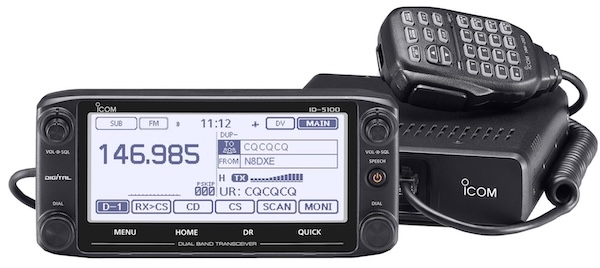
Icom ID-5100A
Pros
- Built-in GPS allows for APRS functionality
- Touch screen operation
- Remote head bracket makes for easy mounting in a vehicle
- Dual watch capable so you can monitor two frequencies simultaneously
Cons
- Abundance of features can prove challenging to navigate for new users
- Higher price
“It’s not a starter radio,” Roberts said of the ICOM ID-5100A. “I’d put it somewhere in the middle of the User-Friendliness Scale. Roberts went on to compliment the radio’s dual band capability (2M/440), and the unit’s “˜Dual Watch’ feature, permitting users to be on two frequencies at the same time. He said he often monitors a local repeater, as well as the 2M calling frequency, so he can listen and respond to repeated traffic within the immediate area, along with call outs, which is someone reaching out via radio on the 2M frequency.
One thing I—as a novice and frequent long-distance traveler—like about the ID-5100A is the radio’s repeater list function, which searches for and accesses nearby repeater sites (towers), even if you’re in a location for the first time. An abbreviated list of repeaters comes pre-programmed into the unit; however, a more in-depth list can be built by entering GPS coordinate information pertaining to the individual repeaters.
Best for Beginners: Baofeng UV-5R
best for beginners
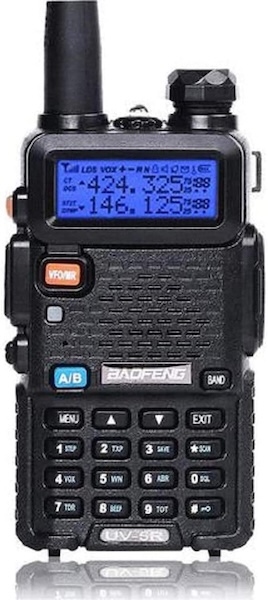
Baofeng UV-5R
Pros
- Widely used and widely available with a wealth of online tutorials
- Extremely user-friendly
- Lightweight and compact
- Earpiece, belt clip, and hand strap included
- Affordable
- Tri-color background light customizable
Cons
- Limited capabilities and functions
- Operates on amateur radio bands only
So you’ve decided to test the waters in terms of ham radios, but in doing a little digging around, you’re seeing prices ranging from $250 to astronomical, along with levels of complexity that would confound an entire Thursday night Mensa meeting. Well, you’re in luck with the Baofeng UV-5R. Perhaps not surprising for $30, this unit is somewhat limited in its features and capabilities. “It’s only 2M and 440,” Roberts explained, “but the UV-5R has the dual watch mode, so you can monitor two frequencies at the same time.” Roberts went on to describe this radio as “clunky” in terms of usability.
Bottom line with the UV-5R? To repeat Roberts, she just—with some limitations—works, and she’s inexpensive to the point you’re not going to shed crocodile tears if she falls off the bumper and you run her over with your truck. “You can afford to break a UV-5R,” he said. “There aren’t many electronics out there you can afford to break.” Baofeng also makes some of the best walkie talkies we’ve tested.
How We Picked the Best Ham Radios
I’ll be the first to admit I’m not a techno-wiz, especially not with what I’d deem highly advanced electronics. I mention this because it’s a major player in how I arrived at the selections I did. First and foremost, I’m looking for something that ranks relatively high on the UFR (User-Friendliness Rating) scale. The unit can be more than simple on/off and volume up/down buttons, but I tried to steer clear of those pieces involving multitudinous microphyte communities and a masters in Astrophysics, neither of which I understand. Here’s what I considered:
- Is it user-friendly? Do I need a degree in tele-comm to make it work?
- Can I talk to the people I want to talk to? Is it rangy enough?
- What does it cost? Should I sell a kidney, or borrow one and sell that?
- Are the batteries rechargeable? Long-lived? Or does it require plug-in power?
- Can I upgrade this particular unit, or am I buying a new one?
What to Look for When Choosing a Ham Radio
Buying a ham radio is no different than buying any other piece of quality outdoor equipment. Sure, you can rush and buy the first unit that catches your eye or the first radio that Mr. Advertising Person tells you is the latest/greatest thing since the Zip-top bag and the safety pin. Or you can do a bit of research prior to the purchase, beginning with criteria such as these.
Price
Quality has a price; so, too, do features, i.e. gingerbread, above and beyond the basic necessities. That said—and as is typical with electronics—you really do get what you pay for in terms of the aforementioned quality and capability. Ham radios come in a wide variety of price points, with some entry-level handhelds costing less than $100, while other more sophisticated and technologically advanced equipment costing tens of thousands of dollars. As a side note , study materials for the FCC license will come at a cost, as will the exam in most cases.
Location and Type of Operation
Where you intend to operate from will in part determine the type of radio you buy, which in turn affects price and other variables. The basic forms of operation include based/fixed (permanent); mobile, as in a vehicle; temporary, or place-to-place and portable; or the ultimate in portability, the handheld. Do you want to operate from a tabletop in the comforts of your own home, or would you rather talk on your feet?
Programmable Memory
Most ham radios offer some type of programmable memory function, where you program in a frequently used channel or repeater, and a single touch takes you immediately to that selection. It’s a convenience, really, but a nice feature to have accessible.
Power Supply
Ham radios get their power from any number of sources, often depending on the style of radio being used. Some draw power from a traditional wall outlet; others, like a mobile, may use 12-volt power pulled from your vehicle’s battery/batteries. Still others operate via AA or AAA rechargeable or non-rechargeable (alkaline) batteries. So, how are you planning to use it? Where? And for what period of time?
Bands
Technically speaking, ham radio frequency bands are a range of frequencies in a radio frequency (RF) spectrum, which run the gamut from very low (vlf) to extremely high (ehf) frequencies. Most, but not all, ham radios allow operators to work on two commonly used bands—two meter (2M) and 440—out of the box, and it’s often best to purchase a unit capable of transmitting and receiving on both.
User-Friendliness Rating (UFR)
No sense in getting technology capable of landing a man on Mars, if you’re still at the “˜walking before you run’ stage. Here, ask questions or do your homework online. How user-friendly is the radio? Are there 12 elemental buttons (keys) that perform 12 equally elemental functions, or does each key offer an additional 12 options? For the novice, myself very much included, simple is best.
FAQs
It’s not so much that the radio itself is called a “ham,” though it is known as a ham radio. It’s because the radio operators themselves go by the moniker of radio amateurs or hams. Many stories exist as to how and why the word ham came to be associated with these amateur radio operators.
There are several factors that contribute to the distance that a ham radio will reach, including the frequency band you’re operating on, the output power of your particular unit, and the terrain. Frequencies below 2M are used by folks wishing to speak, say, from North America to Australia or China. An entry-level 5-watt handheld ham radio, however, should be capable of reaching out to an end-user roughly five miles away under optimum line-of-sight conditions.
You’re required to pass a test prior to earning and obtaining your ham radio license. For most beginners, a Level 1 or Technician License is where you want to begin, with higher levels including a General License and Amateur Extra, both of which open up greater opportunities to explore the radio world. There’s a fee ($15, plus study materials and FCC license fees) followed by studying and either in-person or online testing. Then you can check the FCC database (wireless2.fcc.gov) for your name to appear.
Ham radios do need some type of power source, but it doesn’t necessarily have to be traditional 110V (household) power/electricity. It could be a battery, energy produced via a solar panel, or an ordinary wall outlet.
Final Thoughts
Like many things in life, ham radio operation can be as elemental or as complex as one wishes it to be. In most cases, the old adage KISS (Keep It Simple, Stupid) is, by far, the best advice. Don’t over-complicate the process, especially if you’re just getting your proverbial feet wet. Often, it’s not about having the fanciest or the most expensive radio on the market. Ham radio, I’ve often heard, is all about learning to operate your unit of choice on your own, and then, once semi-skilled, experimenting. And lest we forget the most important aspect of non-emergency related amateur radio: fun.
Why Trust Us
For more than 125 years, Field & Stream has been providing readers with honest and authentic coverage of outdoor gear. Our writers and editors eat, sleep, and breathe the outdoors, and that passion comes through in our product reviews. You can count on F&S to keep you up to date on the best new gear. And when we write about a product—whether it’s a bass lure or a backpack—we cover the good and the bad, so you know exactly what to expect before you decide to make a purchase.

ALL NEW! 1871 CLUB FIELD TRIPS