
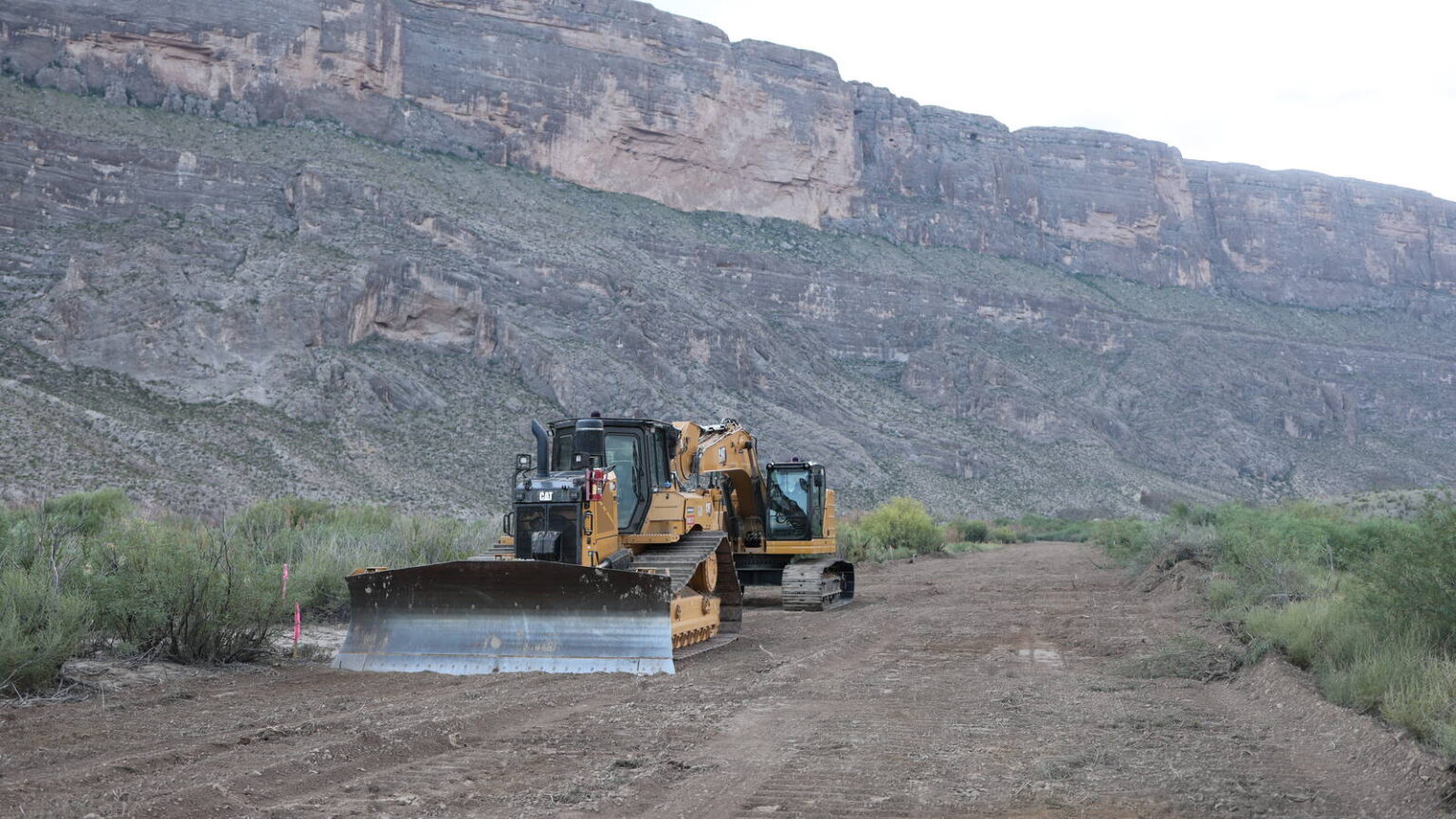
For the first time in U.S. history, the federal government is waving scores of bedrock environmental laws for a large-scale construction project inside a National Park. Bulldozing for the Big Bend border wall project began in earnest on August 4, despite strong bi-partisan opposition from locals. Private contractors are carrying out the $ 1.7 billion project under the authority of Customs and Border Patrol, which operates within the Department of Homeland Security.
According to the National Parks Conservation Association (NPCA), contractors have already bulldozed key areas of the park as part of a plan to build new border barriers, paved roads, and other types of border wall infrastructure. Recent video footage captured by local photojournalist Natalie Newman shows contractors bulldozing riparian vegetation along the banks of the Rio Grande River, not far from the parks iconic Santa Elena Canyon.
“The National Parks Conservation Association strongly opposes the administration’s plans for construction through Big Bend,” NPCA wrote in an August 4 press release, “which could inflict irreparable damage to Texas national parks, iconic wildlife, and tight-knit gateway communities like Terlingua.”
The bulldozing inside Big Bend National Park is just one of several border wall-related construction projects currently underway in the area. Other protected public lands with active construction projects include the Amistad National Recreation Area (administered by NPS), Big Bend Ranch State Park, and the Black Gap Wildlife Management Area.
Hunters Speak Out
The Texas Chapter of Backcountry Hunters and Anglers has voiced “significant concerns” about all of the border wall construction projects underway in the Big Bend region, citing negative impacts to the area’s hunting and fishing heritage. The group says a physical border wall would block native wildlife from accessing the Rio Grande River. And it would impede known movement pathways for black bear, mountain lion, big horn sheep, pronghorn antelope, and hundreds of bird species.
“We’re worried about cutting off migration patterns,” Texas BHA Policy Chair Jake Walker tells Field & Stream. “And with the wall going in on our side of the river, they’d be cutting our wildlife off from its primary water source. It’s very arid here. We don’t get a lot of rain.”
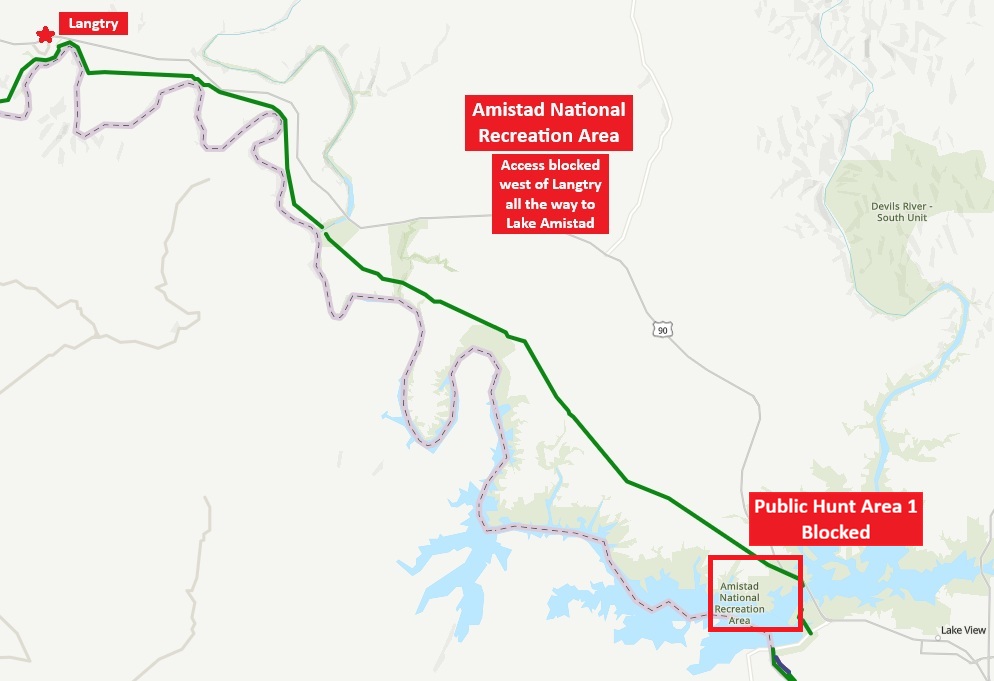
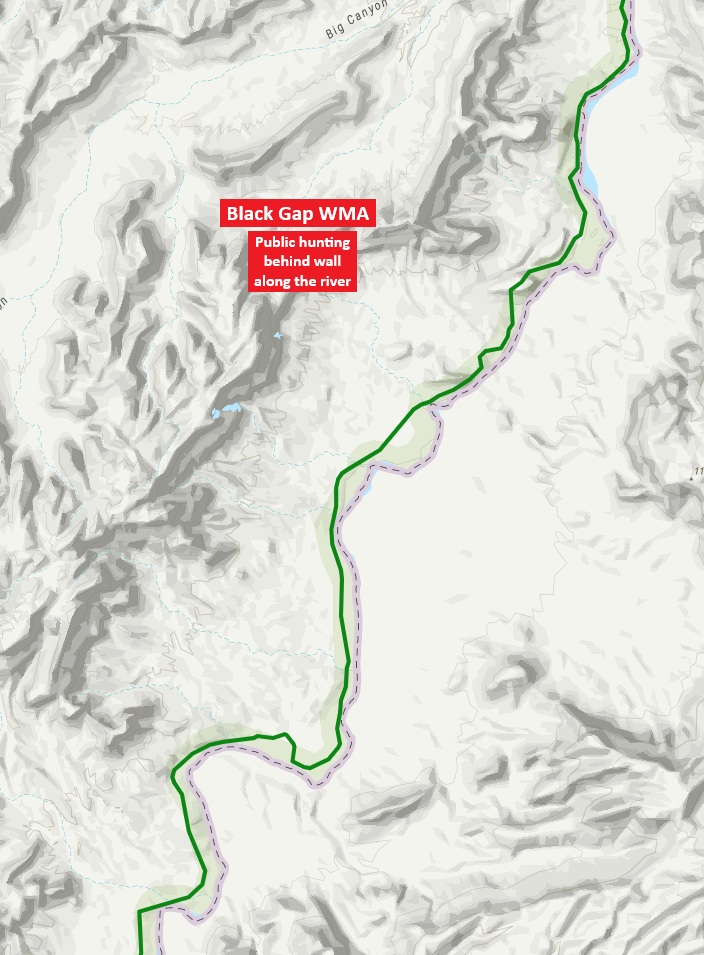
Walker says DHS has been less than forthcoming with detailed information about its border wall construction plans. But he has seen maps that show a definite loss of hunting access if the wall goes through. “According to those maps, the wall would cut off an entire public hunting section near Lake Amistad,” he says. “The maps also show where current public hunting areas inside the Black Gap Wildlife Management Area would be cut off by the wall.”
According to the Customs and Border Patrols’ own data, the Big Bend region is the largest border patrol sector in the United States. But it has the least amount of illegal border crossings. “It doesn’t get a lot of immigration traffic,” Walker says, “because it’s an extremely harsh, almost alien-like desert landscape with high cliffs and canyons that are virtually impassable on foot.”
Recent CNN reporting shows protestors of all stripes gathering near the Santa Elena Canyon within the National Park boundaries. Walker says local opposition to the project breaks across party lines. “All five Republican border country sheriffs have come out against this,” he says. “It doesn’t make sense to anyone to force through a wall here where nature has already created a strong physical barrier.”
All new! 1871 Club Field Trips





4 Comments
Maybe in some areas but the terrain is a natural barrier in much of it.
In remote areas helicopters and drones would be an adequate solution .
Field & Stream lost me at the title of this article. I want to read about Outdoors not about environmental activism that has to do with security interests of our country. If a border wall is going to stop a drug smuggler it can’t be a bad thing. Whatever your politics are this article does not belong in Field and Stream and it’s a slighted and underhanded jab by the author with his political viewpoint which I have no interest in. I get that the author is a lefty but his content belongs in a political journal not an outdoors magazine. This is why I don’t read Field & Stream. The final point I’ll make is the author quoted CNN which has a zero credibility and is an equally big mistake in my opinion
Field & Stream lost me at the title of this article. I want to read about Outdoors not about environmental activism that has to do with security interests of our country. If a border wall is going to stop a drug smuggler it can’t be a bad thing. Whatever your politics are this article does not belong in Field and Stream and it’s a slighted and underhanded jab by the author with his political viewpoint which I have no interest in. I get that the author is a lefty but his content belongs in a political journal not an outdoors magazine. This is why I don’t read Field & Stream. The final point I’ll make is the author quoted CNN which has a zero credibility and is an equally big mistake in my opinion
Surely, if the wall is not complete, open areas will become the new migration path. You should work on a solution that meets everyone’s goals. National Security is a #1 priority.