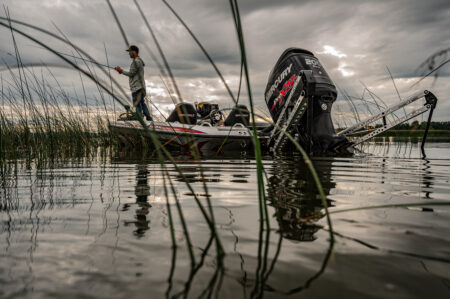
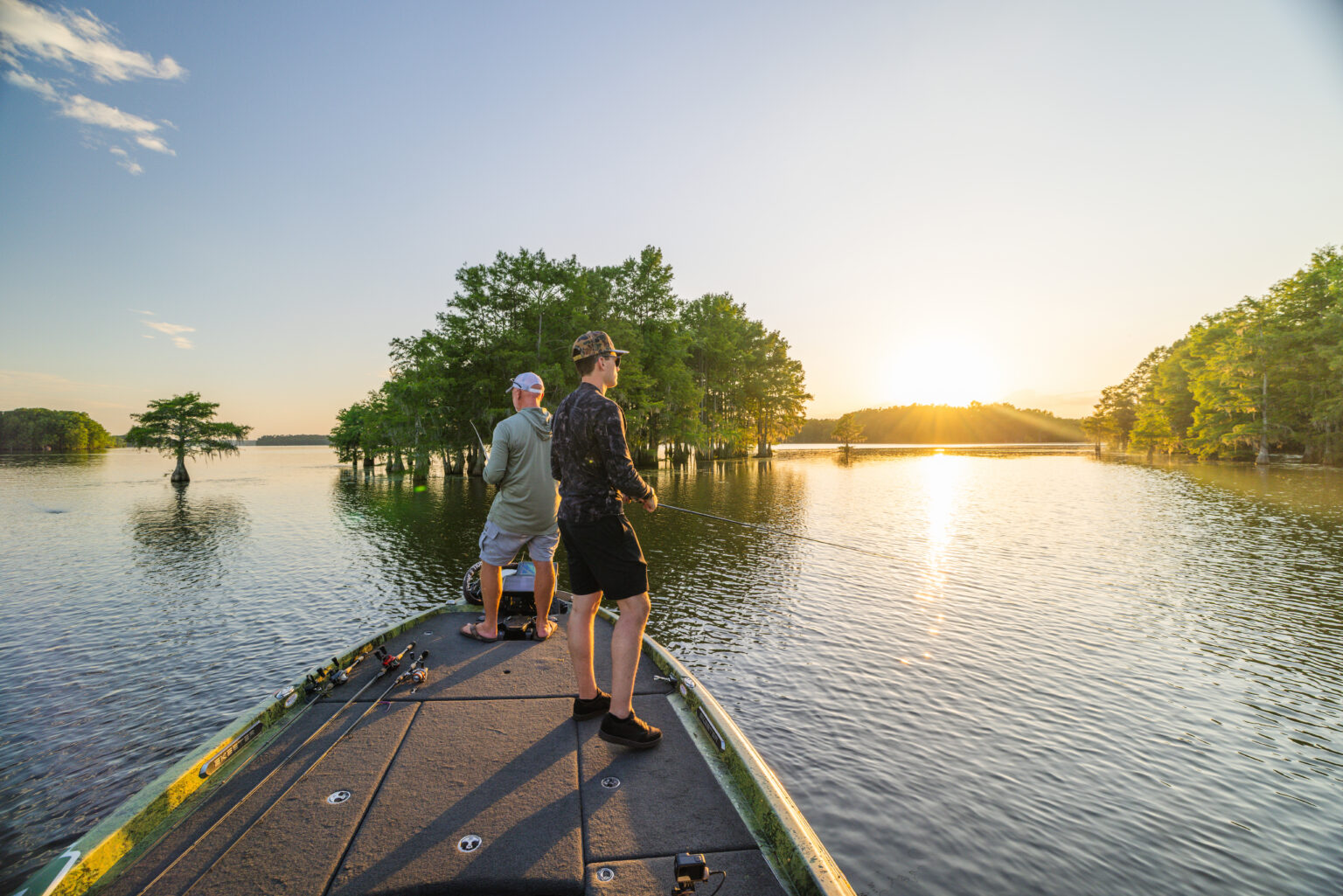
NASCAR driver Corey Heim stood on the edge of a bass boat, studying the water of South Carolina’s Lake Marion. Far ahead of him, cypress trees grew out of the lake, their knees jutting above the surface as if trying to keep their tops dry. Closer in, lily pads dotted the view like an aquatic checkerboard. Behind Heim, the lake ran to shoreline homes far in the distance.
The water, the boat, even Heim himself, remained perfectly still, as if they were all waiting for something, anything, to happen. Not much had so far that day, to be honest, though the occasional alligator sighting and the sound of distant mating calls made staying on the boat feel that much more important.
Underneath that calm water was a relative flurry of activity—or at least it looked that way on the forward-facing sonar mounted to the boat’s bow.
There were bass down there.
They wanted the frog on Heim’s line.
Could he make those two facts converge?
Maybe.
Maybe not.
He knew he’d have fun trying, regardless.
Heim, widely considered a future star for a NASCAR team co-owned by Michael Jordan and sponsored by Field & Stream, told me as we drove to this spot that he fishes because he loves the peace that settles over him when he does. Now on the boat, I asked him to expand on that.
“It’s instant,” he said.
“It’s healing,” said Andrew Greene, Field & Stream’s community manager, who was fishing to Heim’s left and interviewing him over the course of the two days.
“I agree,” Heim said.
These two men were having a moment, right there on the boat, despite having met only that morning. It was the kind of the-rest-of-the-world-barely-exists moment that happens only when you give it time to happen, the kind that has drawn men and women to this sport for as long as it’s been a sport.
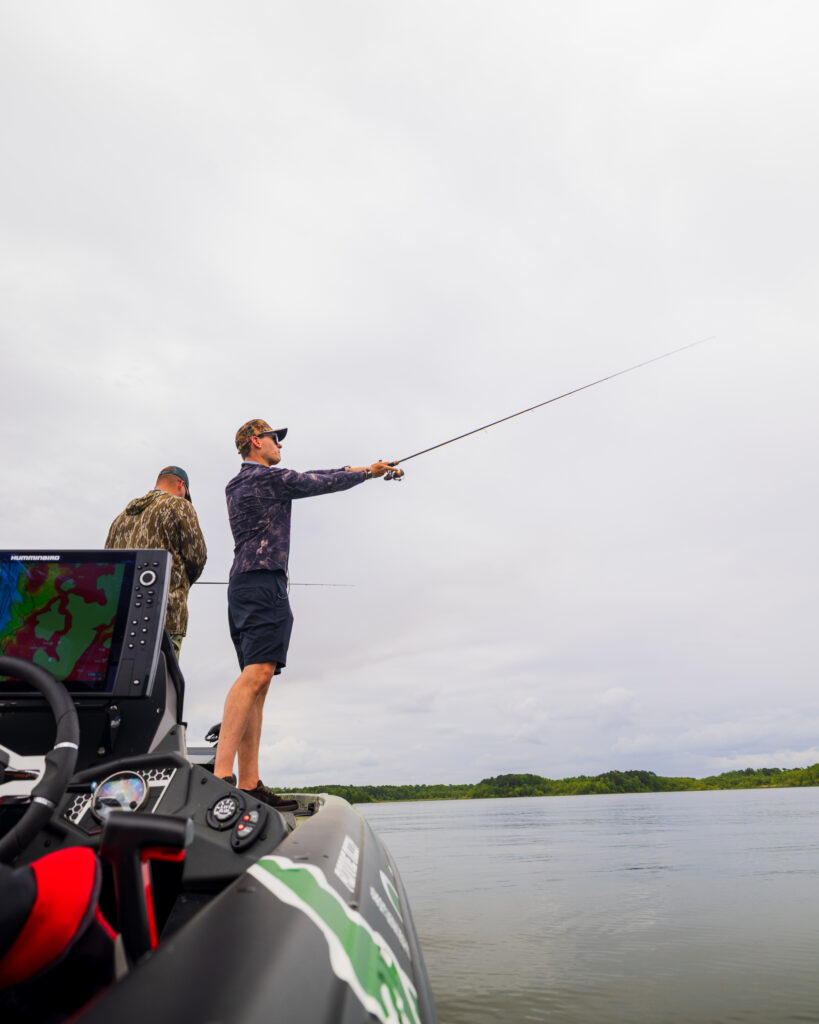
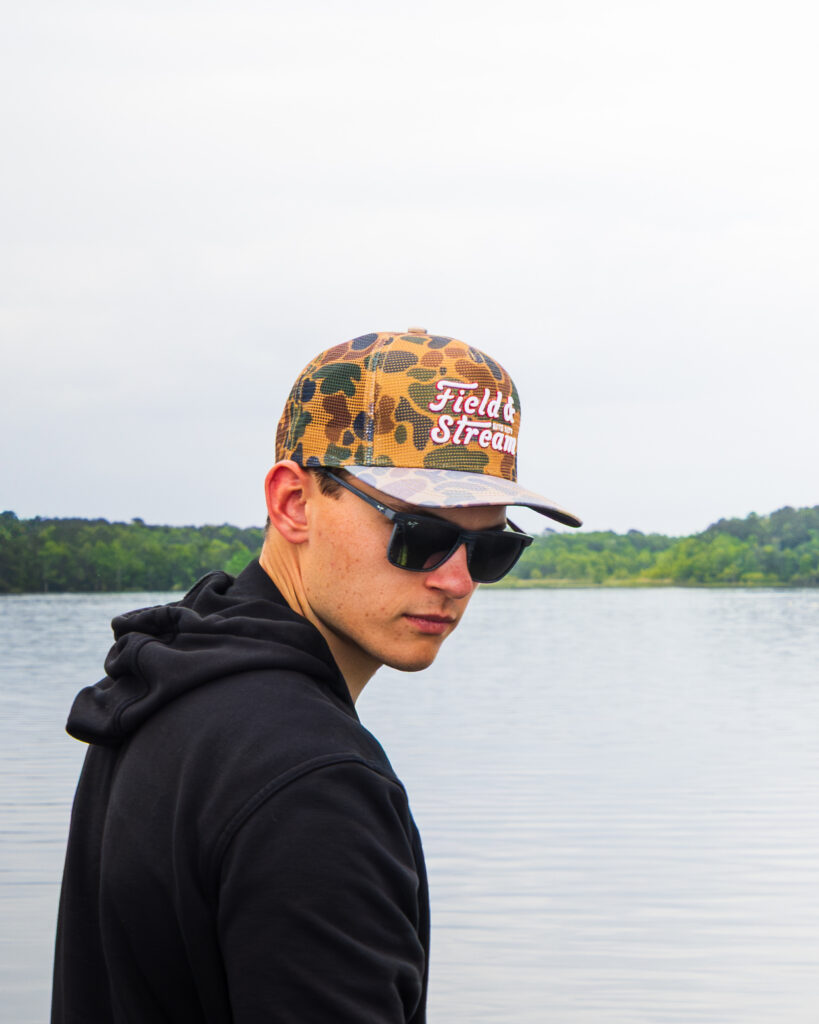
Wearing black Nikes, a dark Air Jordan camouflage shirt, and a Field & Stream hat, Heim cast his frog lure with a two-handed, sidearm technique he had been working on all day. He learns by asking questions, by watching others, and by doing. “I’ve never been a guy who gets it right away,” he says. “But when I get it, I get it. When it clicks, it clicks hard.”
And now it clicked hard.
Heim again sent the frog whistling over the still water, using the hand-eye coordination you’d expect from a guy who wheels a 3,400-pound stock car at 180 mph inches from other cars for hours at a time. The frog cleared a small opening and plopped onto a patch of lily pads, right where he wanted it. As he drew it back, it looked like a toy boat skimming across the surface until— BAM!
The lure disappeared.
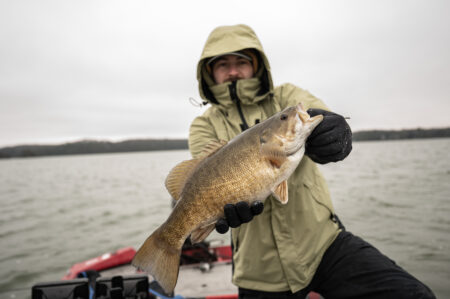
Heim yanked back on the rod to set the hook and, a minute or so later, held up a beautiful bass.
“That’s my first frog fish ever,” Heim told Greene. “That’s fun, dude. I like it.”
Heim paused. The satisfaction of the first catch mingled with the peace of the process and the joy of the natural beauty surrounding him. As if channeling every angler ever, he said: “It makes me feel like I’m doing something right.”
Partnering with Field & Stream
Whether he’s pulling bass into a boat or barreling down a straightaway, Heim, 23, is doing a lot right these days. As a driver in NASCAR’s top series, he is considered a future star for 23XI Racing, a team co-owned by Jordan and Denny Hamlin, a current driver and future hall of famer. The team derives its name from Jordan’s No. 23 and Hamlin’s No. 11, stylized as the Roman numeral XI.
At the Cup race in Nashville on Sunday, May 31, Heim’s No. 67 Toyota Camry will feature Chief’s as the primary partner, with Field & Stream highlighted on the car. (Chief’s is a Nashville bar owned by Eric Church, who also co-owns Field & Stream.) Field & Stream will be Heim’s primary sponsor at Indianapolis in July and at Charlotte Motor Speedway in October, and Field & Stream branding will appear on Heim’s firesuits and his team’s uniforms and equipment. Heim and Field & Stream will also create digital content designed to inspire people to get outside through unique storytelling.
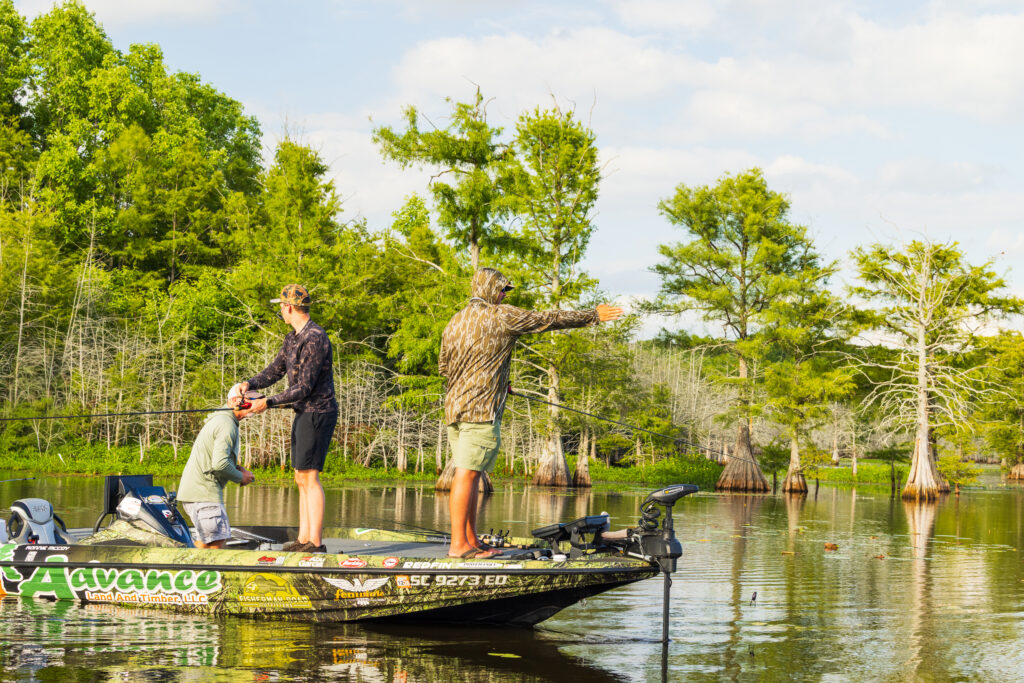
It’s unusual for a media company to sponsor a driver, but it’s common for an outdoor company to do so. The fan bases overlap, and so do the necessary skills. It might seem like driving 180 mph has nothing in common with pulling bass out of a maze of cypress trees on Lake Marion, but the two sports demand many of the same things: hand-eye coordination, the elusive interplay of feel between hands, eyes, and feet, the razor’s-edge balance of aggression and patience, and more.
“The main thing they have in common is you have good days and bad days,” Heim says, “and sometimes it’s out of your control. Sometimes you do everything right, and you just don’t have the luck that goes your way.”
As much as the two sports have in common, it’s how fishing differs from racing that attracts Heim. In his racing career, he is always on the go, always searching for speed, always on the ragged edge, always chasing, always striving, always competing.
In fishing, he doesn’t have to do any of that. He can just chill. And that’s why he loves it so much.
Finding Peace on the Water
I rode to and from the fishing spots with Heim and Charlie Wend, a member of 23XI’s marketing team and a serious fisherman in his own right. The conversations were part interview, part analysis of Heim’s fondness for early 1990s alternative music, part lament over all the fish we didn’t catch.
On the final drive back to the Airbnb at the end of the two-day adventure, though, the topics changed. It was as if now that the fishing was done, it was time to work. For the 30-minute drive, and all through lunch, Wend and Heim talked about Heim’s schedule for the upcoming weekend, which would be full of appearances at the Academy of Country Music Awards in Las Vegas. They went over where he had to be, when he had to be there, what he would wear, what kind of parties he’d go to, and more.
It sounded fun, glamorous, exciting—and stressful, wearying, exhausting.
Being a big-time NASCAR driver means always being in the public eye, with cameras watching, phones recording, and social media trolls seizing on any little mistake. And that’s not even counting the driving. The difference between success and failure is measured in tenths of a second. The work to make up those tiniest fractions of time can be all-consuming, with long hours in a racing simulator, endless meetings, and rigorous study of data.
A race takes three hours. The prep takes a lifetime. The pressure suffocates even the best drivers. The higher Heim has climbed the racing ladder, and the more time he has spent chasing success, the more important finding an escape has become.
“Anything that gets me off of a computer screen and off my phone is good for me,” Heim says.
His need for fishing, and his love for it, arrived at the same time.
The sun was just coming up as they pointed the boat east and headed from the dock at Virginia Beach into the Atlantic Ocean. Invited by his friend, fellow race car driver Connor Hall, Heim didn’t know what to expect when the four friends set out for a day of cobia fishing. He was still in high school at the time and had never done anything like it. They motored maybe 20 miles offshore. Floating out there, surrounded by endless blue, they chased, fought, and caught cobia all day.
As the sun began to set, they turned the boat back toward Virginia Beach. It was dark by the time they got there. As Heim headed home, he thought it was a fun day, but not one he expected to change his life. It did.
That fishing adventure in 2019 became another and another. He learned new skills, tried new techniques, and checked out new places.
Asked to pinpoint when this hobby took on the role it has in his life now, he tells a story about fishing with his team owner at the time, Lee Pulliam, who lives in Danville, Virginia. They often worked all day in the shop, then unwound by wetting lines in Pulliam’s pond. Once, about five years ago, just as Heim’s career was taking off, he spent a long day pulling smallmouth bass out of there. At some point, Heim realized he had gone eight hours without looking at his phone or even thinking about looking at his phone.
“I can’t think of another experience where I’ve been so distracted in a good way,” he said. “It gets your mind right.”
That’s when fishing became important to him, when he knew it wasn’t just fun but good for him, his mental health, and his ability to deal with the stress of being a professional athlete. He now fishes roughly twice a week, sneaking away to stand on docks or shores or boats whenever he can.
He intentionally keeps the hobby low key. Ask Heim about his favorite place to fish or his favorite species to target, and you’ll get answers, but not especially passionate ones. That’s too reductive. He’s much more interested in what he gets out of fishing—peace, quiet, escape from the noise, new and strengthened friendships—than what he catches, where he catches it, or how he catches it.
He tells stories about bass fishing, catfishing, cobia fishing. He tells stories that take place on the ocean, on lakes, on private ponds, about big fish and small fish, fish that he caught, fish that he didn’t catch, and fish he hasn’t caught yet but will.
His girlfriend’s dad wants to take him fishing in Brazil, and he’s eager to go.
When Greene invited him to his favorite spot near Nashville—maybe sneak off for a few hours during the long race weekend?—Heim sounded ready to commit right then and there.
Being Here Is What Matters
On Day two, we climbed into Heim’s black Toyota Sequoia well before sunrise. It was an early morning after a late night. “But it’s all right,” Heim said. “We’re here.”
Here was Goat Island, a put-in point on Lake Marion. Lake Marion looks like a hook that’s been flattened out, and Goat Island is on the north side of the hook. A cool breeze slow-rolled across the docks. Across Lake Marion, the sun crested over the trees, bathing the water, and us, in purple, pink, and orange light. We cruised in a pontoon boat toward those purple, pink, and orange rays. The guide found a spot he liked, sliced blueback herring into catfish-size bites, attached them to circle hooks, then cast them as if toward the numbers on half a clock, six in all.
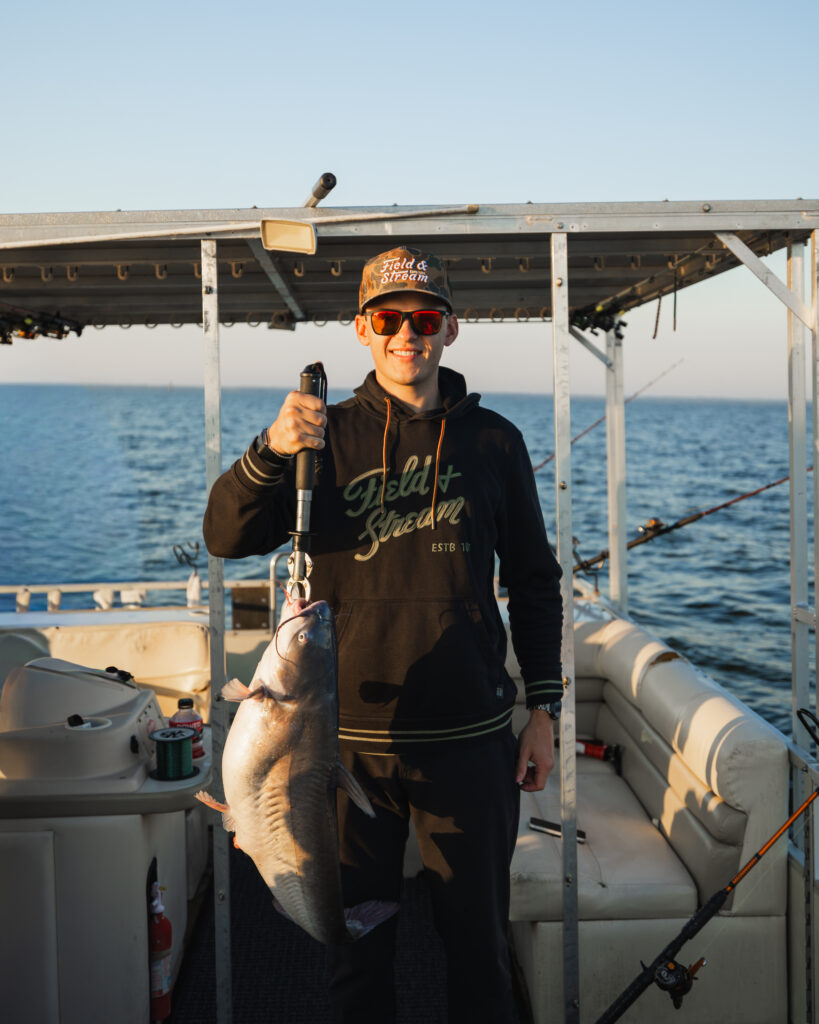
Heim sat facing the center of the boat. As he did across two days of fishing, he engaged in the easy banter that marks any great fishing trip. He explained what drivers do if they have to go to the bathroom during a race—for some drivers, a firesuit becomes a wetsuit, but he never does that—shared his bucket-list adventures, including deer hunting, to which Greene said, “That can be arranged,” and told stories about knocking drivers out of the way and getting knocked out of the way himself.
Suddenly, the rod over his left shoulder shook and then bent as if the line had turned to lightning. In a flash, Heim hopped out of his seat, spun around, grabbed the rod, and started reeling.
And reeling. And reeling.
He looked back toward the guide. “What’d you do, throw this 600 yards?” he joked.
Soon enough, Heim held up a 10-pound blue catfish for inspection. That got the boat off the schneid early, hinting that today’s haul would be better than yesterday’s unimpressive showing.
Nope.
But that didn’t make a difference in how much Heim enjoyed himself. On the boats, in his SUV, in the Airbnb, Heim was loose, comfortable, relaxed. In talking with Greene, he asked as many questions as he answered. He broke big career news between frog casts, about which we were all sworn to secrecy, described the delicate balance of navigating on-track friendships and rivalries, and led a roundtable conversation on what we would eat for our death-row dinners. His was chicken wings.
You would have never known his day job requires ferocious intensity. His team co-owner, Michael Jordan, is one of the most competitive men in sports history, and co-owner Denny Hamlin isn’t too far behind. When Heim puts on his helmet and sits behind the wheel, he’s the same.
Some athletes never shut that off. But he does, at least when it comes to fishing. He knows that if he gets too serious about it, he’ll ruin it. Golf is his other form of pressure relief, and he loves it, but he also sometimes hates it. Golf is maddening when you fail. He hasn’t fallen into that trap with fishing. It is an obsession he doesn’t have to care about. His passion for it remains steady regardless of the results.
Over two days on Lake Marion with Field & Stream, he caught only a handful of fish. That meager showing didn’t bother him at all. He’ll remember the laughter and the new friendships, and that’s a more valuable haul anyway.
“It’s nice to be able to catch fish, and I did,” he says. “But even if I didn’t, it’s not the end of the world.”

All new! 1871 Club Field Trips