The first thing you should ask yourself before you go deer hunting isn’t Where should I sit? or Should I bring a decoy? or even Where did I put those keys? It’s, Which way is the wind blowing? In a recent survey of whitetail guides from around the country, F&S asked, “What’s the craziest thing you hear clients say?” One of the top answers was, “Forget the wind. Just hunt.” Most of us already know the difference between downwind vs upwind. (We’ll cover it quickly for anyone who doesn’t.) But that just a start.
If you’re not paying very close attention to the wind when you’re hunting and if you haven’t mastered playing the wind, then you’re not tagging anywhere near the number of critters you could be. The good news is: Your success is about to skyrocket. Follow the tips below and you will simple put more and bigger critters on your wall. Even if you already know downwind vs upwind, and even if you’re good at playing the wind to your advantage, several of the tricks here will help take your game to another level.
Downwind vs Upwind: The Basics
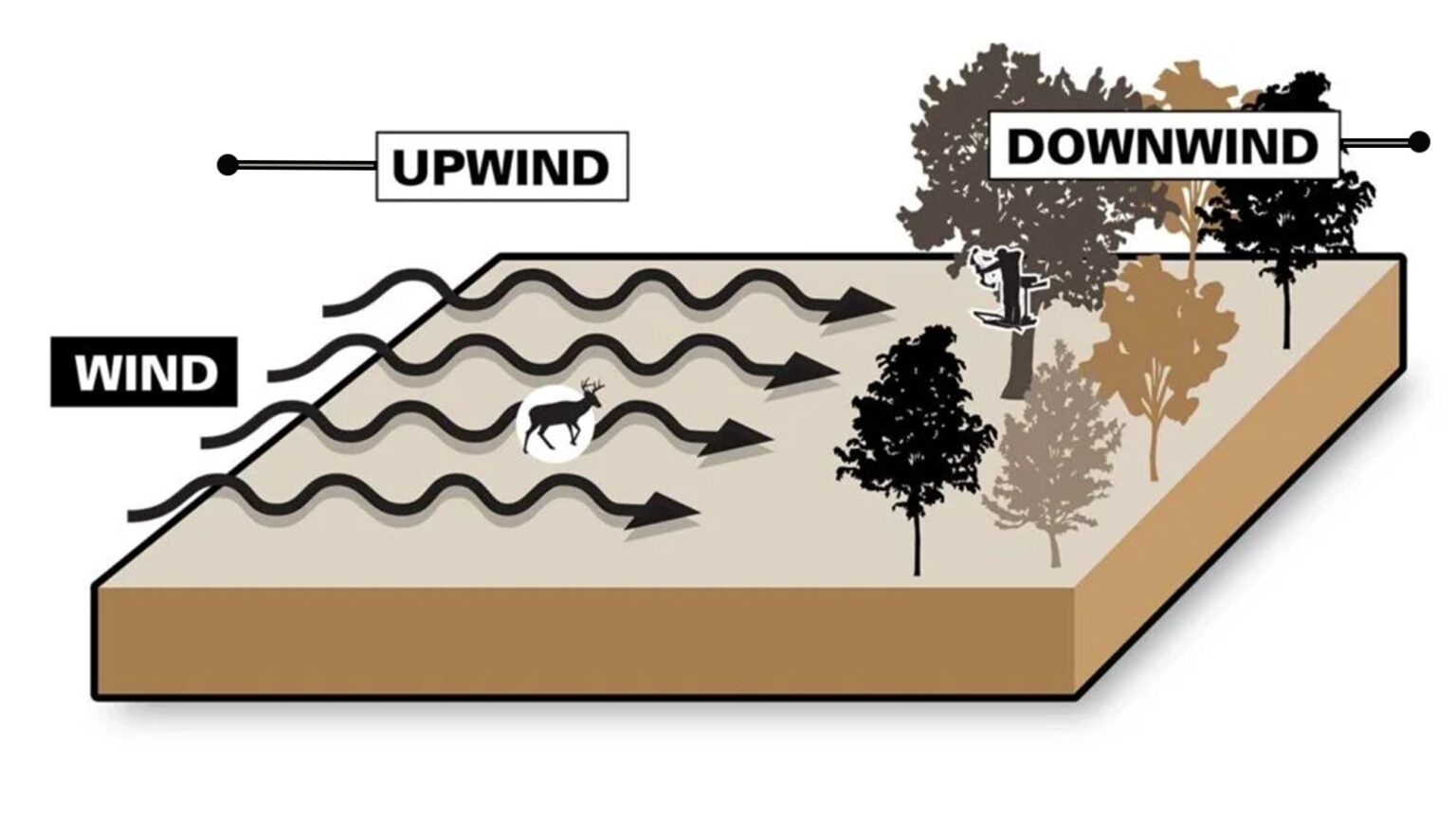
Okay, this part will be obvious to many of you, so feel free to skip ahead. But to anyone who is new to hunting or doesn’t currently hunt the wind, you need to know the facts. Fact number one is that you stink, at least to deer. You smell like danger, and if they smell you, they will run. Fact number two is that a big-game animal’s first line of defense is its sense of smell, which is otherworldly in most cases. Under the right conditions, a whitetail can smell you from 300 yards away. We know this because F&S's late whitetails editor Scott Bestul once tested it with a drug-sniffing dog (and because deer have more olfactory receptors than any pooch). Which brings us to fact number three and the heart of the matter: No matter how good a deer’s nose is, it can’t smell you unless the wind carries your stinky scent particles to its nose. In other words, whitetail deer can’t bust you unless they are downwind. So as long as you know which way the wind is blowing—and you know the difference between downwind vs upwind (see the diagram below)—you can use that to your advantage.
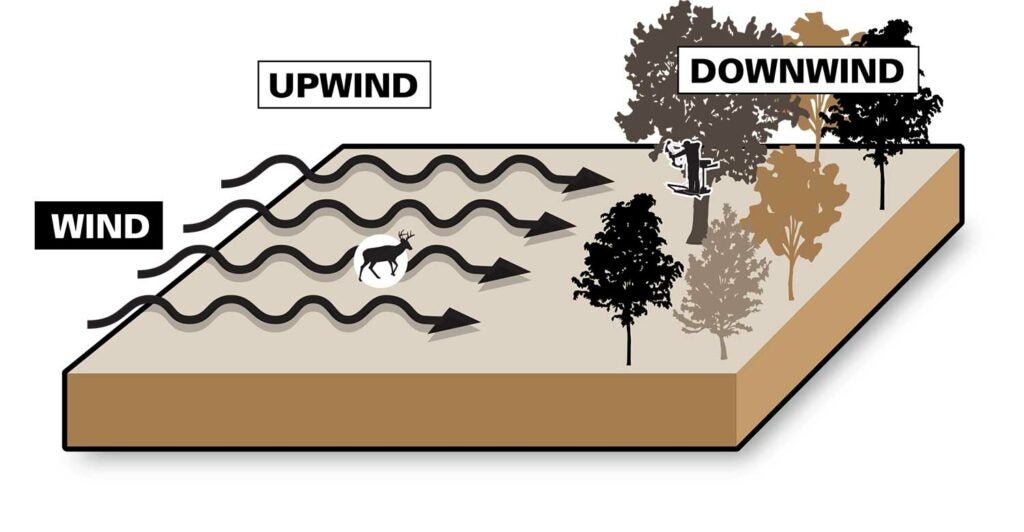
Suppose you and your B.O. are standing in one spot and the wind is blowing into your face. Upwind is the direction you are facing. And just as water doesn’t flow uphill, your scent cannot be carried upwind. So, any critters out in front of you will not be able to detect you with their nose. Downwind is everything behind you. Just as water flows downhill, your scent particles flow downwind, and any critter in that direction is apt to smell your funk and run. That’s why, as a general rule, you want to stay downwind of the animals you’re hunting. That said, it can get a little tricky, and there’s a world of difference between understanding downwind vs upwind and mastering the wind as a hunter.
Does Downwind vs Upwind Matter with Scent-Control Products?
Scent-control products are a salesman’s dream: They promise a miracle (Become imperceptible to deer!), and yet it’s very hard to prove that they don’t work. We didn’t prove it, per se, but we came pretty close. Again with a drug-sniffing dog, F&S has tested about every scent-control product you can think of, from rubber boots and carbon suits to sprays, cover scents, and ozone. None—not one—fooled the dog’s nose. Most had zero effect on the K9 cop’s ability to detect human scent. However, two products—cover scents (like acorn and pine) and Ozonics did confuse the dog somewhat and prolonged the time needed to detect the scent. So, it has to be said that some scent-control products may indeed provide some advantage.
But you’d be crazy to hunt from upwind just because you’ve got an acorn-scented wafer attached to your hat. No scent-control product gives you carte blanche. If you use them, use them as an insurance policy. Be smart, hunt the wind, and hope they bail you out if things go sideways. Even many of the companies that sell these products will tell you that you still need to hunt the wind.
Downwind vs Upwind: 15 Tips to Master The Wind When Hunting
So, with that in mind, here are 15 wind tips, from the basic to the advanced, all guaranteed to help keep your funk from noses of deer, so you can shoot them instead of shoo them.
1. Get a Good Wind App
The first step in hunting the wind is knowing generally which way it’s blowing—and you can know this anytime, anywhere via an app on your phone. This can be as simple as The Weather Channel app, which gives hourly forecasts—including wind direction—for whatever location you choose.
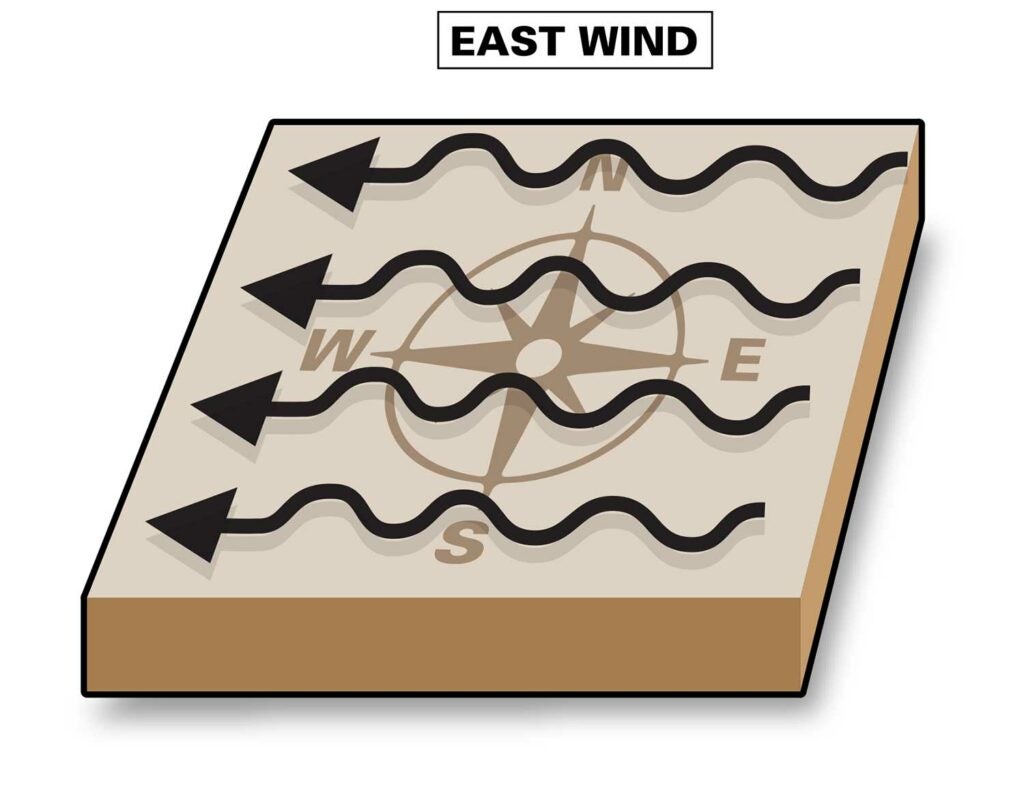
Some fancier hunting-weather apps, like HuntWise, display a map with up-to-the-minute wind direction in relation to your stands, which is very handy. Suppose you are thinking, Maybe I’ll hunt the soybean plot tonight. Then you pull up the app, and it shows that the wind is blowing from your tree stand right into the plot. At a glance, you know that you need to pick a different spot.
2. Map Out Your Stands with the Wind
If you don’t have the fancy app, knowing the wind direction only helps if you also know exactly how your stands are oriented. So bring a compass when you hang a stand, and make a note of which wind directions you can and cannot hunt from that spot. Or drop a pin for each of your stands on a mapping app, and refer to that when checking the current wind direction. Don’t count on your sense of direction for this. You need to be precise.
3. Always Double-Check the Wind
Handy as weather apps are, they only give you a general wind direction, assuming that nothing else is acting on it. That’s a good starting point, but keep in mind that things do act on the wind: hills, valleys, river corridors, and even thick woodlots can deflect and funnel air currents in odd directions. So, what you think is downwind might be upwind. Plus, weather apps can be wrong. All of this means that you need to double-check the wind when you get to your hunting area and be prepared to check it regularly as you hunt, in case of unexpected shifts. (See below for a list of tools to check the wind.)
4. Look for a True Wind
As a general rule, hilly country means fickle winds, and flat country, as well as the tops of hills and plateaus, means a true and steady breeze. Given a choice, you want the latter. In Wisconsin’s famous bluff country, for example, the majority of tree stands are hung on the tops of the bluffs and plateaus, because that’s where the wind is truest. That doesn’t mean you can’t hunt the hillsides or valleys; it just means that you’ll likely contend with swirling currents there—and you’ll have to check the wind and adjust a lot more often.
5. Set Up Crosswind Instead of Upwind
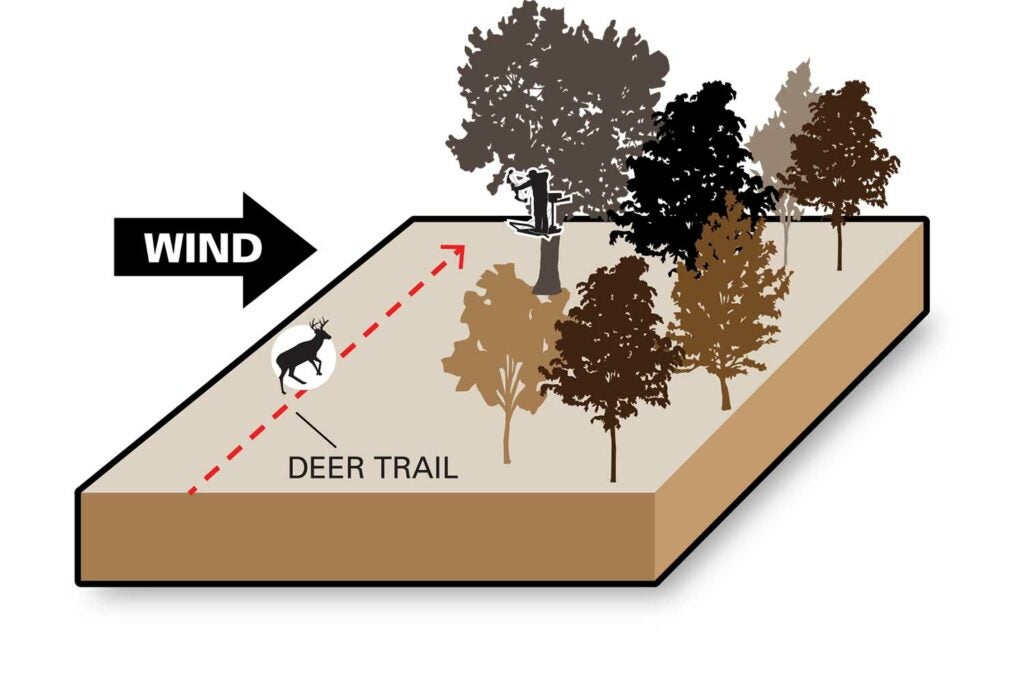
“Keep the wind in your face,” is something every hunter has heard, and as long as you are facing the deer or where you expect them to show up, it’s a pretty good rule of thumb. But remember this too: When you know how deer are going to walk through a certain area—say on a heavy trail or through a hard funnel—it’s a good idea to set up on a crosswind—or so the wind is blowing perpendicular to the deers’ line of travel. That way, small bucks or does that you don’t want to shoot can get past you without catching your scent and alerting all the other deer in the area.
6. Know the Ups and Downs of Wind Thermals
When air gets warmer, it rises, and when it cools, it falls. These flows are called thermals, and they can make or break your hunt in hill country. It doesn’t much matter if the air is rising or falling in flat terrain because the deer are neither above nor below you. But when the morning sun hits the wooded slope you’re on and the warming air starts riding up the hill, the buck above you on the ridge is going to get you. As a general rule, thermals rise in the morning and fall in the evening, and you need to be above or below the deer accordingly.
Read Next: 10 Proven Ways to Grow Giant Bucks On Your Land
7. Wait For the Right Thermals
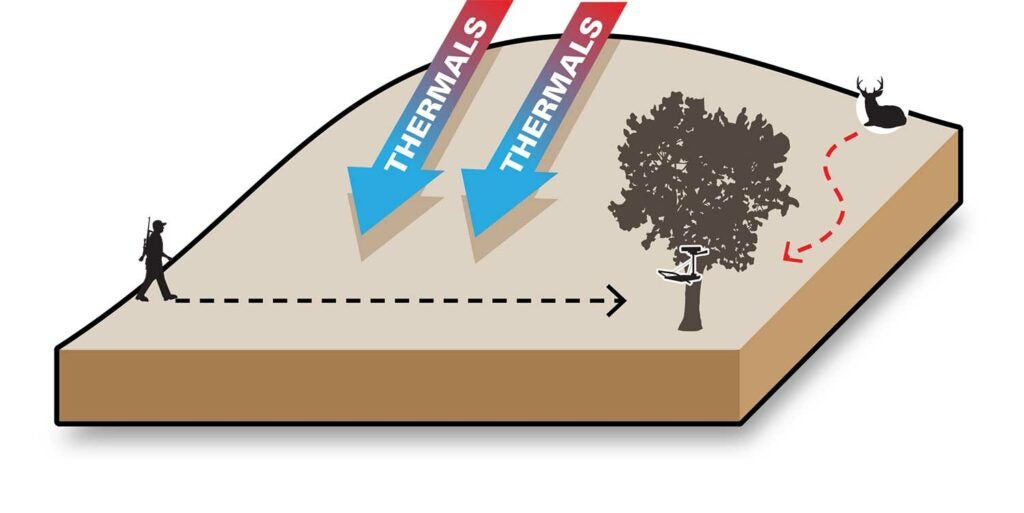
Keep in mind, however, that the general rule above can get you in trouble too. Yes, thermals rise in the morning, but not until the air on the hillside warms enough to start climbing, which might be an hour or more after sunrise. By the same token, thermals may not start falling in the evening until an hour or two before dusk. You need to take this into account. One trick I learned from an Ohio guide is if you have a killer stand location on a hillside and deer are bedded above it, just set up on the ground a few hundred yards off to one side of your stand and wait for the thermals to start falling. When they do, quietly still-hunt over to your stand and then climb in for prime time. The same thing works on a spot and stalk. When you glass a buck on a hillside, post up to one side or the other and wait for the thermals to shift in your favor before making your move.
8. Approach Your Stand from Upwind
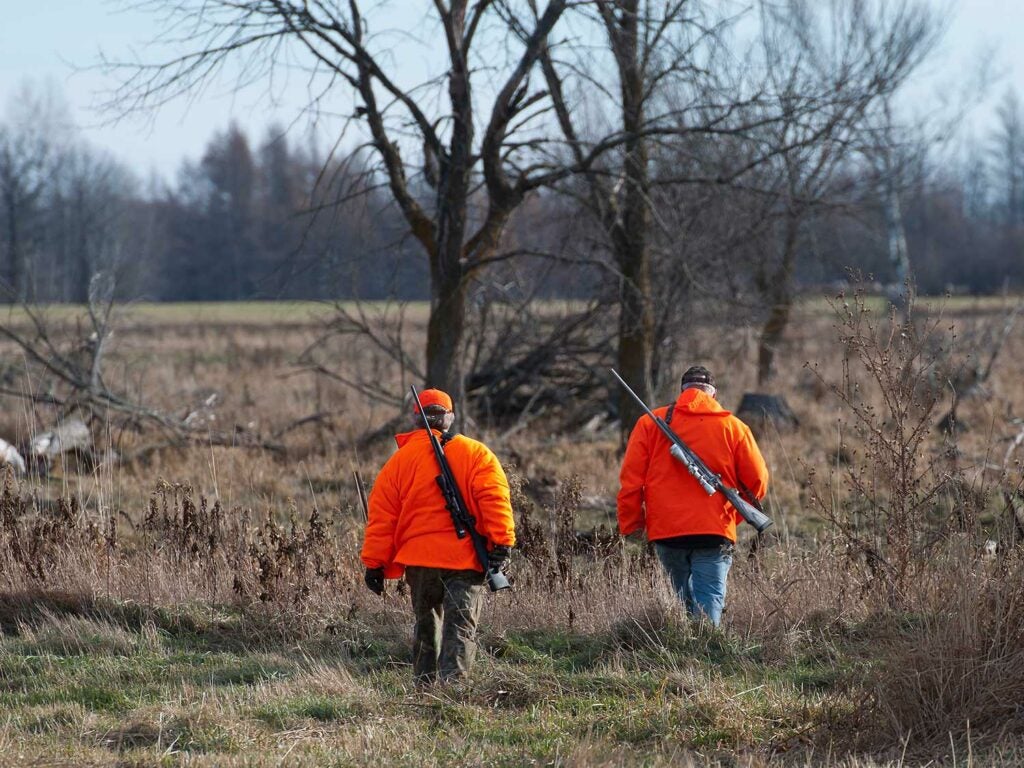
So you’ve done your homework and placed a stand right on a well-used trail that’s perfect for the wind but you’re still not seeing deer. In this case, your problem is probably the journey and not the destination. Deer can still smell you when you’re walking to the stand, and if your route has the wind blowing your scent into something like a bedding area, then you’re busted before you even start hunting.
This is another time when a map comes in handy. Drop pins and lay out possible bedding areas and food sources. Once you know where they are, mark your stands. Your route to the stand is next. If you have a stand set for a specific wind, make sure your route to get there won’t blow your scent through areas that may be holding deer. Even if you have to spend an extra hour taking the long way, it’s a lot better than sitting in a stand for hours without seeing any deer.
9. Never Get Busted Again
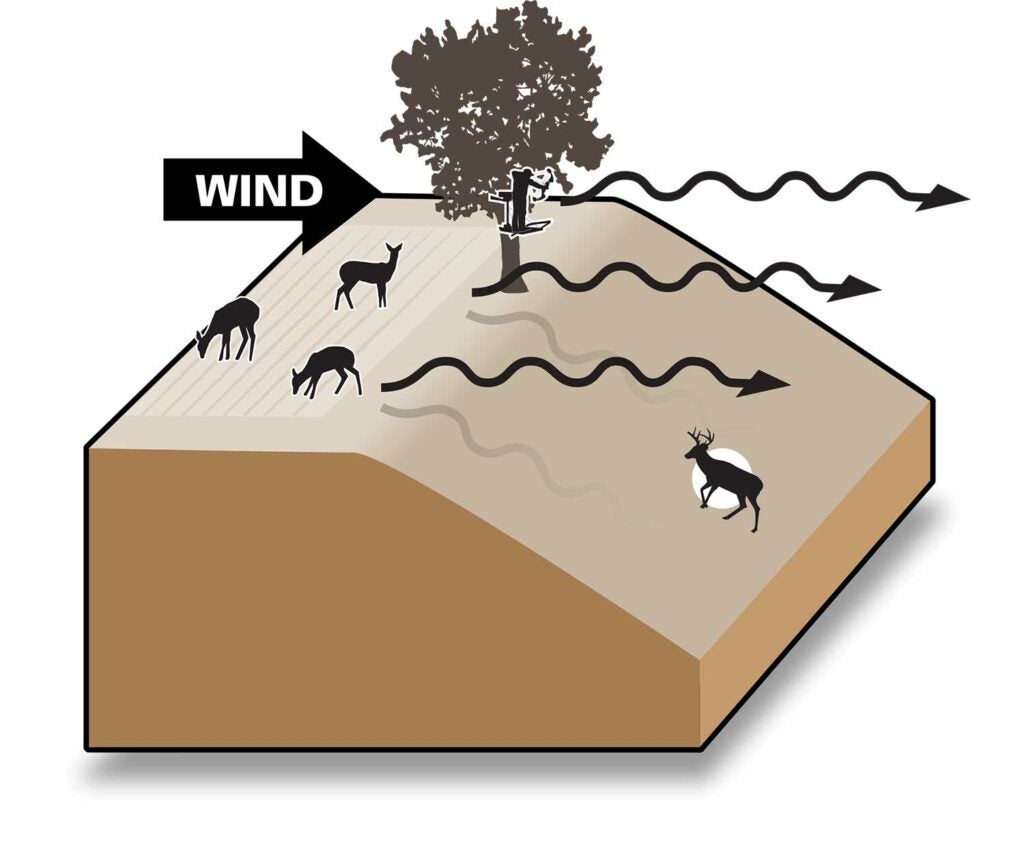
A good, steady wind will typically override thermals, and on almost any property, there are a handful of perfect stand locations where a steady wind will virtually guarantee that deer won’t get your scent, no matter how they approach. That is, as long as you set up and hunt it right. The best example is a stand with a steep downhill slope on one side. As long as the wind is blowing toward the slope, even downwind deer can’t get you, because your scent will blow right over the top of them. In the big woods, bucks love to use beaver dams as bridges to cross from one side of the water to the other; as long as the wind is blowing over the pond, you can’t get busted.
10. Give a Buck the Wind
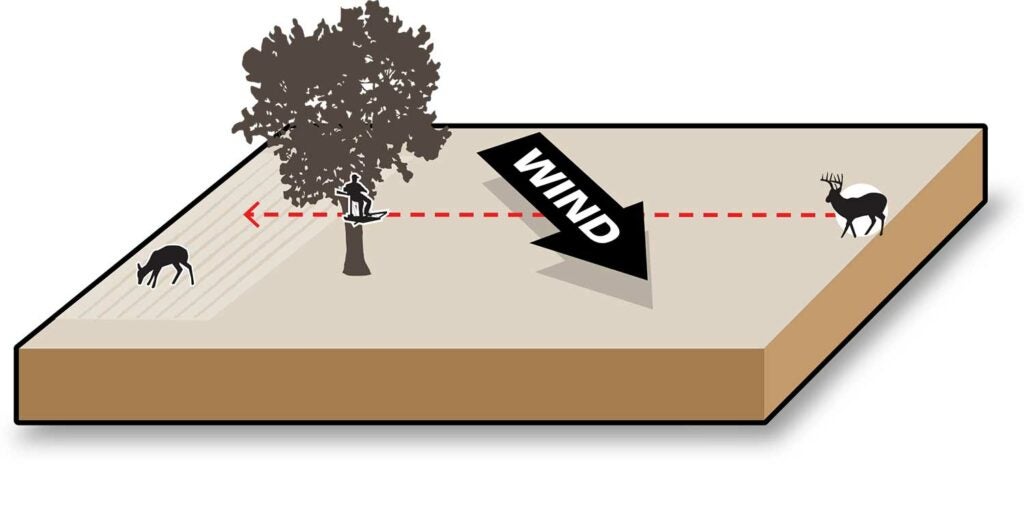
Another trick used by many top deer hunters—including Ohio pro Adam Hays who owns The Deer Hunter’s Moon Guide and has arrowed four 200-plus-inch bucks—is to purposely hunt an almost-wrong wind. Some older bucks almost refuse to move unless the wind is in their face. The way you kill one is you give him the wind—mostly. Say, for example, that the buck travels straight south to get to a feeding area. If you set up on the east side of his trail with a south-southwest breeze, even though you are upwind, there’s just enough angle to the breeze that he won’t scent you.
11. Put a Cheek to the Wind
Registered Maine Guide Randy Flannery of Wilderness Escape Outfitters always still-hunts with a crosswind. Why? Because it allows him to kill bumped bucks. “I guarantee you’ll improve your luck tenfold if you cross-cut the wind instead of still-hunting into it, whether you jump a deer or not,” he says. “But if you do jump one, open the action of your rifle and run forward at a 45-degree angle toward the downwind side about 75 to 100 yards. Then drop to one knee and wait 10 to 15 minutes. When that buck circles downwind to see or scent what spooked it, you’ll often get a shot.”
12. Stalk from Upwind, But Off to the Side
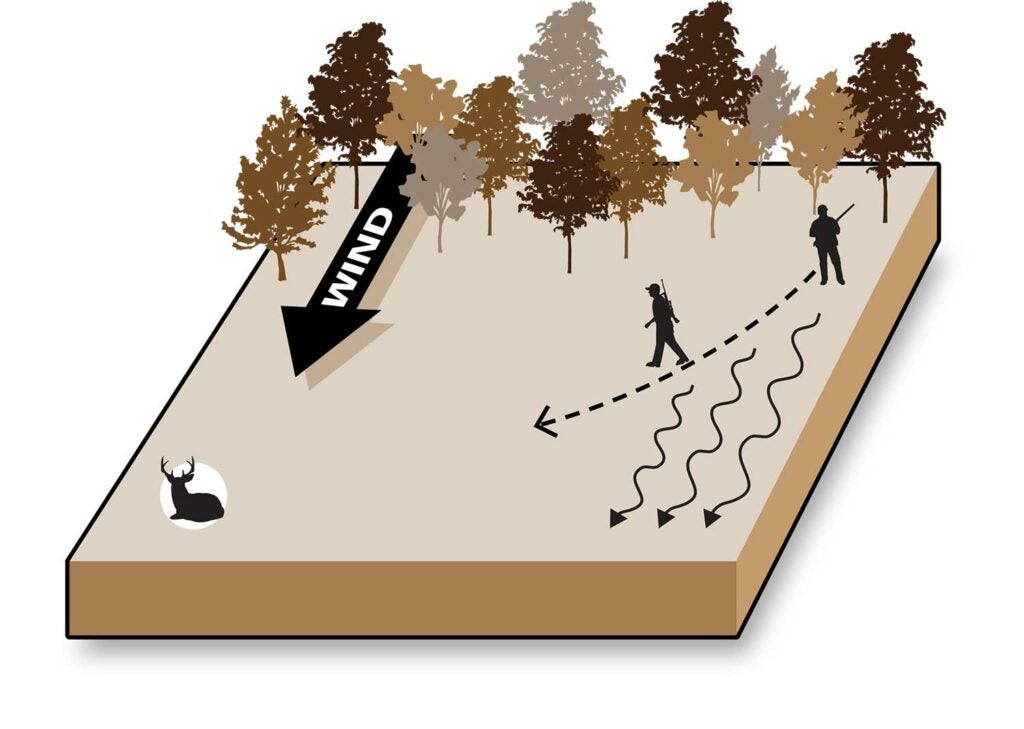
Michigan hunter Tony Trietch, who travels throughout the West all fall and has taken dozens of P&Y and B&C whitetails and muleys, has a wind trick for stalking prairie bucks. “I’ll sneak in from upwind—just not directly upwind,” he says. “A buck will be bedded with the breeze at his back, eyes forward. So, I’ll move in at an angle from behind him, staying just enough to one side that my scent whips right past him. You need a good, steady breeze, but when it works, the buck is caught totally off guard.”
13. Know How the Rut Affects Downwind vs Upwind
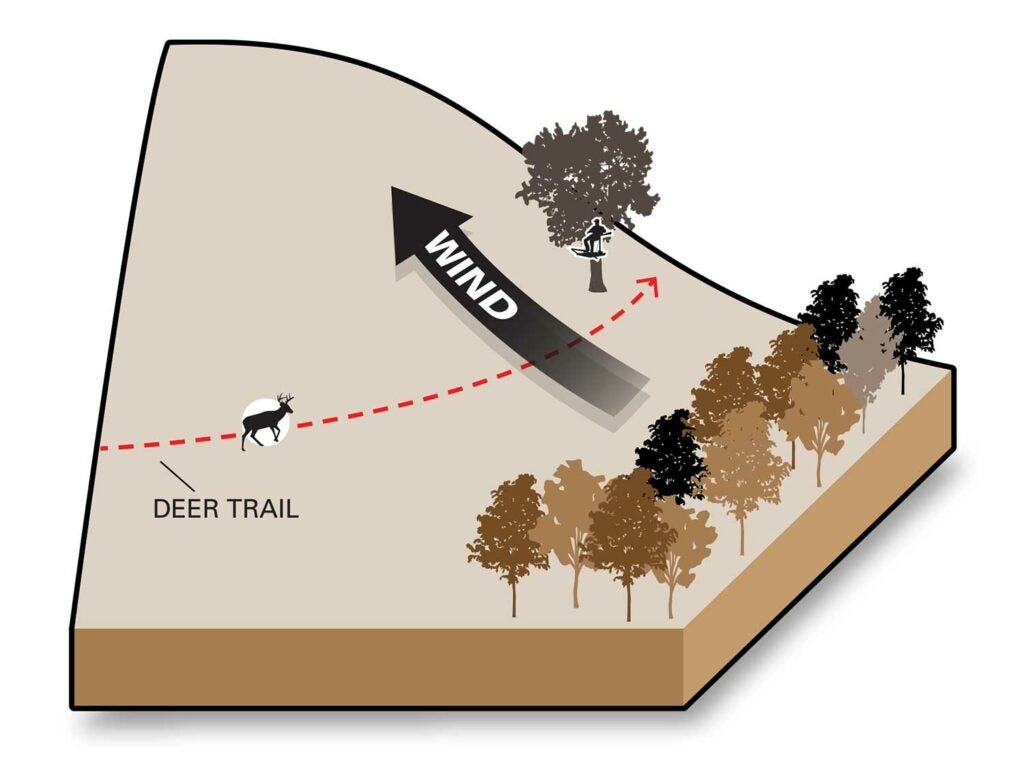
During the rut, bucks aren’t just using the wind to stay alive, they’re using it to find does. Generally, a buck will walk in a crosswind, with the wind hitting the side of his face. This allows him to smell as much territory as possible while staying on the move. Pay special attention to prevailing winds and thermals during the rut. Look for faint buck trails situated perpendicular to the wind direction and hang stands on the downwind side of the trail.
In hill country, these trails usually run across a slope and do not go directly up or down. If you hang a stand above the trail, you can use the morning thermals on a calm day to your advantage. Walk up to your stand well before first light while the thermals are pushing wind down the mountain then wait for it to rise back towards you when the sun comes out. This will keep you downwind of any bucks working the ridge. To make sure there aren’t any deer above you, focus these stands on choke points and saddles. Just remember to double-check the wind from your stand with the change in terrain.
14. Turn a Deer Drive into a Upwind Bump
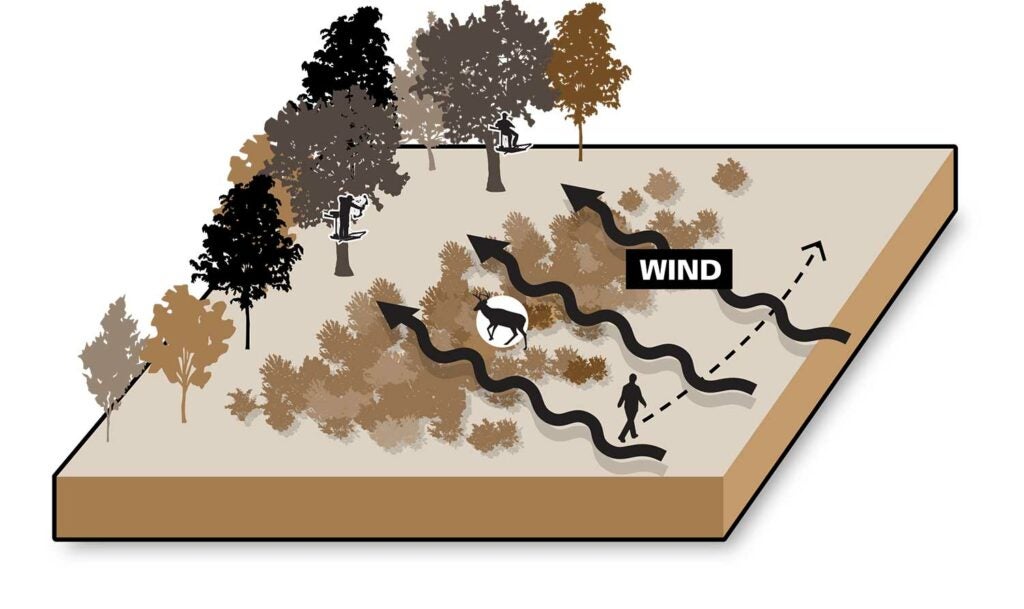
Hunters have been scaring deer to other hunters since we figured out that deer were scared of us. But, anybody who has participated in a deer drive knows that this kind of hunting can get hectic. The wind bump is a subtler approach. Instead of crashing through the brush and running deer past the posters, use the wind to do the driving for you. First, locate the deer-holding thicket you’d like to drive. Then, position your shooters downwind at key escape routes and make sure they approach their spots with the wind in their favor. Finally, circle around the thicket and walk upwind of the deer. Let them catch your scent, and they’ll walk calmly towards the shooters, making for much easier and safer shots.
15. Check Downwind vs Upwind While Scouting
It takes practice to get better at anything, and hunting with the wind in your favor isn’t any different. But you’re journey to becoming a wind genius is going to be slow if you’re only thinking about it during deer season. When you’re scouting, hanging stands, or just walking the dog, check the wind. It’s a good idea to keep a notebook too. If you’re in an area you’re going to hunt on a regular basis, take notes on the wind direction for a given day. Compare this to things like weather events, and you’ll start to get a better idea of how the wind works. Who knows, you might find that it will only take some slight tweaks to your stand setup for you to start seeing a lot more deer.
5 Tools to Check Downwind, Upwind, Crosswind, and Quartering
The worst thing about keeping track of the wind is that it’s hard to see. But, with the help of a few tools, you’ll be able to visualize and keep track of the wind better than the weatherman.
1. Commercial Wind Indicator
These are sold under a variety of names—Smoke in a Bottle, Windicator, etc. They are essentially a plastic bottle with a hole in the top filled with superfine, odorless talcum powder. When you squeeze the bottle, a puff of powder comes out, gets picked up by the wind, and tells you immediately if you’ll be upwind or downwind of where you know or expect a critter is.
2. Use Milkweed to Tell Downwind vs Upwind
Dry milkweed pods look like cotton balls sitting on top of brown, straight stalks. Look for them in old hay fields, on the side of the road, or in swamps. The fluffy, white strands attached to the seeds float on the air. They will pick up the slightest breeze or thermal and keep going until they hit the ground. This is even better than a powder, because it gives a much longer reading of the wind and reveals subtle changes.
3. Try a Lighter
If you carry a lighter with you into the woods, it can double as a wind indicator. It’s not the greatest reading and will only give you the wind direction immediately around you, but it will work. All you have to do is light it, watch which way the flame goes, and you know downwind vs upwind.
4. Use Smoke Bombs for Downwind vs Upwind While Scouting
If you really want to geek out about the wind, use smoke bombs for scouting in the off-season. They cover large areas and linger in the air allowing you to see how the wind works around your stand. Position and light the smoke bomb where you would sit, then stand back and observe. You’ll be able to see how your scent interacts with the terrain on certain prevailing winds. Just be smart and don’t burn the woods down.
5. Lick Your Finger
All you need for this one is some spit and a finger. Just lick your finger, and stick it out in the wind. The cold side is where the wind is coming from, and therefore upwind.
All new! 1871 Club Field Trips