
The United States Forest Service is eyeing revisions to longstanding rules that govern off-road vehicle use on the 380,000 miles of roads under the agency’s management. If implemented, the proposal will fundamentally change motorized vehicle policies in all National Forests, opening areas that have been closed to vehicles for over two decades. The policy shift would also open the door for e-bike use on non-motorized trails in National Forests.
Announced via press release on Friday, August 21, the plan would rewrite the Forest Service’s Travel Management Rule. Crafted in 2005, that rule is the framework for determining where ATVs, dirt bikes, snowmobiles, trucks, and other vehicles can legally travel on National Forest lands. Foresters across the country use it to designate route restrictions, create official public maps, and to mitigate environmental damages associated with motorized travel in backcountry areas. It also mandates the public input that is used when determining which roads should be active and which defunct or deteriorated road systems should be decommissioned.
In its press release, the Forest Service said the proposed revisions will simplify regulatory requirements, not just for traditional motorized vehicles, but for e-bikes and other mobility devices. “The Forest Service administers more than 380,000 miles of road, exceeding the length of the U.S. Interstate Highway System by nearly eight times, and 165,000 miles of trails,” reads a statement in the press release from Forest Service Chief Tom Schultz. “This action provides the legal foundation to streamline and modernize the Travel Management Rule and align Forest Service policy with administration priorities to increase access and protect private and commercial interests, while conserving natural resources.”
Opposition Mounts
The proposal has sparked strong backlash in the hunting-and-fishing conservation community, most notably from Backcountry Hunters & Anglers (BHA). That organization sees it as a far-reaching attempt to de-regulate motorized uses on public lands long used as sanctuaries for fish and wildlife.
According to BHA President and CEO Ryan Callaghan, the proposal has troubling implications for National Forest elk herds in particular. “Travel Management Plans are developed on a forest-by-forest basis with ample input from the locals who use these areas most frequently,” Callaghan tells Field & Stream. “They can be contentious, but they work, and they’re one of the most important tools we have in the wildlife management tool box. Where and how we travel across public lands directly affects migration corridors, calving and wintering areas, and our ability to keep public wildlife on public land.”
Major Policy Shifts
With its proposed revisions, USFS wants to implement an “open-unless-closed” policy for motorized vehicles on all existing roads and trails. That’s a 180-degree change from the “closed-unless-open” framework that the agency has used since 2005.
The change would revert to a paradigm that existed more than two decades ago when off-road vehicles could travel freely through sensitive wildlife habitat on National Forest lands, Callaghan says. That’s because it eliminates a “national minimization criteria” that was designed to protect watersheds, soil health, and wildlife habitat—like wetlands, fish-bearing streams, and elk calving grounds.
“There are certainly areas that are appropriate for expansion in motorized use,” Callaghan says. “People just need to be informed and understand the associated costs. Motorized roads and trail densities directly correlate to where and how long public wildlife stays on public land. So expansion in one area should come with the expectation of providing [wildlife] sanctuary in another. These revisions don’t do that.”
How Motorized Use and Road Building Impact Elk
The move comes on the heels of the Forest Service’s plan to completely rescind the 2001 Roadless Area Conservation Rule, opening some 45 million acres of USFS backcountry to industrial road building and development.
And it stems from an Executive Order that Field & Stream previously reported on called “Removing Unnecessary and Counterproductive Restrictions on Access to Federal Lands”. Opponents of these policy changes say they’re a direct threat to important wildlife habitat on National Forest lands across the country. When it comes to elk habitat, the science seems to back that argument.
Agency-Supported Science
An exhaustive study published by USFS in 2004, for example, shows a direct mathematical link between motorized road activity and elk habitat loss. Known as the Starky Experimental Forest Studies, this decades-long research effort found that elk completely abandon highly productive meadow habitat when there’s an active road nearby.
It also showed that elk exhibit higher stress and increased movement rates in areas of higher road density. Overall, the Starky studies and mountains of similar scientific findings have proved what most hunters know intuitively: elk tend to flee for non-pressured areas when motorized vehicles move in. According to USFS’s own data, the Starky studies played a foundational role in the formation of the current Travel Management Rule.
Comment Opportunity
BHA isn’t alone in its concerns about proposed revisions to the Travel Management Rule. In a recent press release, the Theodore Roosevelt Conservation Partnership (TRCP) said high [motorized] route densities can cause big game to avoid otherwise productive habitat. “Hunters and anglers rely on many of these routes to reach important hunting and fishing destinations,” the statement reads, “and they also recognize that roads and trails must be managed carefully to conserve habitat.” But this proposal needs refinement, TRCP adds, “to ensure the revised travel management rule supports quality recreation experiences, minimizes user conflicts, and helps avoid fragmentation of important habitat.”
The Blue Ribbon Coalition, on the other hand, a non-profit advocacy group that lobbies for expanded motorized access on public lands, is applauding both the repeal of the Roadless Rule and the proposed Travel Management rollbacks. They say that the environmental mitigation criteria built into the travel management rule has been abused to push motorized users off public lands in favor of non-motorized uses.
Callaghan sees it differently. “If these revisions go through the way they’re listed in the Federal Register, and then you take that in conjunction with the wholesale recision of the Roadless Rule and the OHV Executive Order, it’s not hyperbolic to say that we’re going to be heading into elk-less elk woods on our National Forests by the time hunting open up next season,” he says. “We’re going to have public land hunters staring at public wildlife on private ground with no way to get to them.”
The agency’s announcement kicked off a 30-day comment period in the federal register. If you’d like to weigh in, you can do so here.
All new! 1871 Club Field Trips



7 Comments
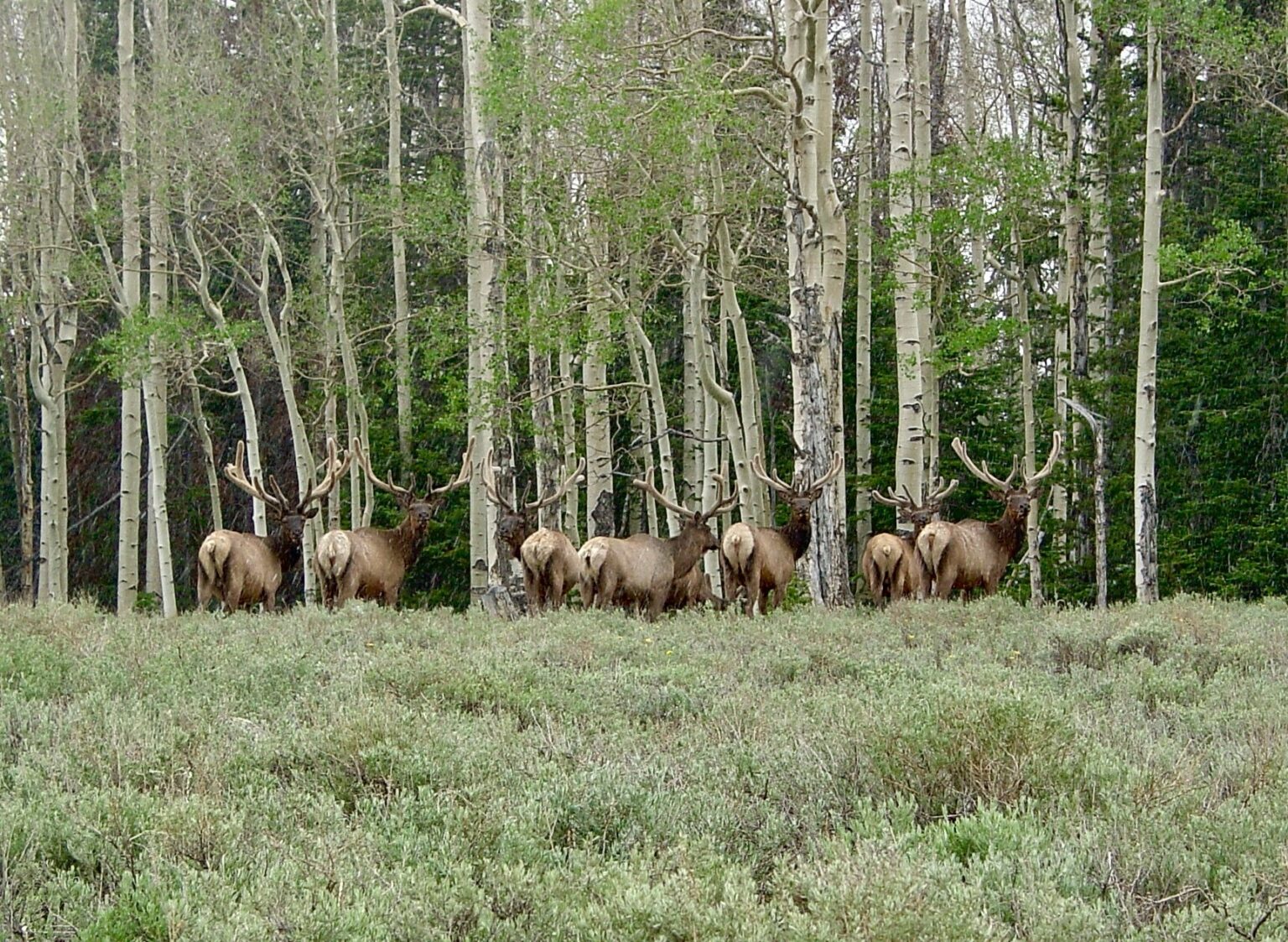
The photo of the elk herd in article is taken from a paved highway. They hang out there all the time, unaffected by vehicles or human activity.
Living in one of the areas that is highly effected by the roadless rules, elk hunting has declined ever since, bighorn sheep have been wiped out and mule deer are almost non existant now. We used to be able to access that country and hunt predators, mountain lions, bear, wolves and coyotes were managable because there was access, logging managed the forest in a highly productive way for more elk carrying capacity. I hunt in these areas and BHA activity has put so many people in these areas that just ride their horses all day you can sit and watch them push all the elk and deer in an entire unit across the boarder into Idaho, horse trailer up every ridge and every drainage, its no different that side by sides!!
this admin is a nightmare for our forests, parks and wildlife. I’ve had motorbikes and ATV people ruin day long hunts and scare off wildlife.
The motorized vehicle areas are the only place game exists now other than in towns where they can avoid predators. The wilderness areas have been sterilized of large prey thanks to woke mismanagement and the introduction of a large non native predators.
I think it’s pathetic that they are even thinking about repealing this protection!!! WHAT IS HAPPENING TO THIS COUNTRY??? GOD HELP US!
Has anyone heard of Yellowstone national park? 30k to 40k a day, and idiots are able to get too close to the animals. Obviously the animals are unaffected by that many people or the construction!! The mining roads in the national forest haven’t “run off” in the last 100 years. Horses trash trails worse that dirt bikes or jeeps. Follow 10 horses up a trail and see if they leave no trace! I know that was all over the place, just trying to cover all the excuses heard daily from people that don’t really know or use the “wilderness” weekly.
In the rush to slake the lust for virgin territory, Steve Daines, Tim Sheehy, and Ryan Zinke discovered they did not have enough leverage with the White House to keep the headwaters of the Bitterroot River off Trump’s extra legal the Fast Track 41 list. Accurately reading the tea leaves, the Supervisor of the Bitteroot National Forest, Mathew Anderson, is promoting approval of an Exploration Plan as a Categorical Exclusion. If approved without an EIS or EA 90% of the West Forks nursing cows and their calves will be subjected to twice daily helicopter flights over the ridges and draws where cow elk birth and nurse. The Absaroka Elk Ecology Project documented the impact of this type of disturbance on cow calf mortality:
1. The Disturbance Threshold: Controlled studies tracking human and motorized disruptions on elk calving grounds indicate that an average of just over 8 disturbances per cow elk results in nearly 40% fewer surviving calves. [1]
2. Cumulative Mortality Risk: Within these studies, each repeated high-level disturbance event carried an average of a 5% probability of calf death due to tracking exhaustion,
abandonment, or separation. [1]
3. Zero-Growth Ceiling: When cumulative human-induced disturbances reach an average of 10 events per cow above ambient baseline levels, monitored elk herds demonstrate no net population growth. [1]
4. Predation Vulnerability: Forcing nursing cows to abandon heavy timber security cover for
open slopes leaves neonates highly exposed to apex predators.
[1] https://wyocoopunit.org/kauffman-lab/absaroka-elk-ecology-project/
Abuse of the use of CATEGORICAL EXCLUSIONS AUTHORITY by Region One Forest Supervisors is serving as a precursor to the management ethics we can expect if the Roadless Rule is revoked. Comments on the plan and process for approving it can be submitted to this email address: [email protected]